Blog

  • 12 Best SEO Tips to Improve Website Rankings in 2026

    12 Best SEO Tips to Improve Website Rankings in 2026

    SEO advice usually sounds deceptively simple: use the right keywords, publish good content, get backlinks, and wait.

    Then you do all of that and wonder why Google still refuses to send you traffic.

    The problem isn’t that SEO doesn’t work. It’s that the way people search and the way Google evaluates content have changed. Rankings now depend on much more than putting a keyword in a title.

    If you want better organic visibility in 2026, these SEO tips will help you focus on what actually matters.

    1. Start With Search Intent, Not Keywords

    One of the biggest SEO tricks is also one of the easiest to overlook: figure out what the searcher actually wants. Suppose you want to rank for “email marketing software.” What does the person searching mean?

    They might be looking for:

    • The best email marketing platforms
    • Software for a small business
    • A comparison between Mailchimp and HubSpot
    • Pricing information
    • A definition of email marketing software

    Those are completely different needs.

    Before creating a page, search the keyword yourself. Look at what Google is already ranking. Are the results product pages, comparison articles, tutorials, category pages, or something else?

    The SERP is basically Google telling you what it thinks the search intent is. Listen to it.

    If comparison pages dominate the results, don’t publish a generic “What Is Email Marketing?” article and hope for the best.

    Match the format and intent first. Then make your content better.

    1. Stop Writing for a Word Count

    There is no magic number of words that makes Google rank a page.

    Google explicitly says not to create content because you’ve heard there’s a preferred word count. Its guidance instead emphasizes helpful, reliable, people-first content that provides substantial value.

    So don’t stretch a 700-word answer into 2,500 words just because someone told you “long-form content ranks.” If the answer needs 800 words, write 800. If the topic genuinely requires 3,000, write 3,000.

    The goal isn’t to make the reader spend 15 minutes on your page. The goal is to make them leave with their question answered.

    That distinction matters.

    1. Make Your Content More Useful Than the Current Top Results

    Here’s a simple test for any SEO content.

    If I removed the URLs from the first page of Google, would my article give readers a reason to choose it? If the answer is no, you probably haven’t added enough value. Don’t just rewrite what competitors have already said.

    Add something of your own:

    • Original research
    • Expert commentary
    • First-hand experience
    • Screenshots
    • Real examples
    • Case studies
    • Comparisons
    • Data
    • A useful framework or process

    Google’s current guidance specifically asks whether content provides original information, research, or analysis and whether it offers substantial value compared with other results.

    That’s a much better target than “make it SEO-friendly.”

    1. Fix the Pages That Are Already Almost Ranking

    Here’s an SEO tip that can save you a lot of unnecessary content production:

    Don’t always create a new page. Open Google Search Console and look for queries where your existing pages rank somewhere around positions 5-20. These are your striking-distance keywords. You already have Google’s attention. Now figure out why you’re not further up.

    Maybe the page:

    • Doesn’t fully answer the query
    • Has weak internal links
    • Needs better examples
    • Is outdated
    • Has a poor title
    • Misses an important subtopic
    • Doesn’t satisfy the search intent as well as competing pages

    Google Search Console gives you clicks, impressions, CTR, and average position, along with query- and page-level performance data.

    Use that information before deciding you need another 30 blog posts. Sometimes your next traffic increase is hiding inside a page you already published.

    1. Write Titles People Actually Want to Click

    Ranking is only half the job. You also need someone to click.

    Compare SEO Tips with 12 SEO Tips to Increase Organic Traffic in 2026. The second one tells the reader what they’re getting and gives the topic some context.

    Your title should be clear, specific, and relevant to the search. Avoid turning it into clickbait, though. A dramatic title that promises something your page doesn’t deliver may earn a click, but it won’t earn trust.

    Think of the title as your first sales pitch. You have one line. Make it count.

    1. Build Internal Links Like You Mean It

    Internal linking is one of the easiest SEO improvements to ignore because it doesn’t feel particularly exciting.

    But it matters.

    Let’s say you have a strong page about technical SEO and a newer page about website crawlability.

    Consider that you have a page on technical SEO and another one on website crawlability. If the former naturally mentions website crawlability, create an internal link to the latter. Avoid using “click here”. 

    Use keywords in anchor text to help both readers and search engines understand where the link leads.

    In addition, pay attention to the existence of any orphan pages on your website, i.e., those that do not receive any internal links.

    It is quite possible that if an important page is hidden from your site like a sock in the laundry pile, Google will not be able to find it either.

    1. Get Your Technical SEO Basics Right

    You don’t need to become a full-time developer to handle technical SEO. But you do need to make sure Google can access, crawl, and understand your website.

    Basic things to look for:

    • XML sitemap
    • Robots.txt
    • Canonical
    • HTTPS
    • Broken links
    • Redirects
    • 404 errors
    • URL duplicates
    • Mobile usability
    • Indexing problems

    According to Google’s Search Essentials, you should create content that is available to search engines and use the right keywords in important places such as titles, headings, alt text, and anchor text.

    A brilliant article won’t do much if Google can’t properly crawl or index the page. SEO starts with making sure the door is actually open.

    1. Take Core Web Vitals Seriously

    Nobody enjoys waiting for a website to load.

    Google measures three Core Web Vitals:

    • LCP: How quickly the main content loads.
    • INP: How responsive the page is when someone interacts with it.
    • CLS: How much the layout unexpectedly shifts while loading.

    Google’s recommended thresholds are an LCP of 2.5 seconds or less, an INP of 200 milliseconds or less, and a CLS of 0.1 or less, measured at the 75th percentile.

    You don’t need to obsess over milliseconds. Start with the obvious problems:

    Compress oversized images. Remove unnecessary scripts. Improve server response time. Fix layout shifts. Don’t make mobile visitors download half the internet just to read a paragraph. Good technical SEO should make the website better for humans first.

    1. Create Topic Clusters Instead of Random Content

    Publishing a blog post on SEO now, one about social media later, and then one on office furniture in another week does not constitute a content strategy.

    Develop your topic clusters around subjects in which your business has expertise.

    Example :

    Topic cluster for a company providing cybersecurity services might be “small business cybersecurity”:

    • Checklist For Small Business Cybersecurity
    • Types Of Cybersecurity Threats To Watch Out For
    • Employee Cybersecurity Training
    • Password Cybersecurity
    • Preventing Phishing
    • Endpoint Security

    And link to them internally within each other.

    In that case, in the end, you are not only creating posts. You’re building a body of related knowledge.

    That gives users more useful paths through your website and helps search engines understand what your site is actually about.

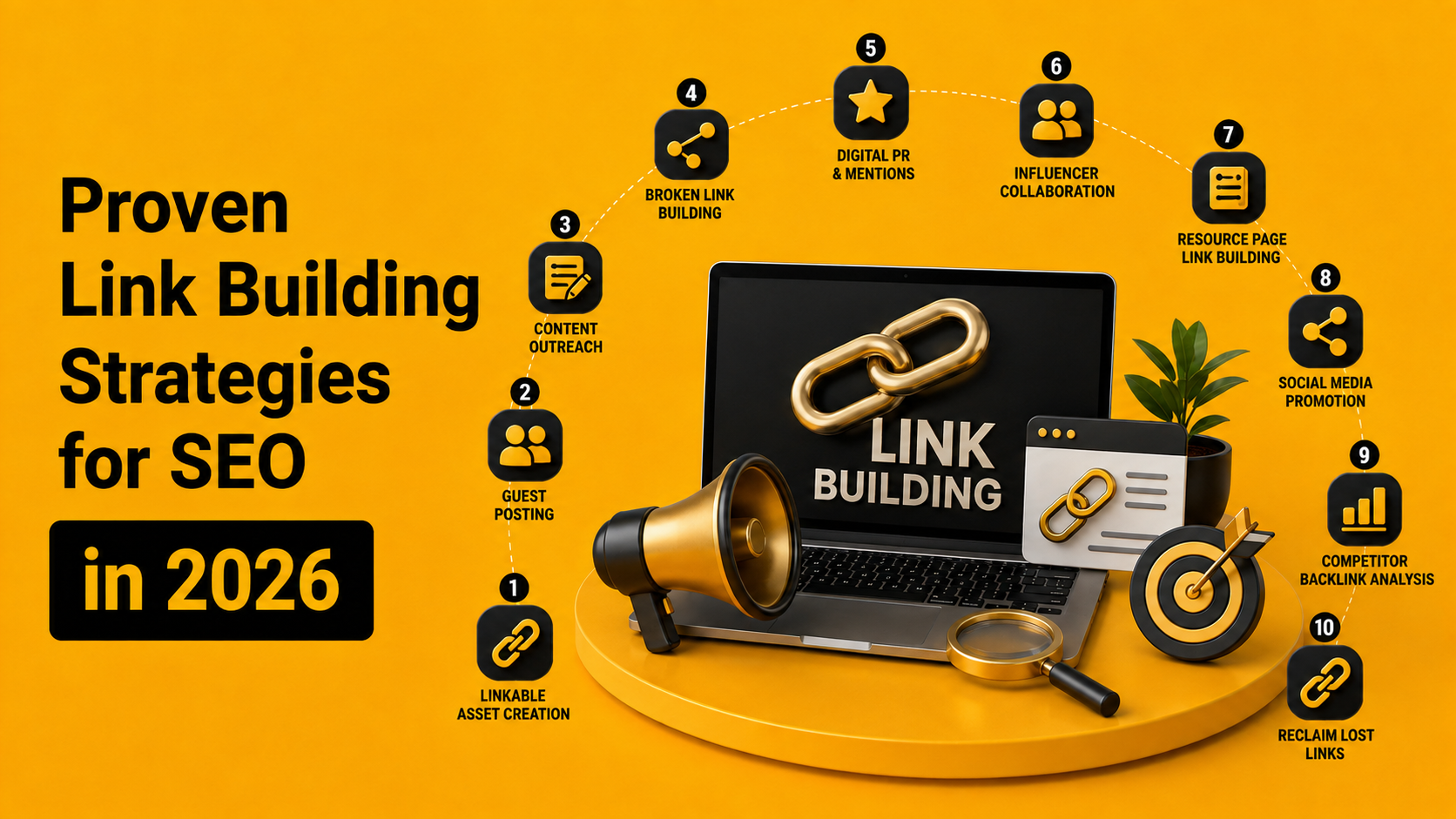
    1. Don’t Treat Backlinks Like a Numbers Game

    Yes, backlinks matter. No, you don’t need 500 questionable links from websites nobody has heard of.

    A relevant link from a credible industry publication can be far more meaningful than dozens of random links. The best link-building strategy starts with creating something worth referencing.

    Try:

    • Original research
    • Industry statistics
    • Free tools
    • Calculators
    • Original surveys
    • Data studies
    • Expert guides
    • Useful templates

    Then promote those assets to journalists, publishers, industry sites, and relevant communities.

    If your “link-building strategy” is sending strangers 200 emails that begin with “I loved your amazing article!”, it may be time for a rethink.

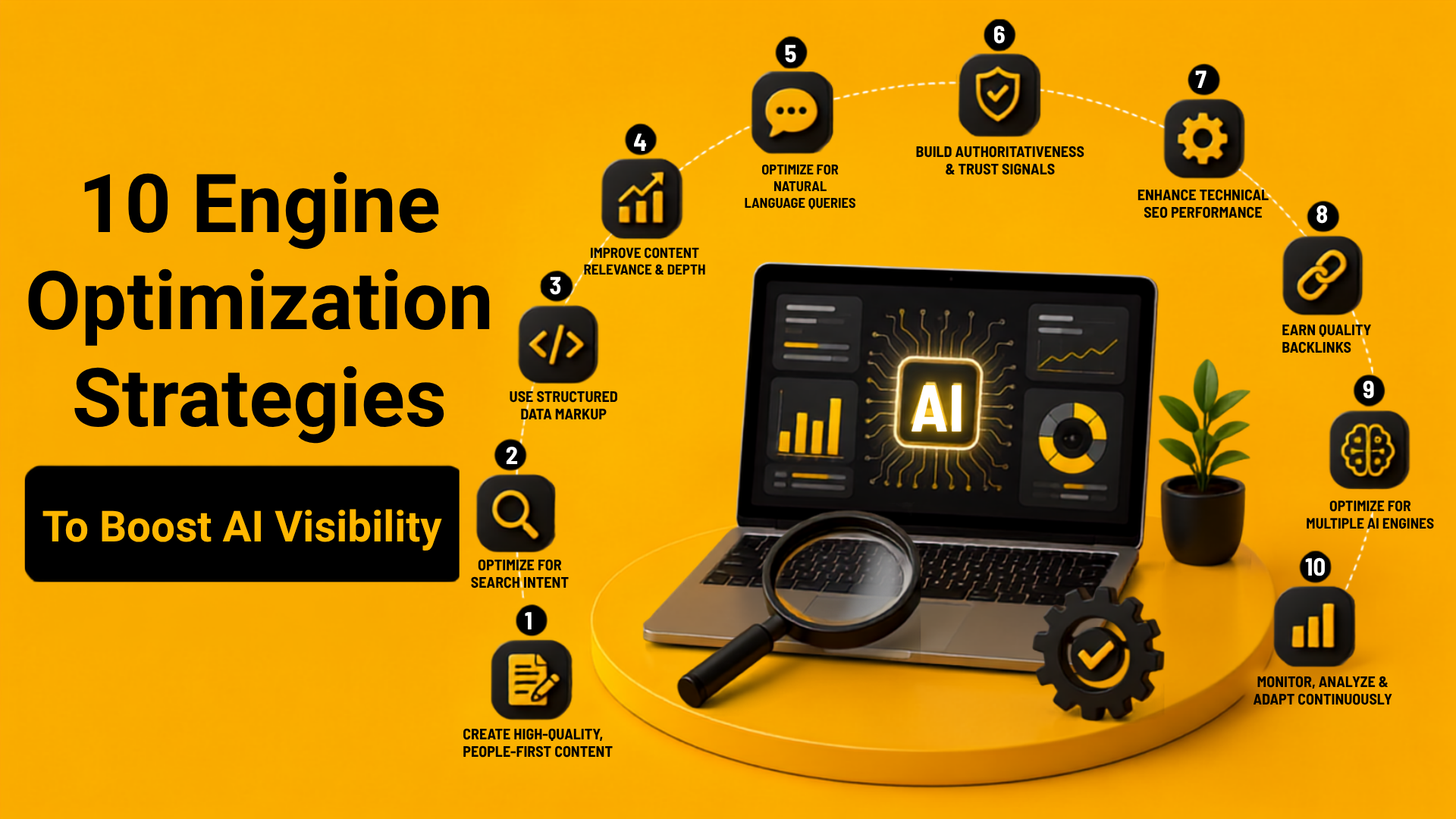
    1. Optimize for AI Search Too

    Search isn’t just ten blue links anymore.

    Google now uses AI-generated summaries in search, and that changes how websites compete for visibility.

    Pew Research Center analyzed 68,879 Google searches from March 2025 and found that users clicked a traditional search result in 8% of visits when an AI summary appeared, compared with 15% when there was no AI summary. Only 1% of visits resulted in a click on a link within the AI summary itself.

    That’s significant.

    Your content now needs to be useful not only as a ranking result but also as a source that search systems can understand and potentially reference.

    Google’s own guidance for AI search emphasizes the same fundamentals: unique, valuable content, strong page experience, and technically accessible pages.

    So don’t chase some mysterious “AI SEO hack.” Create genuinely useful information. Original data. First-hand expertise. Specific examples. Expert opinions. Clear explanations. In other words, give search engines something worth citing.

    1. Measure SEO Like a Business, Not a Vanity Project

    Traffic looks great on a report. Revenue looks better. A page getting 20,000 organic visits isn’t necessarily successful if nobody buys anything.

    Track the full journey:

    Impressions → clicks → engagement → leads → qualified leads → customers → revenue

    For an e-commerce company, that might mean tracking organic revenue and product conversions. For a B2B company, it could mean demo requests and qualified leads. For a local business, it could mean calls, bookings, or direction requests.

    The right SEO metric depends on what the page is supposed to accomplish. And don’t panic every time rankings move.

    SEO is rarely a straight line upward. Look for meaningful trends over time, identify what changed, and use the data to decide what to improve next.

    Final Takeaway

    The best SEO advice isn’t really a collection of tricks. It’s a way of thinking.

    • Understand the searcher.
    • Create something genuinely useful.
    • Make it easy for Google to crawl and understand.
    • Build authority around topics you actually know.
    • Keep improving pages based on real data.

    And most importantly, don’t create content just because a keyword tool gave you another 47 variations of the same phrase.

    Google’s current guidance is remarkably clear: create helpful, reliable, people-first content rather than content designed primarily to manipulate rankings.

    That’s good SEO advice, and honestly, it’s good marketing advice too.

    FAQs

    1. What are the most important SEO tips for beginners?

    Consider search intent, useful content, technical SEO, internal linking, and Google Search Console. There is no need to focus on all areas at the same time. First, make your site searchable and indexed. Then optimize pages that have already been found by search engines.

    1. How long does SEO take to work?

    There is no universal timeline. Competition, website authority, technical SEO, content quality, and the particular search query play roles in this process. Existing websites can receive results faster through optimizing already visible pages.

    1. Are SEO tricks still effective in 2026?

    The tricks that will allow you to change your ranking artificially won’t give you the desired result. The “tricks” that you can consider using are more like useful SEO tips: working on CTR, targeting long-tail keywords, building internal links, fixing technical issues, and producing original content.

    1. Does AI-generated content hurt SEO?

    The use of AI in itself is not the biggest problem. What matters is the usefulness, accuracy, originality, and target audience of the final product. Google warns about the risk of using automation to manipulate search rankings.

    1. What SEO metrics should I track?

    At least, track organic clicks, impressions, CTR, average position, and conversions. Google Search Console helps you understand your visibility, while analytics and CRM provide insight into what this visibility means for the business.

  • What Is EEAT in SEO? A Complete Guide for 2026

    What Is EEAT in SEO? A Complete Guide for 2026

    You’ve got the keywords, content, and even the technical SEO part… So why isn’t your website getting the visibility you expected?

    Sometimes, the missing piece is credibility.

    Google wants to surface content that people can actually rely on—not pages that simply happen to mention the right keywords 15 times. That’s where EEAT comes into the picture.

    E-E-A-T stands for Experience, Expertise, Authoritativeness, and Trustworthiness. It’s not a rating system used by Google to assign scores to your website. E-E-A-T simply refers to the criteria that Google uses when assessing how useful and reliable content is. According to Google, Trust is the most critical component of all these criteria.

    So, what does E-E-A-T actually mean for your SEO strategy? More importantly, what can you do about it? Let’s get into it.

    What Is E-E-A-T?

    E-E-A-T stands for:

    Experience – Have you actually done or experienced what you’re talking about?

    Expertise – Do you know the subject?

    Authoritativeness – Do other credible people or organizations recognize that knowledge?

    Trustworthiness – Can people rely on the information you’re providing?

    The framework used to be called E-A-T. Google added the extra E for Experience in December 2022 because firsthand experience can make a huge difference depending on what someone is searching for.

    And honestly, it makes sense. Say you’re looking for “best CRM for a small business.” Would you rather read an article that lists 10 CRMs after summarizing their websites?

    Or one written by someone who actually tested them, struggled with integrations, compared onboarding times, and can tell you which platform became frustrating after the first month?

    The second article has something the first one doesn’t… Experience.

    The Four Parts of E-E-A-T

    1.Experience: “Have you actually done this?”

    Experience is about firsthand knowledge.

    This is increasingly important because the internet has no shortage of articles written by people who have never actually used the product, visited the location, run the experiment, or performed the process they’re explaining.

    If you’re reviewing software, show what happened when you used it. If you’re writing about SEO, talk about campaigns you’ve actually worked on. If you’re publishing a product comparison, explain how the products were tested.

    Screenshots, original photographs, case studies, testing notes, customer experiences, and real results can all help demonstrate experience.

    There’s a big difference between “Personalized emails can increase conversions.” and “We tested three subject-line variations across 20,000 subscribers and saw X% more opens with the personalized version.”

    The second gives the reader something to work with.

    Just make sure the data is real. Making up “firsthand experience” because it sounds good is a spectacularly bad content strategy.

    2.Expertise: “Do you actually know your stuff?”

    Experience and expertise aren’t quite the same thing.

    You can have firsthand experience without being an expert. You can also have deep expertise without personally experiencing every situation you write about.

    The level of expertise you need depends on the topic.

    A casual restaurant review doesn’t require the same credentials as an article explaining U.S. tax law. A blog about cybersecurity should ideally be written or reviewed by someone who understands cybersecurity beyond what they found in three Google searches.

    That’s why author information matters.

    Instead of an author bio that says “John is a passionate digital marketing expert who loves helping businesses grow.” Tell readers something useful “John has 10 years of experience in technical SEO and has led organic growth programs for B2B SaaS companies across the U.S.”

    Now there’s context.

    Readers know where the writer’s knowledge comes from, and the website isn’t asking them to take a stranger’s word for everything.

    3.Authoritativeness: “Do other people recognize your expertise?”

    This is when the role of reputation comes into play.

    It doesn’t matter how much you know about your niche. The key point is whether people outside of your site acknowledge your expertise.

    Backlinks can do the trick here, as well as mentioning your site in relevant publications and in expert interviews, writing for respected websites, conducting your own research, and so on.

    Don’t confuse “the more backlinks = the more authority.”

    If you’re a U.S. cybersecurity company, one relevant mention from a respected technology publication is more meaningful than a pile of random links from websites nobody in your industry cares about.

    Authority is built through relevance and reputation, not link-counting gymnastics.

    4.Trustworthiness: “Can I actually believe you?”

    This is the big one.

    Google’s guidance identifies trust as the most important part of E-E-A-T. Experience, expertise, and authority all help establish that trust. And trust isn’t limited to your blog articles.

    Look at your website as a customer would. Can they tell who runs the business? Is there a real contact page? Are your claims supported by credible sources? Are your authors identifiable? Is important information current? Do you clearly disclose affiliate relationships or sponsored content? Does the website use HTTPS?

    These might sound like small details, but together they answer a very important question:

    “Why should I trust this website?”

    If your website sells financial services, healthcare products, legal services, or anything else that can significantly affect someone’s life or money, that question becomes even more important.

    Why Does E-E-A-T Matter for SEO?

    Because Google search doesn’t work the way it used to.

    Not everyone is still relying on ten blue links. Google is more and more often providing answers right out of the box using artificial intelligence-based search experience.

    According to Pew Research Center’s analysis of 68,879 Google searches conducted in March 2025, 18% of searches contained AI-generated summaries. When such a summary was provided, the user only clicked on the regular search results link 8% of the time, compared to 15% when no AI summary was provided.

    A considerable change indeed.

    Not only do you want your content to be ranked well, but you also want to be recognized as a credible source of information worthy of citation.

    According to Google’s guidelines on succeeding in AI search, the key to success is creating unique and valuable content, not just another page designed for search traffic. In other words, “another article explaining the same thing” probably isn’t going to set your website apart.

    How Can You Improve E-E-A-T?

    You don’t need to redesign your entire website tomorrow. Start with the pages that matter most to your business.

    Put real people behind your content

    Take a look at the authors writing your important pages.

    Do they actually understand the subject? Can you show their experience? For specialized topics, consider having qualified subject-matter experts review the content before publication.

    And give those people proper author profiles. A name alone doesn’t tell readers much.

    Give readers something original

    This is probably the biggest opportunity for most websites.

    Search your target keyword. Read the top results. Then ask “What can we add that these pages don’t already have?”

    Maybe it’s original research or customer data or a real experiment or an expert interview. Maybe it’s simply a much more honest explanation of what works and what doesn’t.

    If your article could be produced by copying the top five search results into an AI tool, that’s a warning sign.

    Use better sources

    If you’re making a factual claim, especially one involving statistics, don’t cite another blog that cites another blog that cites another blog. Go to the original source.

    For U.S. audiences, that might mean government agencies, research institutions, universities, industry organizations, or the company that originally produced the data.

    Readers notice when research is sloppy. Search engines are getting better at it too.

    Build authority around a subject

    Publishing one great article doesn’t make your website an authority. Consistency matters.

    If you’re a cybersecurity company, build meaningful coverage around cybersecurity. If you’re a SaaS company specializing in project management, develop content that genuinely demonstrates knowledge of that space.

    Think in topics, not isolated keywords.

    For example:

    Ransomware → prevention → employee security → incident response → backups → recovery → compliance

    Those topics naturally connect. Together, they demonstrate much more subject knowledge than 20 unrelated articles written simply because the keywords had search volume.

    Keep your content fresh

    Nothing kills trust quite like an article published as “The Best SEO Tools for 2026” that recommends a product discontinued two years ago.

    Review important pages regularly.

    Check:

    • Statistics
    • Links
    • Product information
    • Screenshots
    • Recommendations
    • Industry regulations
    • Examples
    • Dates and terminology

    And don’t just update the date at the top, ‘actually’ update the content.

    Does AI-Generated Content Hurt E-E-A-T?

    Here’s the short answer: not automatically.

    Google has said that using AI to create content isn’t inherently against its guidelines. What matters is the quality and purpose of that content.

    The problem starts when AI becomes a shortcut for producing hundreds of pages that say absolutely nothing new.

    AI can help you brainstorm, organize research, create an outline, or clean up a rough draft. But someone still needs to bring the experience and judgment.

    What did you actually learn? What happened when you tried the strategy? What surprised you? What failed? What would you do differently? Those details turn generic content into something people might actually bookmark, share, cite, or remember.

    Is E-E-A-T a Google Ranking Factor?

    Not exactly. This is an important distinction.

    Google says E-E-A-T itself is not a specific ranking factor. Its Search Quality Rater Guidelines use E-E-A-T as a framework for assessing the quality of search results, while Google’s ranking systems use many different signals.

    So don’t treat E-E-A-T like an SEO checklist:

    • Add author bio
    • Add three backlinks
    • Add some citations
    • Congratulations, you’re trustworthy

    It doesn’t work that way. Instead, think of E-E-A-T as a way to pressure-test your content.

    • Is it written by someone who knows the subject?
    • Does it contain firsthand knowledge?
    • Does anyone credible recognize that expertise?
    • Can readers trust the information?

    If the answer is yes, you’re moving in the right direction.

    Final Takeaway

    E-E-A-T isn’t about making your website look credible. It’s about giving people a genuine reason to trust it.

    Show what you’ve actually experienced. Put knowledgeable people behind important content. Back up claims with solid sources. Build a reputation in your industry. Keep your information accurate.

    And don’t be afraid to sound human. The internet already has enough articles that say, “In today’s rapidly evolving digital landscape…”

    What it needs is someone who can say “We tried this. Here’s what happened. Here’s what worked. And here’s what we’d do differently next time.”

    That’s the kind of content that earns trust and increasingly, that’s the kind of content worth building your SEO strategy around.

    FAQs

    1. What is E-E-A-T in SEO?

    E-E-A-T stands for experience, expertise, authoritativeness, and trustworthiness. These are features that Google associates with helpful content.

    1. What is the difference between E-A-T and E-E-A-T?

    Initially, E-A-T meant expertise, authoritativeness, and trustworthiness. Google introduced the concept of experience in 2022 to acknowledge the significance of experience.

    1. Is E-E-A-T a ranking factor?

    Google does not use E-E-A-T as an individual ranking factor but considers various factors when creating rankings for websites. E-E-A-T is a structure that defines qualities of good content.

    1. How can I improve E-E-A-T on my website?

    Focus on qualified authors, firsthand information, original research, references to reputable sources, relevant backlinks and mentions, clear company data, and frequent updates of the content.

    1. Does AI-generated content hurt E-E-A-T?

    No, it does not. The usage of AI does not influence Google rankings. The bigger concern is low-quality content produced primarily to manipulate search rankings rather than genuinely help users. 

  • August 2026 Instagram Trends You Need to Know

    August 2026 Instagram Trends You Need to Know

    Instagram trends move fast. One week, everyone is posting the same audio. The next, that audio is so overused that seeing it on a brand account feels like watching someone arrive at a party three hours late.

    For marketers, the problem isn’t finding trends. It’s figuring out which ones are actually worth using.

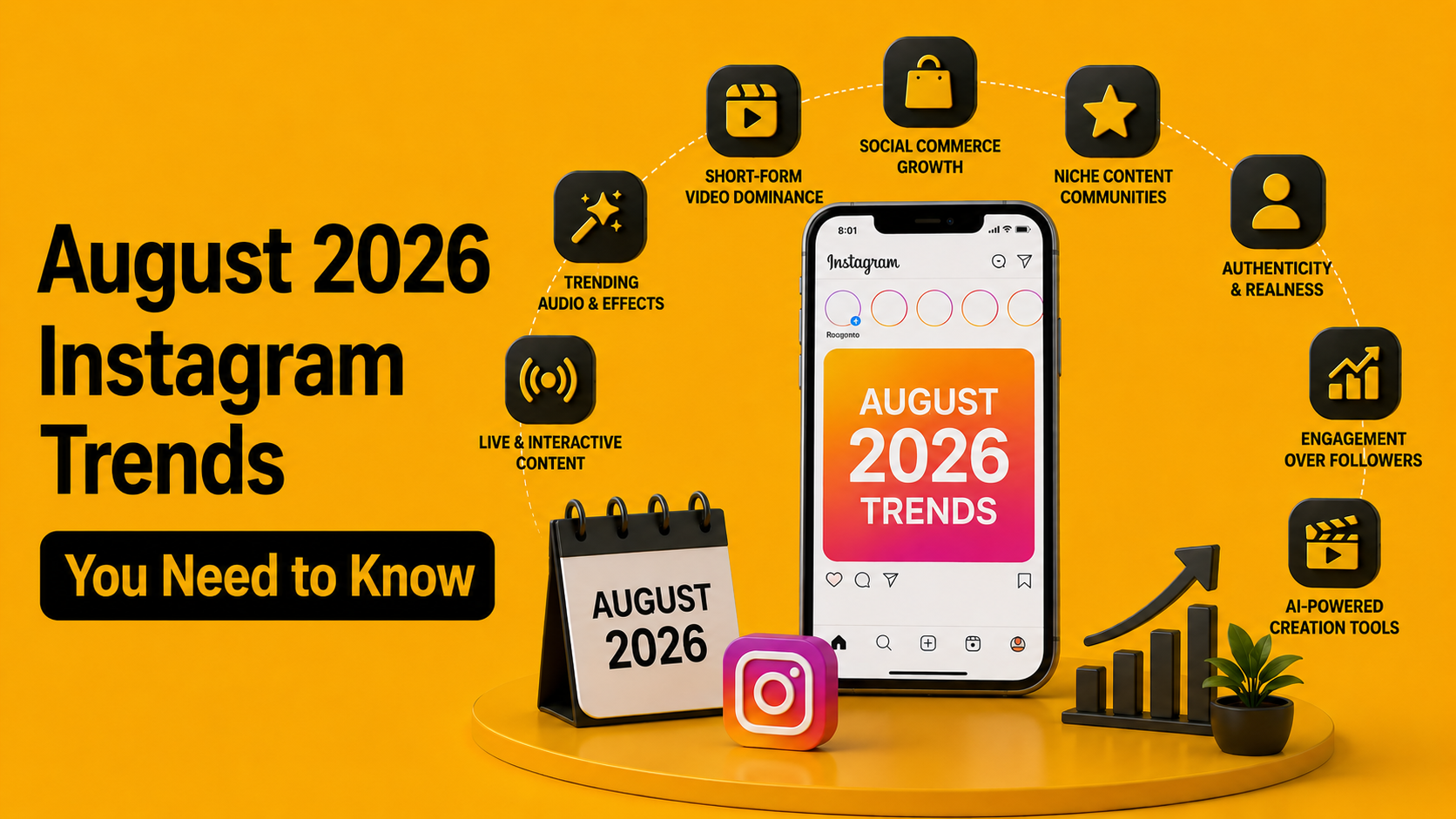
    August 2026 has made one thing pretty clear. Instagram is leaning harder into short-form video, original content, relatable storytelling, and formats people want to share, not just content that looks polished. Reels remain a major part of how people discover content, while carousels, original audio, memes, and low-production videos are finding plenty of room in the feed.

    And the numbers back up just how big the opportunity is. Instagram has more than 2 billion monthly active users, while Meta says Instagram now has 3 billion monthly active users across the platform as of September 2025. People also reshare Reels more than 4.5 billion times every day across Meta platforms.

    So, what’s actually trending on Instagram this August?

    Let’s break it down.

    August 2026 Instagram Trends: The Quick Version

    TrendWhat’s happeningBest brand use
    Low-production ReelsSimple, single-take videos are gaining tractionFounder content, BTS, quick takes
    Absurdist memesSurreal formats are spreading quicklyRelatable brand humor
    Tribute carouselsNostalgic, emotional multi-slide posts are trendingCommunity, storytelling, milestones
    “August”Seasonal nostalgia is backSummer recaps, lifestyle content
    “And for the lady…”Products are revealed for specific audiencesProduct positioning
    “My Biggest Flex”Creators are showcasing skills and capabilitiesExpertise and service promotion
    “Let me guess…”Relatable traits drive recognitionAudience-focused content
    Trending audioPopular songs continue to fuel ReelsReach and cultural relevance
    Original contentInstagram is increasing original-content recommendationsBuild unique brand IP
    First DraftInstagram is simplifying Reel editingFaster content production

    The Biggest Instagram Trends of August 2026

    1. Low-production Reels are having a very good month

    Remember when every brand Reel needed perfect lighting, cinematic transitions, professional cameras, three people behind the camera, and roughly 47 rounds of approval?

    Yeah. Instagram seems increasingly interested in something else.

    Content that feels like content.

    One of the clearest patterns emerging this month is the rise of low-production, single-take, or minimally edited Reels. Creators are using simple setups, direct-to-camera delivery, basic lip-syncs, and quick visual jokes instead of trying to make every Reel look like a commercial.

    New Engen’s August trend report highlights this shift, including a single-take truck-driver lip-sync Reel that reportedly reached 336 million views. The same report points to documentary-style and low-production formats gaining traction alongside more polished content.

    That’s important for brands because low production doesn’t necessarily mean low effort.

    The difference is intentional simplicity.

    A founder sitting at their desk and saying, “Three things I wish I knew before launching this business,” can work better than a beautifully produced 30-second video that takes ten seconds to get to the point.

    How brands can use it

    Try:

    • A founder or employee speaking directly to camera
    • A one-take product demonstration
    • A behind-the-scenes clip with text overlays
    • A quick reaction to something happening in your industry
    • A “POV” format that doesn’t require elaborate production
    • A simple workplace moment your audience will recognize

    The goal isn’t to make your content look unfinished. It’s to make it feel native to Instagram. And that’s a useful distinction.

    1. The “Netflix Documentary” trend is turning everyday drama into prestige TV

    What happens when a completely ordinary problem gets treated like it’s the subject of a six-part Netflix docuseries?

    Apparently, Instagram wants to watch.

    The “Preparing for my Netflix Documentary” trend has been making the rounds on TikTok and Instagram Reels, with creators sitting down for a mock documentary interview, fixing their hair, adjusting a microphone, or simply staring into the camera while dramatic music plays. The joke comes from the contrast: the production feels serious, but the “documentary” is about something hilariously mundane.

    The format typically uses Duomo’s “On a Mission” as the dramatic backdrop. Creators add text such as “Preparing for my Netflix documentary about surviving the worst group chat” or turn an everyday workplace headache into a supposedly career-defining scandal.

    And brands have plenty of room to play with it.

    How brands can use it

    The trick is specificity.

    Don’t make a Reel that says “Preparing for my Netflix documentary about running a business.” That’s too broad. Try “Preparing for my Netflix documentary about the client who said ‘just one tiny revision.’”

    Or “Preparing for my Netflix documentary about the espresso machine that survived our first year.” Or “Preparing for my Netflix documentary about how our founder turned a kitchen experiment into a six-figure business.”

    The last one shows why this trend can work particularly well for brands: it can turn a real brand story into entertainment without making it feel like a case study.

    You can also use archival footage, old product photos, behind-the-scenes clips, founder footage, or even a dramatic close-up of the product after the opening shot. The trend has already been identified as a format brands can adapt, particularly for founder stories, product origins, and niche inside jokes.

    And there’s another reason I’d keep this trend in our August roundup: it’s a cross-platform format. New Engen specifically notes that the Netflix Documentary chair-sit format crossed over from TikTok and was independently gaining traction on Instagram.

    1. Nostalgia is driving the carousel comeback

    Instagram may be a video-heavy platform, but August has also been a surprisingly strong month for carousel storytelling.

    One major example is the rise of nostalgic tribute carousels using Olivia Rodrigo’s “u + me = <3” and “Stupid Song.”

    New Engen identifies both tracks as drivers of a broader tribute-carousel trend, while other August trend reports point to nostalgic photo dumps and emotionally driven carousel content gaining traction.

    The format is simple:

    A series of photos, screenshots, memories, or moments builds an emotional story across multiple slides.

    There’s no complicated production. No talking head. No elaborate hook. Just a reason to keep swiping. And that’s exactly why brands shouldn’t write carousels off as “old Instagram.”

    And the numbers suggest carousels aren’t simply hanging around; they’re becoming more useful for certain types of engagement. Metricool’s 2026 Instagram study found that brands published 24% more carousels this year, while carousels generated 9× more saves than single-image posts.

    The brand opportunity

    Nostalgia can work particularly well for:

    • Hospitality brands
    • Fashion
    • Food and beverage
    • Entertainment
    • Education
    • Local businesses
    • Consumer brands
    • Community-based organizations

    A restaurant, for example, could create:

    “10 moments from our first year that we’ll never forget.”

    A fashion brand could do:

    “The looks that defined our summer.”

    A SaaS company could even get in on it:

    “Things we used to think were normal before we automated them.”

    The key is that the carousel needs a story, not just a collection of images.

    That’s also why format choice matters. Socialinsider’s 2026 analysis found that carousels are particularly effective at driving saves, while Reels are stronger at generating shares. So the question isn’t whether Reels or carousels are “better.” It’s what action you want the content to drive.

    1. “August” is back because the internet apparently has seasons now

    Some trends are predictable.

    Taylor Swift’s “august” returning to Instagram every August is one of them.

    Buffer included the track among its leading Instagram sounds for August 2026, noting that creators are using it for summer recaps, “life lately” content, sunsets, and end-of-season moments.

    This is a good example of a seasonal recurring trend.

    Not every trend needs to be brand new. Some trends return because they are culturally associated with a specific moment. That’s useful because it gives marketers something most trends don’t:

    Predictability.

    How brands can use recurring trends

    Think beyond the obvious.

    Instead of posting “August recap,” A brand could turn the seasonal audio into “The August moments that made us stop scrolling.”

    Or: “August at [Brand Name]: 12 seconds of summer.” Or, for a service business: “What our team was up to this August.”

    The lesson isn’t “use Taylor Swift.”

    It’s to watch for recurring cultural moments that your audience already recognizes.

    1. “And for the lady…” turns product positioning into entertainment

    Another notable August format is the “And for the lady…” trend, driven by Noah Kahan’s End of August.

    Buffer identifies it as a format where creators reveal the perfect product, place, or experience for a specific type of person.

    This one is particularly interesting for marketers because it’s basically product positioning disguised as a trend.

    Instead of saying, “Our product is perfect for busy professionals.” You can show the person first and reveal the product second. That small change makes the content feel less like an advertisement.

    Example

    A coffee shop:

    “And for the lady who has three meetings before 10 a.m…”

    Cut to:

    Your largest iced coffee.

    A hotel:

    “And for the lady who said she needs a vacation but refuses to take PTO…”

    Cut to:

    Your weekend getaway package.

    A fitness brand:

    “And for the lady who wants to work out but hates working out…”

    Cut to:

    A beginner-friendly class.

    It’s a classic marketing principle wrapped in a social-native format:

    Show people that you understand them before you try to sell to them.

    1. “My Biggest Flex” is turning expertise into content

    Shakira’s “She Wolf” is another August trend worth watching.

    Creators are using the audio with the “My biggest flex” format to highlight their skills, capabilities, or different roles. Buffer lists it among August’s trending Instagram sounds.

    • For creators, it’s a fun personality trend.
    • For businesses, it can become a positioning tool.

    Instead of bragging about your company in a traditional case-study format, you can show the things your team does exceptionally well.

    For example:

    “My biggest flex is that you can hire me as your…”

    • Strategist
    • Copywriter
    • Creative director
    • Paid media nerd
    • Analytics person
    • Last-minute problem solver

    A B2B brand could even use it to show capabilities customers may not know it offers.

    Why this format matters

    People don’t always understand the full scope of a business. They see the product. They don’t necessarily see the expertise behind it.

    Trend formats like this give brands a reason to show their range without turning the Reel into a corporate brochure.

    1. “Let me guess…” content is built for relatability

    Later’s August roundup highlights another format based on “Let me guess…”, where creators identify someone’s interests, habits, or personality traits using visual clues and screenshots.

    This format taps into something social media has always been very good at: making people feel seen.

    The viewer watches and thinks, “Wait. That’s literally me.” That’s powerful because relatable content has a natural reason to be shared.

    For brands, try this:

    A coffee brand: “Let me guess. You said you’d only have one coffee today.”

    A marketing agency: “Let me guess. You have 17 tabs open and still can’t find the campaign report.”

    A gym: “Let me guess. You bought the workout clothes before deciding to actually work out.”

    The product isn’t necessarily the joke. The audience is. And that’s usually a better place to start.

    1. Trending audio is still important, but don’t build your entire strategy around it

    Let’s settle this once and for all:

    Trending audio still matters. But blindly attaching a popular sound to a Reel doesn’t make the Reel good.

    Buffer’s August roundup lists tracks ranging from Taylor Swift’s august and Noah Kahan’s End of August to Shakira’s She Wolf, Steve Lacy’s oh yeah?, Bad Bunny’s EoO, and several original sounds.

    SocialPilot’s August roundup similarly highlights August, End of August, She Wolf, oh yeah?, EoO, and other sounds as part of the month’s trend cycle.

    But there’s an important catch for brands. Not every trending sound is commercially usable.

    Later specifically warns that even some sounds labeled “original audio” aren’t technically royalty-free, and recommends that brands running sponsored content or paid ads use Meta’s commercially licensed music options when appropriate.

    So before your social team says, “This audio is trending! Post it!”

    Ask:

    • Is it appropriate for our audience?
    • Does the trend fit our brand?
    • Is the audio available for our account type?
    • Can we use it commercially?
    • Does the trend actually improve the idea?

    If the answer to number five is no, skip it.

    1. Original content is becoming more important

    Here’s one of the biggest strategic takeaways from August that has nothing to do with a specific meme.

    Originality matters.

    Meta said in January 2026 that it had increased the prevalence of original content in Instagram recommendations in the U.S. by 10 percentage points in Q4 2025, with 75% of recommendations coming from original posts at that time.

    Add Visual Chart: 75% of Instagram recommendations were coming from original posts.

    That’s a significant signal for brands.

    The social strategy of:

    Find a viral post → download → add your logo → repost

    isn’t exactly a long-term growth strategy. And while reacting to trends is still valuable, brands need to add something of their own.

    That could be:

    • A unique opinion
    • Original footage
    • A company-specific joke
    • An employee’s perspective
    • A customer story
    • Proprietary data
    • A new interpretation of an existing trend

    Think of trends as templates, not finished products. The trend gets you into the conversation. Your perspective is what gives people a reason to remember you.

    1. Instagram is making Reels easier to create

    Instagram also made an interesting product move this month.

    On August 25, Instagram introduced First Draft, a Reels feature that automatically trims selected clips into a rough-cut Reel, removing pauses and pulling together useful sections. The tool is designed to create a starting point that users can continue editing before publishing.

    Instagram’s First Draft feature is designed to turn raw clips into a rough-cut Reel, helping creators get from footage to an editable first version faster.

    And there’s a useful takeaway here:

    Instagram is lowering the production barrier. That matters because the platform isn’t asking every creator to become a professional editor.

    It’s making it easier to go from “I have footage.” to “I have something I can actually post.”

    For businesses, that’s an opportunity to create more content from material they’re already capturing.

    A sales team can record customer-event footage. A founder can record a few talking-head clips. A restaurant can capture behind-the-scenes footage throughout the week. A creative team can collect raw product footage.

    Then the editing process becomes less of a bottleneck. The bigger trend isn’t First Draft itself. It’s content velocity. And that race is already visible in publishing behavior. Metricool’s 2026 study found that the volume of Reels published increased by 35%, alongside a 24% increase in carousel publishing.

    The easier it becomes to create and edit video, the less defensible highly polished production becomes.

    Your competitive advantage shifts toward:

    ideas + speed + relevance + originality.

    1. Cross-platform trends are arriving on Instagram faster

    Another pattern worth watching is how quickly trends move between platforms.

    Later’s August roundup includes formats that have crossed over from TikTok, while New Engen specifically calls out the migration of formats such as the “Netflix Documentary” chair-sit concept onto Instagram.

    This means social teams can’t really afford to monitor Instagram in isolation anymore.

    A trend may start on TikTok. A creator may remix it on Instagram. A brand may adapt it for LinkedIn. Then the format becomes part of broader internet culture.

    But here’s where businesses can get ahead:

    Don’t wait until the trend is everywhere on Instagram.

    Watch for formats that are beginning to show up across platforms, then figure out whether there’s a brand-relevant version before the format becomes completely saturated.

    The sweet spot is recognizable but not exhausted.

    What these August Instagram trends actually tell us

    If you look at all these trends individually, they can seem random.

    A Taylor Swift song.

    A bizarre Bangladesh joke.

    A sentimental carousel.

    A single-take truck-driver Reel.

    A product reveal.

    A “My Biggest Flex” video.

    A new editing feature.

    But together, they tell a much more interesting story. Instagram is becoming less about polished content and more about recognizable ideas. People don’t necessarily need another beautifully shot video. 

    They need something they can understand quickly. Something that makes them laugh. Something that makes them feel seen. Something that gives them a reason to send it to a friend. Something that makes them stop because the first two seconds feel familiar.

    And, increasingly, something original.

    Meta’s own recommendation data supports the direction: the company reported that 75% of Instagram recommendations in the U.S. were coming from original posts after a 10-percentage-point increase in original-content prevalence during Q4 2025.

    That’s a useful shift for brands that have been treating Instagram like a digital billboard. It isn’t. It’s a recommendation engine. And recommendation engines need content people actually want to consume.

    What should brands do with Instagram trends in August 2026?

    The worst possible response to a trend report is:

    “Okay, let’s recreate all of these.” Please don’t. Instead, use a simple filter.

    1. Does the trend fit your audience?

    A viral meme isn’t automatically relevant to your customers. If your audience won’t get it, skip it.

    1. Can you add a brand-specific angle?

    If the only thing your account adds is your logo, you haven’t really adapted the trend. 

    You’ve copied it.

    1. Can you make it quickly?

    Trends have expiration dates.

    If it takes three weeks to get a Reel approved, you’re probably not trend-jumping. You’re trend-archiving.

    1. Is there a business objective?

    Not every Reel needs to sell. But it should do something. Something that builds awareness, shows personality, educates, creates engagement, drives profile visits, starts a conversation, and strengthens brand recall.

    1. Can the idea work without the trend?

    This is the big one. If the trend disappears tomorrow, would the content still make sense?

    If yes, you’ve probably created something useful. If no, you’ve created a disposable post. And sometimes that’s fine. Just know the difference. The Instagram trend to watch isn’t a sound

    If there’s one takeaway from August 2026, it’s this:

    Stop treating Instagram trends as a list of sounds. The bigger trends are behavioral.

    People want content that feels:

    • Original
    • Relatable
    • Fast
    • Easy to understand
    • Emotionally recognizable
    • Native to the platform
    • Worth sharing

    The audio is often just the wrapper. The real trend is the format underneath it.

    That’s why a brand shouldn’t ask “What song is trending?” The better question is “What kind of content are people repeatedly choosing to watch, share, save, and recreate?”

    That’s where the useful insight is.

    Final take: Don’t chase every Instagram trend. Find your version of it.

    August 2026 isn’t showing us that brands need to post more. It’s showing us that brands need to participate better.

    Use the “And for the lady…” format to sharpen your positioning.

    Use “My Biggest Flex” to show expertise.

    Use nostalgia-driven carousels to tell stories.

    Use absurdist memes when your brand voice can actually carry the joke.

    Use low-production Reels when a phone camera gets the job done.

    Use trending audio when it genuinely improves the idea, and when you have the rights to use it.

    And keep an eye on Instagram’s own product changes, because tools like First Draft are making video creation faster and easier.

    Most importantly, don’t confuse being early with being relevant.

    A trend is useful when it gives your brand a better way to communicate something your audience already cares about. Otherwise, it’s just another sound in your saved folder. And let’s be honest, you have enough of those.

  • How KFC Turned 1,000 Rejections Into a Global Brand

    How KFC Turned 1,000 Rejections Into a Global Brand

    Imagine hearing “No” so many times that most people would have stopped counting. Colonel Harland Sanders apparently heard it more than 1,000 times.

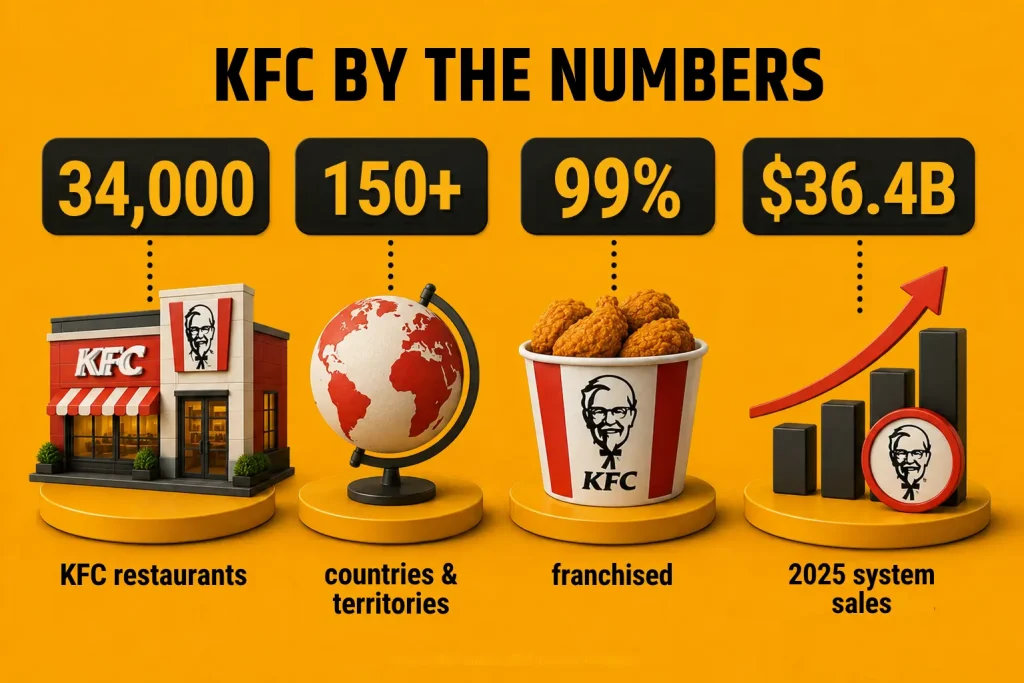
    And somehow, the man who couldn’t convince enough restaurant owners to sell his chicken eventually built a brand with 34,000 restaurants across 150+ countries and territories, generating $36.4 billion in system sales in 2025.`

    Oh, and about 99% of those restaurants are franchised. That’s not just a comeback story. That’s a marketing case study hiding inside a bucket of fried chicken.

    The popular version of the KFC story goes something like… Colonel Sanders had a recipe → People rejected him → He kept going → Eventually, someone said yes → KFC became huge.

    Nice story… In fact, very inspirational. Also, way too simple. Because thousands of entrepreneurs have had great recipes, faced rejection, and refused to quit. They didn’t all end up with nearly 34,000 restaurants.

    The interesting question isn’t “How did Sanders survive 1,000 rejections?” It’s “What did Sanders build that made the next yes scalable?”

    That is where the real KFC marketing story begins.

    First, Let’s Kill the Most Popular KFC Myth

    You will often see the story repeated that Sanders was rejected 1,009 times before someone finally accepted his chicken. It’s a great number. It is also one we should treat carefully.

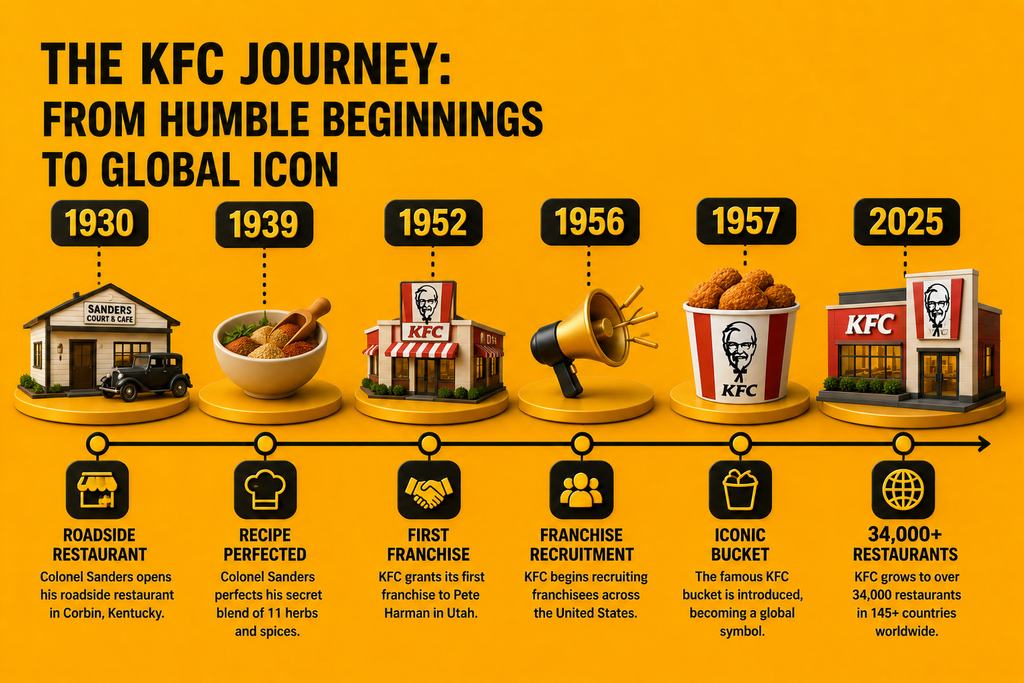
    KFC’s official history confirms that Sanders went on the road in 1956 to recruit franchisees after selling his Corbin restaurant, and that the first KFC franchise opened near Salt Lake City in 1952. But KFC’s official timeline does not substantiate the exact “1,009 rejections” figure.

    So for a serious case study, the better phrasing is “Over 1,000 rejections” rather than presenting 1,009 as an audited historical fact. And honestly, the exact number isn’t even the most interesting part.

    Because rejection wasn’t the breakthrough. The system Sanders built after rejection was.

    The First Marketing Lesson: A Great Product Is Not Enough

    Sanders had something genuinely differentiated.

    He had spent years developing his fried chicken recipe and eventually perfected the blend of 11 herbs and spices. KFC’s history dates the perfected recipe to 1939.

    But having a differentiated product and having a scalable business are two completely different things.

    “I only have two rules: Do all you can and do the best you can.”
    –Colonel Harland Sanders

    Imagine opening the greatest little burger restaurant in America. People love it, so they come back, you make money. Great.

    Now try putting that exact experience in 500 cities.

    Suddenly, you have problems. Who makes the burgers? How? With what ingredients? At what temperature? How much? What packaging? What does the restaurant look like? What happens if the customer orders it somewhere else? That’s where KFC’s story becomes a marketing story rather than merely a food story.

    Sanders didn’t just have to convince people that his chicken tasted good. He had to make the chicken repeatable. That distinction is enormous.

    A product can create a customer. A repeatable product can create a brand.

    Timeline of KFC

    Sanders Wasn’t Really Selling Chicken

    This is perhaps the biggest overlooked part of the story.

    When Sanders started approaching restaurant owners, he wasn’t simply saying “Hey, I’ve got some really good chicken.” That wouldn’t be much of a business proposition.

    He was effectively offering restaurant operators a way to add a proven product to their existing business. That’s a very different pitch.

    Instead of “Come eat at my restaurant.” The model became “Let your restaurant sell my chicken.” And suddenly, the growth problem changed. Sanders didn’t need to personally own every restaurant.

    Other people could provide the location, staff, investment, local knowledge, and day-to-day operation. Whereas KFC could provide the brand, product system, and operating model. That is the beauty of franchising. And the scale of that decision is visible today.

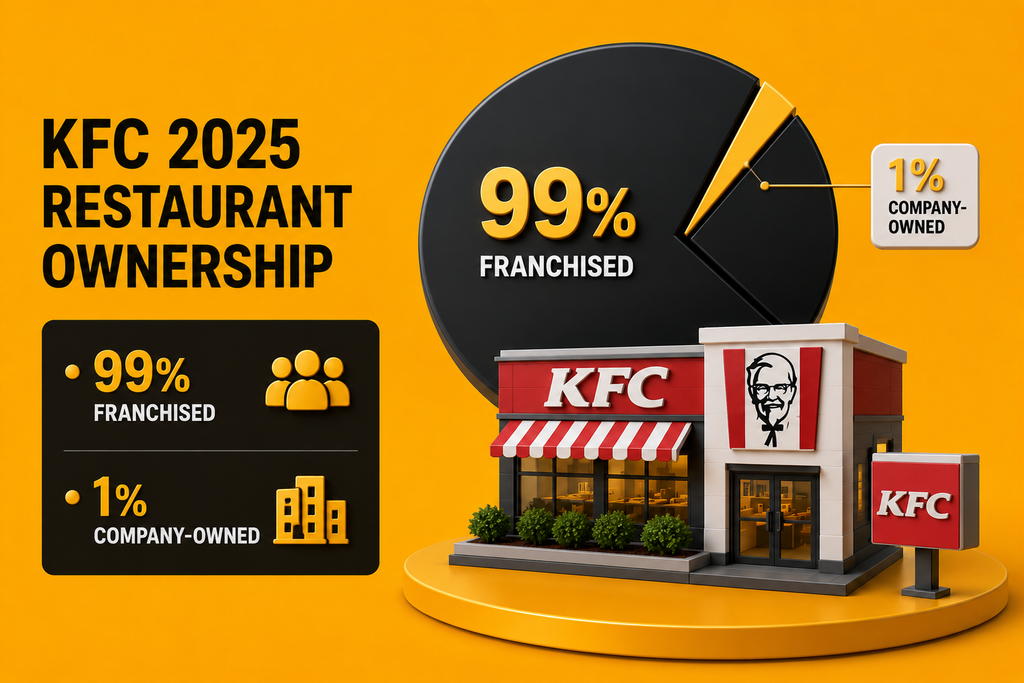
    In 2025, 99% of KFC’s restaurants were franchised, with 90% of its units located internationally.

    KFC Restaurant Ownership

    Think about what that means from a marketing perspective.

    KFC didn’t just build an audience. It built a distribution network around the audience. That’s a very different way of thinking about growth.

    Brilliant Idea of Sanders: He Became the Brand

    Today, we call it personal branding. In the 1950s, it was basically “This guy looks memorable.” In 1950, Sanders adopted the white suit that would become inseparable from his public identity. KFC’s official history says he wore the suit whenever he appeared publicly.

    Think about the decision. He could have marketed 11 herbs and spices. Instead, he also marketed a human being: a white suit, black string tie, goatee, glasses, southern gentleman persona, and Colonel Sanders.

    Suddenly, the brand had a face. And faces are easier to remember than recipes. The Colonel turned a product story into a character story. That matters because people don’t naturally remember corporate entities. They remember people.

    Think about the brands you can identify instantly. Sometimes it’s a logo, sometimes it’s a color, sometimes it’s a sound, and sometimes… it’s a person.

    The Colonel became KFC’s human shortcut. You didn’t need to explain what KFC was every time. Show the Colonel and people instantly knew.

    The Bucket

    Now we get to one of KFC’s most underrated marketing moves.

    The bucket.

    In 1957, Sanders and early franchisee Pete Harman developed the takeout bucket concept. KFC says Harman purchased 500 paper buckets from another franchisee, then filled them with 14 pieces of chicken, five rolls, and a pint of gravy. The idea became an instant success and remained a signature part of KFC for decades.

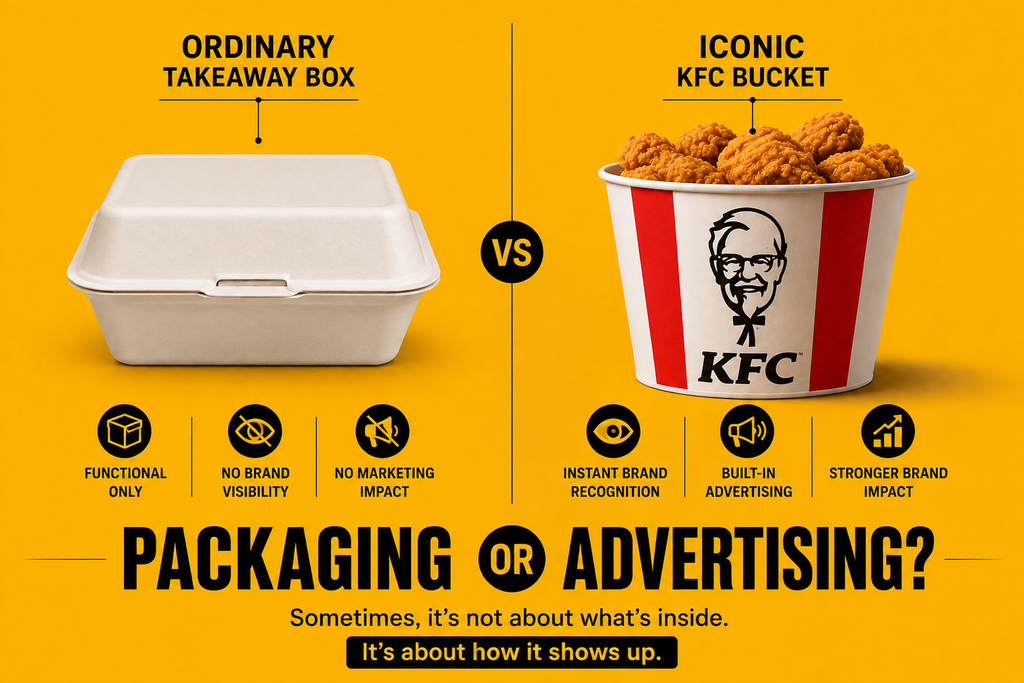
    At first glance, this looks like packaging. But if you think a little too deeply, it wasn’t. It was media. Think about the difference.

    A regular box goes from restaurant → customer → trash.

    A bucket goes from restaurant → customer → car → home → dinner table → party → social gathering.

    And when everyone sees it, the Colonel’s face is on it, the KFC branding is on it… Like the product is literally sitting inside it. The quantity is visible. The brand becomes part of the occasion. 

    KFC turned packaging into advertising that customers carried for free.

    KFC Packaging vs Advertising

    And there’s another clever psychological element. The bucket isn’t just a container for one person’s meal. It naturally suggests sharing. A bucket is bigger; a bucket goes in the middle of the table; a bucket says “We’re eating together.” That’s positioning.

    KFC wasn’t simply selling individual pieces of chicken. It was gradually owning a social eating occasion. KFC Didn’t Just Sell Food. It Sold a Ritual. 

    This is where marketers should pay attention. Strong brands often become attached to behaviors. Starbucks isn’t only coffee. Nike isn’t only shoes. Apple isn’t only computers. And KFC isn’t only fried chicken.

    It’s bucket + family + gathering + indulgence + recognizable taste + Colonel.

    The customer isn’t necessarily thinking “I require precisely eight pieces of pressure-cooked chicken.” They’re thinking “Let’s get KFC.” That’s a completely different level of brand strength.

    The brand becomes a verb-like shortcut for a decision. And once a brand owns a mental shortcut, competitors have a much harder job.

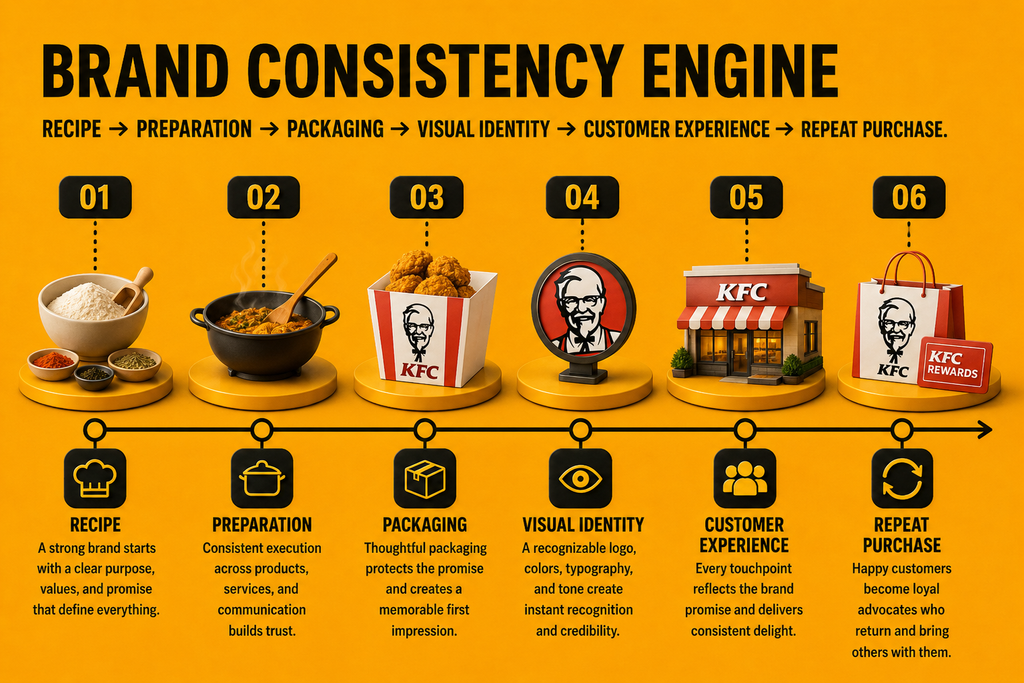
    The Real Secret Was Consistency

    Here’s where the story gets less glamorous and much more important. Branding gets the attention. Consistency earns the trust. 

    KFC’s Original Recipe isn’t simply a marketing claim. The company says its chicken is still prepared using its secret blend of 11 herbs and spices, hand-breaded and cooked using its established preparation process.

    Why does this matter?

    Because KFC was trying to create something that could travel. Kentucky, Utah, New York, London, Sydney, Dubai, and India. Different customers, different cultures, different employees, different restaurant owners, yet the customer should still feel “Yep. That’s KFC.” That’s the promise.

    Consistency is what allows a brand to scale without becoming unrecognizable.

    This is also why franchising and marketing are connected. A franchise system can’t survive if every restaurant interprets the brand differently. So the operational system becomes part of the brand.

    Marketing makes the promise. Operations keep it.

    KFC Faced the Hardest Marketing Problem of All

    Going global.

    Because America isn’t the world. A brand can be extremely successful domestically and still fail miserably overseas. Why? Because customers don’t leave their culture at the restaurant door.

    Taste changes, food habits change, price expectations change, religious considerations change, occasions change, competition changes. So KFC had to solve a difficult equation…How do you remain KFC without making every market feel like America was copied and pasted into it? The answer has been global consistency with local adaptation.

    KFC’s global platform highlights market-specific products and campaigns rather than treating every country as identical.

    The core remains recognizable. The execution changes. That distinction is incredibly important. Global brands don’t win by being identical everywhere. They win by being recognizable everywhere.

    The Numbers Make the Strategy Hard to Ignore

    By the end of 2025, KFC had 34,000 restaurants, over 150 countries and territories, with 90% of its restaurants outside the U.S. and 99% franchised.

    Its 2025 system sales reached approximately $36.434 billion. That’s the result of decades of brand building, distribution, franchising, and operational standardization.

    KFC By the Numbers

    And there’s one number that should particularly interest marketers… 90% international. Because that means KFC didn’t merely create a successful American restaurant. It created a brand architecture capable of traveling.

    Here’s Where Things Get Really Interesting

    You might think that after becoming one of the world’s largest restaurant brands, KFC could simply sit back. Chicken sells, buckets sell, the Colonel is famous, and the job done… Nope.

    In 2025, KFC U.S. launched what it called its “comeback era.”

    The brand openly acknowledged fierce competition in the fried chicken category and returned the Colonel to advertising while emphasizing Original Recipe and improvements in taste and customer satisfaction.

    Read that carefully.

    A 75-year-old brand was talking about winning customers back. That’s fascinating. Because brand equity doesn’t make you permanently relevant. Competitors don’t care how famous you were in 1975. Consumers don’t owe you loyalty because your founder wore a white suit. And nostalgia only works until somebody else becomes more interesting.

    KFC understood that. So the brand went back to one of its oldest assets… The Colonel. But it didn’t simply recreate old advertising.

    It used the Colonel in a new cultural context, describing him as a “chefpreneur” and positioning the campaign around the brand’s pursuit of flavor.

    That’s not nostalgia for nostalgia’s sake. That’s using heritage as a strategic asset.

    Difference Between Heritage and Nostalgia

    Nostalgia says “Remember when we were great?” Heritage says “Here’s what made us great. Now watch us use it again.” That’s a huge difference.

    KFC’s 2025 comeback campaign leaned into its history while addressing a current competitive problem. This is something many legacy brands struggle with. They either become obsessed with their past… or become so desperate to look young that they abandon everything recognizable about themselves.

    KFC’s challenge is more interesting… How do you modernize without deleting the reason people remember you? That is a branding problem. Not an advertising problem.

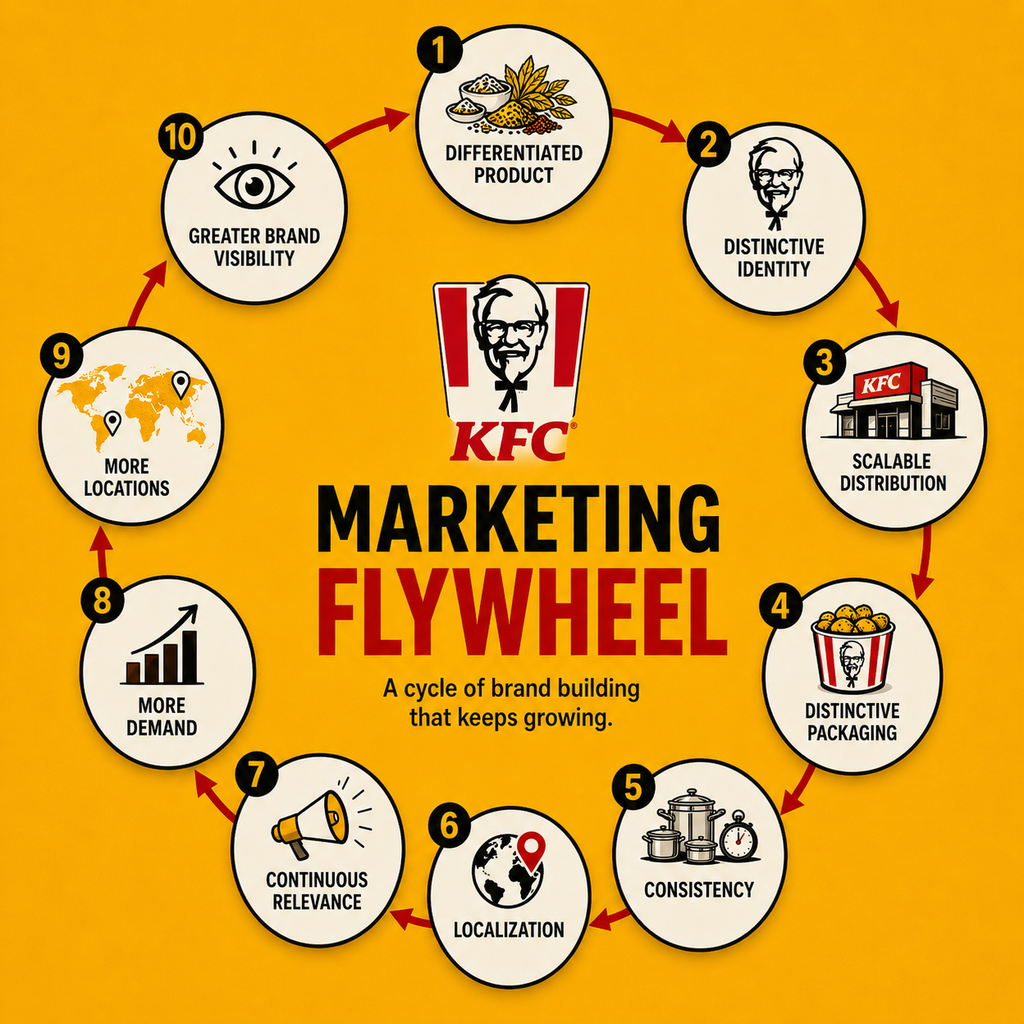
    KFC’s Marketing Flywheel

    If you strip away the Colonel jokes, secret recipes, and buckets, KFC’s growth starts looking like a very sophisticated marketing flywheel.

    1. Differentiated product

    The 11 herbs and spices gave KFC a recognizable product story.

    1. Distinctive identity

    The Colonel gave the product a human face.

    1. Scalable distribution

    Franchising allowed other operators to bring KFC to new markets.

    1. Distinctive packaging

    The bucket turned the product into a visible brand asset.

    1. Consistency

    Standardized preparation helped maintain the recognizable KFC experience.

    1. Localization

    Markets could adapt products and campaigns without abandoning the core identity.

    1. Continuous relevance

    Advertising and new product launches keep the brand in culture.

    1. More demand

    More demand makes the franchise model more valuable.

    1. More locations

    More locations create greater availability.↓

    1. Greater brand visibility

    And the flywheel starts again.

    KFC Marketing Flywheel

    That’s the part the inspirational versions of the Sanders story leave out. Persistence is not a growth strategy. It only becomes one when you learn from every rejection.

    The “No” Was Actually Market Research

    Here’s another way to look at those famous rejections. Every rejection contained information. 

    “One has to remember that every failure is a step toward success.”

    – Colonel Harland Sanders

    Maybe the restaurant owner didn’t see the value, maybe the economics weren’t attractive, maybe the product wasn’t easy enough to integrate, maybe the pitch wasn’t compelling, maybe the restaurant didn’t trust the opportunity.

    We don’t know the exact reason behind every rejection. But here’s the broader marketing lesson:

    • A rejection is data. That’s true today.
    • If customers don’t click, that’s data.
    • If they click but don’t buy, that’s data.
    • If they buy once but don’t return, that’s data.
    • If franchisees don’t renew, that’s data.
    • If a campaign gets attention but no sales, that’s data.

    The worst response to rejection is “They just don’t understand.” The better response is “What exactly are they telling us?” The market isn’t always rejecting your idea. Sometimes it’s rejecting the way you’ve packaged it. That distinction can change an entire business.

    KFC Has Never Been Afraid of Being Weird

    This is another part modern marketers can learn from. KFC has repeatedly leaned into humor, absurdity, and pop culture. The brand has turned the Colonel into different versions of himself, used bizarre partnerships, and even created a campaign around RoboCop protecting the secret recipe.

    Completely ridiculous? Yes. Completely random? Not really. The underlying asset stays the same… The Colonel + secret recipe + KFC. That’s why weirdness can work. The campaign changes, but the memory structure doesn’t, and that’s an important distinction.

    Be unpredictable in the campaign. Be predictable in what the brand stands for. That’s how you can be funny without becoming forgettable.

    So What Did KFC Actually Build?

    KFC built a recognition machine. The product creates the first reason to try.

    • The Colonel creates recognition.
    • The bucket creates visibility.
    • The franchise network creates availability.
    • Consistency creates trust.
    • Localization creates relevance.
    • Advertising creates attention.

    And all of it feeds back into the brand.

    That’s why the company can operate at extraordinary scale without becoming a completely different brand every time you cross a border.

    The Bigger Marketing Lesson

    There is a dangerous misconception in marketing… If the product is good enough, people will eventually come. KFC’s history tells us something different. The product matters. But the product is only one piece. 

    You also need to answer: why should people notice you? Why should they remember you? Why should they trust you? Why should they choose you instead of the next chicken restaurant? Why should someone else want to distribute your product? Why should the brand still matter 20, 50, or 75 years later?

    Sanders didn’t solve all of those questions at once. He built them over time. That’s what makes the story so valuable.

    The Most Important Number Isn’t 1,009

    It isn’t 34,000 either.

    It isn’t $36.4 billion.

    The most important number in the KFC story might actually be… 1.

    One recipe, one recognizable character, one franchise model, one bucket, one consistent brand promise, and then scale. Because brands don’t become enormous by having thousands of disconnected ideas. They become enormous by making a few memorable ideas work thousands of times.

    KFC didn’t win because it had more marketing. It won because more of its marketing pointed back to the same idea. That’s the difference between activity and brand building.

    What Today’s Marketers Can Steal From KFC

    Not the chicken. Obviously!.

    Steal the thinking.

    1. Stop asking whether your product is good enough.

    Ask whether your product is easy to understand and remember.

    1. Build something recognizable.

    A color, a character, a phrase, a visual, or a format- something customers can identify before they see your logo.

    1. Turn distribution into part of your strategy.

    A brilliant product nobody can access is still a small business.

    1. Make your brand operational.

    If your marketing promises something your customer experience cannot deliver, advertising becomes expensive damage control.

    1. Don’t confuse consistency with boring.

    KFC kept its core recognizable while continuously experimenting with products, campaigns, and cultural moments.

    1. Treat rejection as information.

    The market is giving you feedback. Don’t waste it.

    Why the Colonel’s Story Matters

    The inspirational version of the story is “Colonel Sanders was rejected over 1,000 times and never gave up.” It’s a nice quote for a motivational poster. But it’s not the most useful lesson for a marketer.

    The more interesting version is… 

    Sanders had a differentiated product. 

    ↓

    Then he created a recognizable identity. 

    ↓

    He found a scalable distribution model.

    ↓

    He turned packaging into a brand asset.

    ↓

    He built consistency into the experience.

    ↓

    He adapted the brand across markets.

    And decades later, KFC is still using its founder as one of its most powerful marketing assets.

    Today, KFC has nearly 34,000 restaurants in 150+ countries and territories, with $36.4 billion in 2025 system sales and approximately 99% of restaurants franchised.

    That’s what happened after the “yes.” And that is the part worth remembering.

    The Xparro Takeaway

    Most businesses ask “How do we get more customers?” KFC’s history suggests a better question: “How do we build a brand that makes distribution, recognition, and demand easier?”

    Because when your product is recognizable… your marketing gets easier. When your brand is memorable… your advertising gets stronger. When your experience is consistent… your reputation compounds. When your distribution scales… your reach compounds.

    And when all four work together? You don’t just sell more chicken. You build an icon. And somewhere in that story is a Colonel in a white suit, walking into another restaurant and hearing:

    “No.” again, and again, and again. Until one “yes” became a system. Then the system became a brand. Then the brand became a global habit. That’s the real KFC story.

  • How McDonald’s Built a Billion-Dollar Marketing Machine

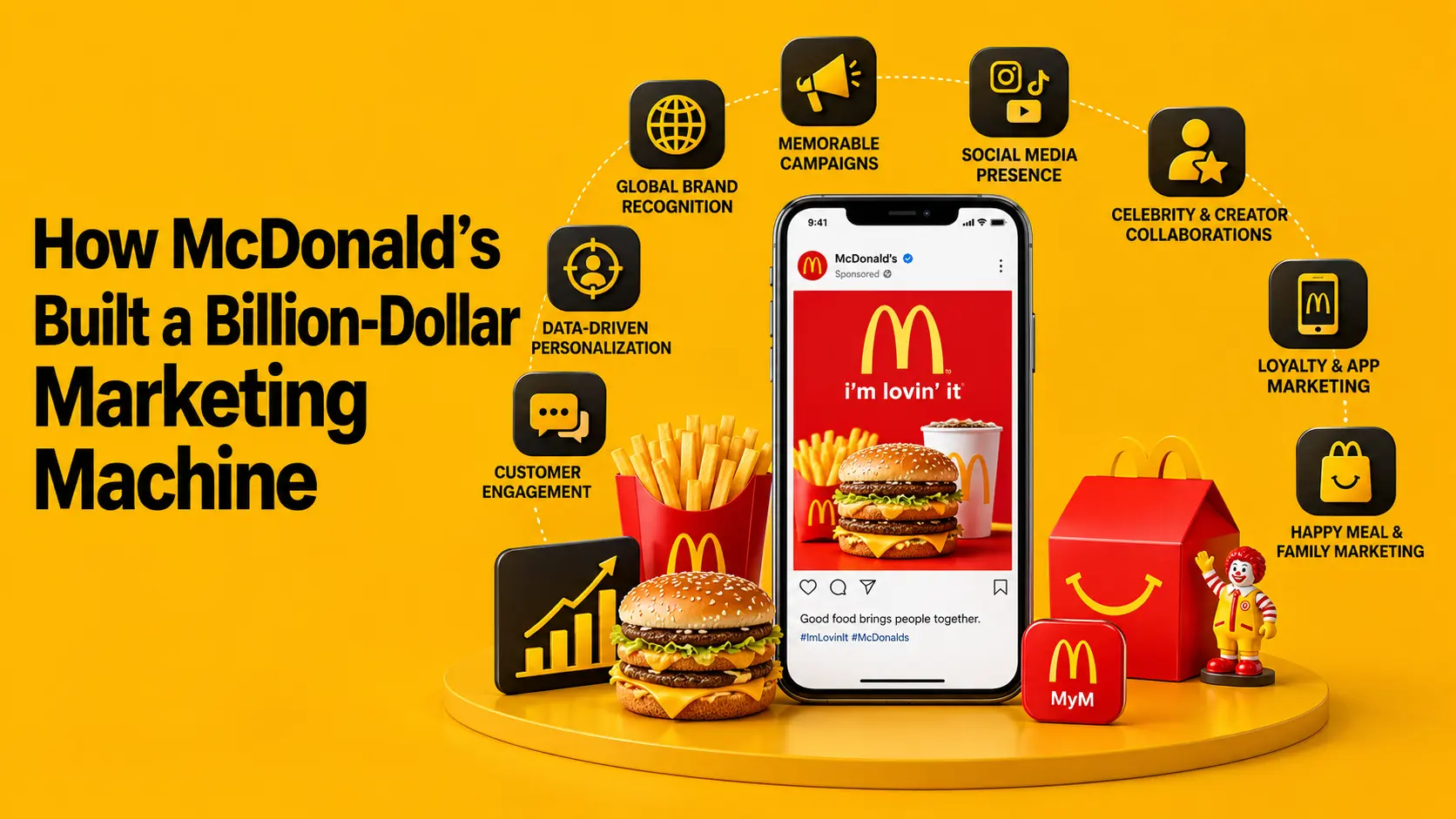
    How McDonald’s Built a Billion-Dollar Marketing Machine

    McDonald’s has spent decades convincing America that it is in the burger business. Guess what? It isn’t.

    At least, that’s not where its real marketing genius lies. Because if McDonald’s were simply selling burgers, it would have been crushed by thousands of better burgers.

    There is always a better burger.

    A local diner has one. Your favorite neighborhood joint has one. Some chef in Brooklyn has probably spent six months making a burger that costs $27 and comes with a paragraph explaining the emotional journey of the onion.

    And yet, when someone says “I’m hungry,” McDonald’s somehow still manages to show up in the conversation.

    That’s the part worth studying.

    McDonald’s didn’t build one of the world’s most recognizable brands by convincing everyone that its burger was the greatest burger ever made. It built the brand by making itself familiar, memorable, culturally relevant, and ridiculously easy to choose.

    The burger was the product. The feeling of knowing exactly what you were getting was the marketing. And once you see McDonald’s that way, its entire advertising history starts to look very different.

    McDonald’s Didn’t Sell Food. It Sold a Shortcut

    Think about the last time you saw the Golden Arches. You probably didn’t stop and think, ‘Ah yes, a multinational foodservice corporation operating a vast franchise network.’ You thought McDonald’s.

    That’s brand recognition doing its job. And McDonald’s has an absurd amount of it.

    Interbrand valued the McDonald’s brand at $53 billion in its 2025 Best Global Brands ranking, placing it ninth among the world’s most valuable brands. Interbrand also estimates that McDonald’s serves more than 69 million people every day worldwide.

    But here’s the interesting part…

    People don’t recognize McDonald’s because someone repeatedly told them that McDonald’s is a good company. They recognize it because McDonald’s has spent decades putting the same handful of visual and verbal assets into their heads.

    The arches, the red, the fries, the Big Mac, the “I’m lovin’ it” , the Happy Meal, the playground, the drive-thru, and of course the little yellow smile.

    It is basically a marketing textbook disguised as a fast-food chain.

    McDonald’s Didn’t Just Buy Land. It Bought Attention

    Here’s where the McDonald’s story gets a little sneaky.

    While everyone else was looking at the burger, Ray Kroc, the one who came into McDonald’s to sell milkshake machines, had an idea that changed the whole story of McDonald’s.

    The land.

    The popular version of the story says Kroc discovered that McDonald’s could make money by owning real estate and leasing restaurants to franchisees. That’s true. But for marketers, there’s a much more interesting question:

    What did owning the locations do for the brand? Quite a lot. Because McDonald’s didn’t just use real estate to make money; it used real estate to make the brand visible, accessible, and ridiculously difficult to forget.

    And that changes the way we should look at the Golden Arches.

    The Restaurant Was Part of the Advertisement

    Think about driving down a highway… You see the Golden Arches… you weren’t necessarily hungry five seconds ago, but now you’re thinking about fries.

    That’s marketing.

    But here’s the clever part: McDonald’s didn’t have to buy an advertising slot for that moment. The restaurant itself was doing the advertising.

    McDonald’s has historically invested heavily in the real estate and buildings behind its franchised restaurants. Under its conventional franchise model, McDonald’s generally owns or controls the property and leases it to franchisees, who operate the restaurant and pay rent and royalties. The company says it manages site evaluation, acquires the property, and constructs the building for these locations.

    So the physical restaurant isn’t just the place where the transaction happens.

    It is also a giant, permanent brand asset sitting exactly where McDonald’s wants customers to see it.

    A billboard says, “Remember us,” And a McDonald’s on your daily commute says, “I’m right here.” That’s a much better advertisement.

    Kroc Understood Something About Franchising

    The genius wasn’t simply putting other people in McDonald’s restaurants.

    It was creating a system where the franchisee could run the restaurant while McDonald’s retained control of the property and brand.

    The franchisee gets a business. McDonald’s gets rent, royalties, and a long-term presence in the location. And when the restaurant does well, everybody has a reason to keep it doing well.

    In 2024, McDonald’s reported $10.017 billion in rent revenue from franchised restaurants, compared with $5.606 billion in royalty revenue.

    That’s not pocket change from the couch cushions. It’s a significant part of the business.

    McDonald’s also reported approximately $6.4 billion in land within its property and equipment associated with franchise arrangements at the end of 2024.

    So while customers were debating whether McNuggets count as a proper meal, McDonald’s was sitting on a serious physical footprint. But the bigger marketing advantage was what that footprint allowed the brand to do.

    Own the Location, Own the Visibility

    Marketing is usually described as getting people to notice you. McDonald’s took that idea literally. If you control where your restaurants are located, you control where your brand appears.

    Busy intersection? Golden Arches.

    Highway exit? Golden Arches.

    Shopping center? Probably Golden Arches.

    Airport? You know the drill.

    The more strategically placed locations a brand has, the more frequently customers encounter it.

    And repeated exposure matters. You may not consciously think,
    “I have now been exposed to McDonald’s branding for the fourth time this week.” Your brain doesn’t work like a media planner. It simply starts thinking, ‘McDonald’s is everywhere.’ And “everywhere” creates familiarity.

    Convenience Became a Brand Message

    McDonald’s has always sold convenience. Fast food, drive-thrus, quick meals, and easy ordering… but convenience isn’t only about how fast the kitchen works.

    It’s also about how little effort it takes to find the restaurant.

    If there is a McDonald’s near your home, another near your office, and another beside the highway you take on weekends, the brand becomes part of your routine. That’s powerful.

    Because the strongest brands aren’t necessarily the ones customers spend the most time researching. They’re the ones customers can retrieve from memory in half a second. McDonald’s spent decades making sure the physical world reinforced that mental shortcut.

    The Franchisee Became Part of the Marketing Machine

    There’s another clever layer. McDonald’s could maintain a globally recognizable brand while giving local operators a stake in the business.

    The company says approximately 95% of McDonald’s restaurants worldwide are owned and operated by local business owners. That matters because a global brand still has to behave like a local business.

    The McDonald’s in Texas doesn’t necessarily need to speak to customers the same way as one in New York. And neither should have exactly the same marketing approach as one in India or Japan.

    The brand stays recognizable. The local execution adapts, and that balance is one of McDonald’s greatest marketing advantages: global recognition and local relevance.

    The Really Clever Part

    The marketing pays for the real estate, and the real estate reinforces the marketing. This is where the model becomes a beautiful little loop. McDonald’s invests in locations.

    The locations increase visibility and accessibility. While visibility creates familiarity, familiarity makes the brand easier to choose, and more customers create more sales. And that revenue supports the larger system that keeps expanding the brand.

    So the restaurant isn’t simply the end of the marketing funnel. It’s part of the funnel.

    McDonald’s Didn’t Just Put Restaurants Where People Were

    McDonald’s put the brand where people were. That’s the real lesson hidden inside the real-estate strategy.

    Most brands ask “How do we get our product into more places?” McDonald’s effectively asked, “How do we get our brand into more people’s routines?” That’s a much smarter question. Because once a brand becomes part of someone’s routine, advertising doesn’t have to work as hard.

    The Golden Arches aren’t just a logo. They’re a location strategy you can see from the highway. And that may be the most overlooked part of McDonald’s marketing machine: It didn’t just spend decades putting McDonald’s into people’s heads.

    It put McDonald’s in their path.

    The First Trick: Make the Brand Impossible to Misunderstand

    McDonald’s has never been particularly complicated, and that’s intentional. 

    A lot of brands want to sound intelligent. They create elaborate positioning statements, poetic taglines, and websites that require three scrolls just to figure out what they actually sell.

    McDonald’s went the other way. Golden arches, red box, Big Mac, and fries? Done. That simplicity matters because attention is scarce. You don’t need a customer to remember your entire brand strategy. You need them to remember you.

    McDonald’s has spent decades building what marketers today would call distinctive brand assets… recognizable elements that trigger the brand without needing the name spelled out.

    And the Golden Arches are probably the best example. You can remove the word McDonald’s and leave the arches. People still know. That’s not decoration; that’s marketing infrastructure.

    McDonald’s Gave Something More Powerful Than a Product

    It gave people a personality to associate with the product.

    Enter Ronald McDonald. Today, the character can look slightly surreal if you stare at him for too long. But the marketing idea was brilliant.

    McDonald’s didn’t want to be just a restaurant. It wanted to be a place associated with childhood, fun, and family.

    The Happy Meal did something similar. Instead of simply selling a children’s meal, McDonald’s wrapped the purchase in a little ritual:

    • Food
    • Toy
    • Box
    • Surprise
    • Collectible

    And, if you’re a parent, the possibility of getting through dinner without negotiating with a tiny dictator. That is clever product marketing. The product became an experience, and experiences are much easier to remember than ingredients.

    The “I’m Lovin’ It” Move Was Much Smarter Than It Sounds

    In 2003, McDonald’s launched its first global advertising campaign, “I’m Lovin’ It,” in Munich, Germany.

    And look at what the tagline doesn’t do. It doesn’t say “Our burgers are delicious.” It doesn’t say “We use the finest ingredients.” It doesn’t say “Come experience our world-class culinary excellence.” Thank God. 

    It simply says “I’m lovin’ it.”

    That’s not a food claim. It’s a feeling, and that distinction is huge. Because food claims invite comparison.

    If McDonald’s says we make the best burger, someone can respond, ‘No, you don’t.’ And then the internet gets involved.

    But if McDonald’s says I’m lovin’ it, there is nothing to fact-check. It’s emotional positioning. The brand isn’t asking you to agree that the burger is objectively superior. It’s asking you to associate McDonald’s with a good moment.

    Music helped make that association even stronger. The five-note musical hook became almost as recognizable as the slogan itself.

    And that is another lesson hiding in plain sight… The strongest brands don’t only create messages. They create memory triggers.

    McDonald’s Doesn’t Always Advertise the Product

    This is probably one of the biggest things marketers can learn from McDonald’s.

    Look at its most memorable advertising. You don’t always see a giant burger sitting in the middle of the screen while someone explains why the bun is amazing.

    Instead, you often see people hanging out, friends laughing, families eating, young people being young, music, humor, pop culture, a weirdly satisfying shot of fries.

    Then, somewhere in the middle of all that, the arches- that’s deliberate.

    McDonald’s often sells the occasion, not the food. Because the food is already understood. The marketing job is to create a reason to think about the brand. That’s a completely different objective.

    McDonald’s Got Very Good at Showing Up in Culture

    This is where the brand stopped behaving like a fast-food company and started behaving like a media brand.

    McDonald’s has repeatedly inserted itself into moments people are already talking about. Like sports, music, movies, gaming, fashion, internet culture, celebrity collaborations, memes, and social media, instead of constantly saying “Hey! Remember that we sell burgers!”

    It asks a more interesting question:n “What is America talking about right now, and how can McDonald’s participate?” That’s cultural marketing.

    And it works because people don’t want more advertising. They want brands that understand the conversation they’re already having. McDonald’s doesn’t need to invent every conversation. It just needs to find the ones where it belongs.

    The Travis Scott Meal Wasn’t Really About the Meal

    Take the 2020 Travis Scott collaboration. On paper, it was simple:e, a celebrity, a meal, and a promotion. But strategically, it was much more interesting.

    McDonald’s turned a menu order into a piece of culture. Suddenly, the purchase wasn’t just “I’ll have a Quarter Pounder.” It was “I’ll have the Travis Scott Meal.” That’s a completely different psychological frame. The product became a cultural object.

    And that is the power of collaboration marketing.

    You don’t always need to build attention from scratch. Sometimes you can borrow attention from somebody who already owns it. That’s a lesson brands across industries can steal. A collaboration isn’t valuable merely because two logos appear together.

    It’s valuable when one brand transfers some of its cultural relevance to the other.

    McDonald’s Started Turning Customers Into Participants

    For years, traditional advertising was basically:

    McDonald’s → message → customer.

    Then social media changed the game. Because now it became:

    McDonald’s → customer → internet → everyone else.

    That’s a much more powerful loop because customers don’t just consume McDonald’s marketing.

    They remix it, post it, joke about it, complain about it, and even turn it into memes. So basically the audience becomes part of the media engine. And McDonald’s has become exceptionally good at operating inside that environment.

    Localization: Same Brand, Different Conversation

    Here’s another piece of McDonald’s marketing strategy that deserves more attention.

    Global brands have a problem. If you standardize everything, you become boring. If you localize everything, you stop feeling like the same brand.

    McDonald’s has spent decades walking the line between the two.

    The Golden Arches stay. But the conversation, products, campaigns, and cultural references change. That’s why McDonald’s can feel unmistakably American in the U.S. while still creating products and campaigns that make sense in other markets.

    The company itself gives examples, including the McArabia in the Middle East, McAloo Tikki in India, and Teriyaki McBurgers in Japan.

    From a marketing perspective, that’s not simply “localization.” It’s “One global identity + thousands of local conversations.” And that is much harder to execute than simply translating an advertisement.

    The Brand Started Listening

    Here’s where McDonald’s marketing story gets really interesting.

    In 2015, McDonald’s USA announced a new brand vision that explicitly described a shift from “billions served” to “billions heard.” That sentence tells you a lot about how marketing was changing.

    For decades, brands talked, and customers listened. Then social media, mobile technology, and digital commerce flipped the relationship. Customers started talking back. So McDonald’s had to become more than a broadcaster. It had to become a listener.

    And eventually, listening became data.

    The App Quietly Changed the Marketing Game

    This might be one of McDonald’s least glamorous but most important marketing moves.

    The app.

    Because an advertisement can tell you that someone likes McDonald’s, an app can show you what they actually buy. That’s a massive difference.

    By the end of 2024, McDonald’s reported more than 175 million active loyalty users across 60 markets. Those loyalty members generated approximately $30 billion in systemwide sales in 2024, up 30% from the previous year.

    Now think about what that means from a marketing perspective. McDonald’s isn’t just hoping you remember it. It has a direct digital relationship with you. It can offer promotions, encourage repeat purchases, personalize offers, create loyalty, learn purchasing behavior, and turn a one-time customer into an identifiable relationship.

    The Golden Arches got people to recognize the brand. The app gives the brand a chance to recognize the customer. That’s a very different level of marketing.

    What Marketers Should Actually Steal From McDonald’s

    Not the arches. Please don’t put yellow arches on your SaaS website.

    The lesson is deeper.

    1. Stop trying to explain everything.

    If customers need a five-minute explanation to understand your brand, your marketing has work to do. McDonald’s can communicate its identity in a few seconds.

    That’s power.

    1. Build things people can remember.

    A tagline, a color, a sound, a visual, a recurring format, or a recognizable personality. The goal isn’t simply consistency.

    It’s recognizability.

    1. Sell the moment, not just the product.

    McDonald’s doesn’t need to explain what a burger is. It sells the reason you might want one right now. Your brand should ask the same question:

    What situation makes someone need us?

    1. Borrow culture instead of constantly creating it.

    You don’t need to manufacture every trend. Find the conversations where your brand naturally belongs.

    Then participate intelligently.

    1. Give people a reason to come back.

    The first purchase proves the product works. The second purchase starts becoming a habit.

    Loyalty programs, personalized offers, and digital experiences turn that habit into a relationship.

    1. Don’t confuse being loved with being remembered.

    This may be the biggest lesson of all. You don’t need every customer to tattoo your logo on their arm. You need them to remember you when the need appears.

    McDonald’s Didn’t Win the Burger War

    It won the memory war. McDonald’s built a brand that lives inside people’s everyday mental shortcuts.

    Interbrand’s $53 billion brand valuation is a useful reminder of just how valuable that mental real estate has become.

    And the company’s 2024 numbers show where that brand is heading next: more than 175 million active loyalty users, approximately $30 billion in loyalty-member sales, and more than $130 billion in global systemwide sales.

    The burger may get the credit. The marketing deserves the investigation because McDonald’s didn’t spend decades asking America to believe that it had the world’s best burger.

    It spent decades making sure that when America thought about fast, familiar, affordable, convenient food, McDonald’s was already sitting somewhere near the front of the list. And that might be the most important marketing lesson hidden behind those ‘Golden Arches.’

    You don’t always win by convincing people you’re the best. Sometimes, you win by becoming the brand they remember first.

  • Proven Link Building Strategies for SEO in 2026

    Proven Link Building Strategies for SEO in 2026

    Publishing great content is only half the SEO battle. If nobody credible is linking to that content, getting it in front of competitive searchers can be much harder.

    That is the problem many businesses run into. Even when they publish on a regular basis, optimize their pages, and target the right keywords, they still see other companies outranking them.

    The missing piece is often authority.

    That is where the right link building strategies can make a difference. However, good link building cannot mean building hundreds of irrelevant backlinks. Good link building means creating relevant and credible links to your site from sites that already have authority in your field.

    In this guide, we will discuss the different strategies and techniques of link building for U.S. based businesses in 2026.

    What Makes a Backlink Valuable?

    Before building links, it helps to understand what you’re actually trying to acquire.

    A backlink is simply a link from another website to yours. But two backlinks can have completely different value depending on where they come from and why they exist.

    Consider these two examples.

    A respected U.S. marketing publication references your original SEO research and links to the study.

    Another website you’ve never heard of publishes a page containing thousands of unrelated links, including yours.

    Both technically give you a backlink. They are not remotely the same opportunity. When evaluating a link, look at relevance, authority, editorial context, and potential referral traffic. Relevance is particularly important. 

    Links from websites covering your industry would make more sense than links from unrelated sites that might have high third-party authority. 

    Google also recommends using descriptive and relevant anchor text and stresses that links are meant to be helpful rather than being used for manipulative purposes. 

    This is why a proper link building strategy always prioritizes quality over quantity.

    1. Create Original Research That People Want to Reference

    One of the strongest link building techniques is also one of the most useful forms of content marketing: original research.

    Think about the articles you read online. When writers mention a statistic, they often link to the original study, report, or dataset.

    That is exactly the behavior you want to create.

    For example, a U.S. digital marketing agency could survey 1,000 small businesses about their 2026 marketing budgets and publish the results as:

    “2026 U.S. Small Business Marketing Budget Report.”

    Now you have something other websites can cite.

    A business publication might use one of the statistics in an article. A marketing consultant could reference the report in a presentation. Another agency might link to it from an industry guide.

    The asset earns links because it provides information that other publishers don’t already have.

    Useful formats include:

    • Original surveys
    • Industry benchmarks
    • First-party datasets
    • Annual reports
    • Consumer research
    • Market studies
    • Trend reports

    Semrush’s research on link building identifies original research and data-driven content as effective linkable assets because other publishers have a reason to reference them.

    The important part is originality. Rewriting statistics from five other websites isn’t original research.

    If you want links from research, give publishers something new to cite.

    1. Use Digital PR to Earn Editorial Links

    Traditional outreach often sounds like this:

    “Hi, we have an amazing website. Would you like to link to us?”

    Unsurprisingly, it doesn’t always work.

    Digital PR takes a different approach. Instead of asking publications to link to your website, you give them a reason to talk about your company, research, experts, or findings.

    For example, a cybersecurity company could release research about the most common security mistakes among U.S. small businesses.

    That creates a story.

    A journalist can report the findings. An industry publication can discuss the implications. A business website can reference the research.

    The backlink becomes part of the editorial coverage rather than the entire purpose of the conversation.

    Other PR-friendly assets include:

    • Original surveys
    • Industry predictions
    • Trend reports
    • Consumer studies
    • Proprietary data
    • Expert commentary
    • Annual rankings
    • Market comparisons

    This approach works particularly well when the research is timely and connected to something people are already discussing.

    Instead of asking, “Who will give us a backlink?”, ask:

    “What information could we publish that a journalist would actually want?”

    That question usually produces better campaigns.

    1. Find Competitor Backlink Gaps

    Your competitors have already done some of the research for you.

    If another company consistently ranks above you, examine its backlink profile and look for websites linking to them but not to you.

    Suppose three competitors all have links from the same industry publication.

    That’s worth investigating.

    It implies that the website you are investigating already covers your business niche and is ready to mention your business.

    Pay attention to:

    • Industry publications
    • Resource pages
    • Business associations
    • Expert interviews
    • Industry roundups
    • Research citations
    • Guest contributions
    • Partner pages

    It does not mean that you need to try to get all the backlinks from your competitors’ list. Some of them might be irrelevant, expired, or simply low-quality backlinks. Try to look at the patterns.

    When several competitors have a backlink from one reliable website, it might be a true link opportunity.

    Such an approach will help you become more targeted when sending out link requests since you start from the websites that are interested in your niche.

    1. Reclaim Unlinked Brand Mentions

    Sometimes another website has already talked about your company but forgot to link to you.

    That’s one of the easiest link opportunities to overlook.

    Imagine a publication writes “Xparro recently published a report on SEO trends.” The brand is mentioned, but there is no hyperlink.

    You can reach out to the publisher and politely ask whether they would consider linking the mention to the original report or relevant company page.

    The conversation is much easier because the publisher has already decided that your brand is worth mentioning.

    The same principle applies to links pointing to outdated URLs.

    A website may still link to an old article that has been moved, deleted, or replaced. If the old URL now returns a 404, you can either redirect it to a highly relevant replacement page or contact the publisher and suggest the correct URL.

    This is known as link reclamation. It isn’t glamorous. But SEO doesn’t always need to be glamorous. Sometimes the best backlink opportunity is simply one you already earned and forgot to maintain.

    1. Use Broken Link Building

    Broken link building works because you’re solving a problem for another website.

    First, you need to find websites that have relevant pages with broken external links.

    For instance, let’s take an industry website that has a resource page with a dead link to SEO research conducted long ago.

    If you happen to know about your company’s recent SEO research on the same topic, then you should contact the owner of the website and suggest replacing the broken link.

    The crucial point here is relevancy. It’s not enough to simply write an article on a certain topic just because you’ve found a broken link.

    The new resource must be as useful as the previous one.

    An effective outreach email could look like this:

    “I noticed that the research link on your website in the SEO resources section is leading to a 404 page. I’ve recently conducted updated research on the same topic. Maybe you will find it useful to replace the broken resource with ours.”

    This is much better than saying, “Please, link us on your site.” You’re identifying a problem and offering a solution.

    1. Build Linkable Assets, Not Just Blog Posts

    Not every article you publish needs to attract backlinks.

    But if link acquisition is one of your goals, some content should be deliberately designed to earn citations.

    A linkable asset gives another website a reason to reference your page.

    That could be:

    • An original statistics page
    • A calculator
    • A research report
    • A downloadable template
    • An industry database
    • A detailed benchmark
    • An interactive tool
    • A comprehensive resource

    For example, an SEO agency could create a free SEO ROI calculator for U.S. businesses.

    A business owner might use it, a marketing consultant might recommend it, or a publication writing about SEO budgets might link to it.

    The asset works because it provides something useful beyond another 1,500-word article.

    Before creating an asset, ask one simple question: “Why would another website link to this?” If you don’t have a good answer, the asset probably needs more originality or utility.

    1. Contribute Expert Content to Relevant Publications

    Guest posting can still be useful when it is approached as an expert contribution, rather than a backlink manufacturing system.

    Google has warned against large-scale article campaigns created primarily to manipulate rankings through links.

    That doesn’t mean contributing an article to an industry publication is automatically a problem.

    The difference is whether you’re providing genuine value. A cybersecurity executive could explain how small businesses should respond to ransomware risks. A SaaS founder could discuss lessons from reducing customer acquisition costs.

    An SEO strategist could explain what businesses should actually do after a major search update.

    These are useful contributions because they come from experience and expertise.

    Choose publications based on:

    • Audience relevance
    • Editorial quality
    • Industry reputation
    • Organic visibility
    • Topic relevance

    Don’t select websites simply because a third-party tool gives them a high Domain Rating. Third-party metrics are useful for prospecting, but they aren’t Google ranking factors.

    And don’t force exact-match anchor text into every contribution.

    Natural, descriptive anchor text is much more appropriate. Google specifically recommends concise and relevant anchor text rather than keyword stuffing.

    1. Turn Expertise Into Journalist Links

    Journalists regularly need credible sources.

    They need someone who can explain a new development, interpret data, provide an expert opinion, or comment on an industry trend.

    That creates another link-building opportunity.

    If your company has genuine subject-matter experts, make them accessible.

    For example, if Google introduces a significant search change, an experienced SEO professional can provide commentary about what businesses should watch.

    If a new AI technology changes advertising, a marketing strategist can explain its practical implications.

    When journalists use that expertise, the resulting article may include the expert’s name, company, website, or supporting research.

    The value goes beyond the backlink. You’re building brand authority, expert visibility, and relationships with publishers at the same time. This is one reason link building and digital PR increasingly overlap.

    1. Strengthen Internal Links After Earning External Links

    External backlinks bring authority into your website. And internal links are needed to establish a connection between the authority and other pages.

    Assume that some marketing magazine links to your guide on SEO strategy.

    In this case, your guide is supposed to link users to other pages of your website, like service pages, research, etc.

    Google suggests linking the most important pages through other relevant pages with descriptive anchor text. But this does not imply linking every page. It implies having a structured website.

    If your pages that are valuable from a commercial point of view are disconnected from the other pages of your website, it creates problems both for visitors and for the search engines.

    So whenever you earn an important backlink, review the page receiving it.

    Ask which related pages this page should naturally link to. That small step can make your broader link building strategy more effective.

    How to Build a Link Building Plan

    A successful link-building plan should be based on your website’s actual competitive position.

    Start with a backlink audit.

    Identify your:

    • Referring domains
    • Best backlinks
    • Unlinked backlinks
    • Broken backlinks
    • Most linked pages
    • Anchor texts

    Conduct a competitor gap analysis by looking at your competitors’ websites. Find out what websites are linking to your competitors but not to you.

    From here, create categories of prospects including:

    • Editorial opportunities – Media and industry publications.
    • PR opportunities – Journalists and media sites.
    • Resource opportunities – Resource pages, guide pages, and industry lists.
    • Reclamation opportunities – Unlinked mentions and lost links.
    • Content opportunities – Websites that could cite your research, tools, and reports.

    This will provide your team with a process rather than a spreadsheet full of websites. Now it is possible to develop campaigns using different tactics on a monthly basis.

    One month could involve research and PR; the next month could involve link reclamation and broken link building, etc.

    How to Measure Link Building Success

    Don’t judge a campaign solely by the number of backlinks acquired.

    A campaign that produces 200 irrelevant links isn’t necessarily better than one that earns 15 highly relevant editorial links.

    Track metrics such as:

    • New referring domains
    • Relevant referring domains
    • Editorial placements
    • Links to priority pages
    • Referral traffic
    • Ranking changes
    • Organic traffic
    • Assisted conversions
    • Organic leads

    You should also look at the quality of the websites linking to you.

    If your campaign is consistently earning links from websites that have genuine audiences, strong editorial standards, and relevance to your industry, you’re building something valuable.

    If the report is full of strange websites you’ve never heard of, it’s time to ask some uncomfortable questions.

    Link Building Strategies to Avoid

    Some tactics can create more problems than opportunities. Avoid buying links specifically to manipulate search rankings. Google classifies this as link spam.

    Be cautious with:

    • Automated backlink software
    • Mass directory submissions
    • Link farms
    • Private blog networks
    • Excessive reciprocal links
    • Comment spam
    • Irrelevant guest posts
    • Keyword-stuffed anchor text
    • Large-scale low-quality link campaigns

    Google also identifies automated link creation and excessive link exchanges among practices that can violate its spam policies.

    And if someone promises thousands of backlinks overnight, remember that a large backlink number isn’t the same thing as authority.

    Final Takeaway

    The best link building strategies don’t begin with the question, “How many backlinks can we get?” They begin with “What can we create that another credible website would genuinely want to reference?”

    That could be original research, a useful tool, expert insight, proprietary data, or a genuinely valuable resource.

    From there, competitor research, digital PR, broken-link building, link reclamation, expert outreach, and targeted content contributions can help turn those assets into real authority.

    The strongest link building strategy is ultimately a combination of good content, smart prospecting, relevant outreach, and genuine relationships.

    Don’t chase links just because they’re available. Chase the links that make sense. Because one relevant editorial backlink from a trusted website can be far more valuable than a spreadsheet full of links nobody would ever click.

  • How Much Do SEO Prices Really Cost in 2026?

    How Much Do SEO Prices Really Cost in 2026?

    SEO pricing can feel like someone threw numbers at a wall and called it a strategy.

    One SEO agency quotes $800 a month. Another asks for $3,000. Someone else promises “guaranteed Google rankings” for $299.

    So, how much should you actually spend on SEO in 2026?

    For most U.S. businesses, that largely depends on the level of competition, size of the website, technical difficulty, content needs, authority and, most importantly, the value of your customers who can be brought in via SEO.

    SEO Prices in 2026: Quick Overview

    There is no official SEO price list, but there are industry averages which give good guidelines.

    According to a study conducted by Ahrefs on 439 SEO companies, the average monthly cost for SEO retainer services was $2,917 while the average hourly cost was about $111. In addition, the most used pricing strategy among SEO providers was monthly retainers.

    For U.S. businesses, practical monthly budget ranges look roughly like this:

    Monthly SEO BudgetBest Suited For
    $500 – $1,000Small local businesses and basic SEO
    $1,000 – $2,500Small businesses and niche markets
    $2,500 – $5,000Competitive local, B2B, e-commerce and regional SEO
    $5,000 – $10,000Competitive national markets
    $10,000+Enterprise SEO and highly competitive industries

    These are planning ranges, not fixed rates. A good SEO quote should be based on the amount and complexity of work required… not an arbitrary package labeled “Gold.”

    What Determines SEO Prices?

    Why can two companies get completely different quotes for SEO?

    Because SEO is not one task.

    It includes technical optimization, writing of content, researching keywords, digital PR, link building, analyzing, conversion optimization and experimenting.

    1. Website Size

    A 20-page local business website doesn’t require the same SEO resources as a 20,000-page e-commerce store.

    Large websites may require:

    • Crawl-budget analysis
    • Indexation management
    • Canonicalization
    • Internal-link optimization
    • Faceted navigation control
    • XML sitemap management
    • JavaScript rendering analysis
    • Content pruning
    • Template optimization

    Google says crawl-budget optimization becomes particularly relevant for very large sites, including sites with more than 1 million unique pages or large websites with frequently changing content.

    In other words, if your website has 50 pages, you probably don’t need an enterprise crawl-budget war room.

    1. Keyword Competition

    Ranking for “dentist in Austin” isn’t the same game as ranking for “best CRM software.”

    Competitive keywords demand better:

    • Relevance
    • Content Quality
    • Backlink Profiles
    • Technical Basis
    • Internal Linking
    • Brand Signals

    SEO prices therefore need to consider the level of competition, rather than the number of keywords in a package.

    1. Website Health

    Before making 50 new pages for your website, you first need to find out whether Google is able to crawl and index all existing pages.

    Technical SEO considerations may include:

    • Robots.txt files
    • XML Sitemap
    • Canonical Tags
    • HTTP Status Codes
    • Duplicate Content
    • JS Rendering
    • Core Web Vitals
    • Structured Data
    • Mobile Usability

    According to Google’s guidelines for technical SEO, Googlebot must be able to access pages, pages need to give the right HTTP response code, and pages need to have indexable content to be indexed.

    Sometimes the highest-ROI SEO work isn’t publishing another blog. It’s fixing the thing preventing Google from understanding the pages you already built.

    How Much Does SEO Cost Per Month in 2026?

    Let’s break the pricing down into realistic budget levels.

    $500 – $1,000 Per Month

    This is an entry-level SEO budget.

    It can work for a small local business with a limited geographic market and relatively low competition.

    A campaign at this level may include:

    • Basic keyword research
    • On-page optimization
    • Google Business Profile support
    • Basic technical recommendations
    • Metadata optimization
    • Limited content optimization
    • Monthly reporting

    What it probably won’t support is an aggressive national campaign involving content production, digital PR, technical development, and substantial link acquisition.

    If somebody promises to take a brand-new website from zero to dominating competitive national keywords for $500 a month, raise an eyebrow.

    Maybe both.

    $1,000 – $2,500 Per Month

    For many small U.S. businesses, this is a more realistic starting point.

    A campaign may include:

    • Technical SEO
    • Keyword mapping
    • Service-page optimization
    • Content strategy
    • Local SEO
    • Internal linking
    • Competitor analysis
    • Content creation
    • Link-building
    • Performance reporting

    This range can work well for:

    • Local service businesses
    • Professional services
    • Small B2B companies
    • Niche e-commerce brands
    • Regional businesses

    The key is prioritization. You don’t need 100 SEO tasks. You need the right 10 tasks executed consistently.

    $2,500 – $5,000 Per Month

    This is the point where the SEO firm may be able to handle several work streams at once:

    Technical SEO + Content + Link Building + Digital PR + CRO + Analytics

    The budget would work well for:

    • Competitive local markets
    • SaaS businesses
    • B2B businesses
    • E-commerce companies
    • Regional businesses
    • High-end professional services firms

    This will not only optimize your current pages but grow your search footprint as well.

    $5,000 – $10,000+ Per Month

    This is generally appropriate for businesses targeting highly competitive markets.

    The SEO program may include:

    • Large-scale content production
    • Technical SEO
    • Digital PR
    • Editorial link acquisition
    • International SEO
    • Programmatic SEO
    • Conversion rate optimization
    • Content refreshes
    • Competitor intelligence
    • Advanced analytics

    At this point, SEO is no longer “something marketing does once a month.” It’s a serious acquisition channel.

    How Much Should You Spend on SEO?

    Here’s the better way to calculate your SEO budget.

    Don’t start with “What does everyone else spend?” Start with “What is one customer worth to my business?”

    Suppose your average customer generates $2,000 in lifetime gross profit.

    If SEO brings you five additional customers per month:

    5 × $2,000 = $10,000

    A $2,000 monthly SEO investment could therefore make economic sense.

    Now imagine your average customer is worth only $100.

    A $5,000 monthly SEO retainer becomes much harder to justify.

    This is why SEO budgets should be tied to customer economics, not arbitrary industry averages.

    How Much Does SEO Optimization Cost?

    “SEO optimization” is an incredibly broad term. Optimizing one landing page is very different from optimizing an entire website.

    On-Page SEO

    This can include:

    • Title tags
    • Meta descriptions
    • Heading structure
    • Search intent alignment
    • Keyword targeting
    • Content structure
    • Internal links
    • Image optimization
    • URLs
    • Entity coverage

    Technical SEO

    This can involve:

    • Crawlability
    • Indexability
    • Canonicalization
    • Redirects
    • XML sitemaps
    • Robots.txt
    • Structured data
    • JavaScript rendering
    • Core Web Vitals

    Content SEO

    A professional campaign may include:

    • Keyword mapping
    • Topic clusters
    • Content-gap analysis
    • Search-intent analysis
    • Content refreshes
    • Expert-reviewed content
    • Original research
    • Internal linking

    Google emphasizes creating helpful, reliable, people-first content rather than content created primarily to manipulate rankings.

    So, yes, you can technically publish 100 AI-generated articles. That doesn’t automatically make them useful.

    SEO Agency vs. Freelancer: Which Costs More?

    The vendor you choose will influence SEO costs.

    According to the study by Ahrefs, the average monthly cost was $3,209 for agencies and $1,349 for freelancers, calculated using the methodology of Ahrefs’ survey.

    If you need:

    • Keywords research
    • On-page optimization
    • Content optimization
    • Local SEO
    • Technical expertise

    Then you should consider hiring a freelancer.

    However, if you need:

    • Technical experts
    • Content writers
    • Developers
    • Links building
    • Digital PR
    • Analytics
    • Conversion rate optimization
    • Strategy management

    Then you should consider working with an SEO agency.

    The key question here is not “Agency or freelancer?” But rather “How many resources do I really need for my SEO campaign?”

    What Should an SEO Agency Include?

    Before signing a contract, get the scope in writing.

    Technical SEO

    Ask:

    • What technical issues will you fix?
    • How will you prioritize them?
    • Will developers implement changes?
    • How will indexation be monitored?

    Content

    Ask:

    • How many pages will be created?
    • How many existing pages will be optimized?
    • Who writes the content?
    • Is it reviewed by subject-matter experts?
    • How is search intent determined?

    Link Building

    Ask:

    • How are backlinks acquired?
    • Are they editorial?
    • What websites are targeted?
    • Are paid or private-network links involved?

    Reporting

    Don’t settle for “You gained 47 keywords!”  Rankings matter, but business outcomes matter more.

    Your SEO dashboard should ideally track:

    • Organic clicks
    • Organic impressions
    • Rankings
    • Qualified traffic
    • Leads
    • Conversion rate
    • Revenue
    • Cost per acquisition

    Google Search Console provides search-performance data that can help businesses evaluate how their pages perform in Google Search.

    Beware of Cheap SEO Packages

    Think of an SEO company that claims “Guaranteed top Google ranking for only $299 per month.” It is quite attractive, but highly suspicious.

    Cheap SEO could consist of:

    • Content generation
    • Inferior backlinks
    • Generic reports
    • Spam directories
    • Reused articles
    • Little technical effort

    Google advises against using techniques created just for manipulation of search results.

    The problem with bad SEO isn’t just wasted money. You may eventually have to pay someone else to clean it up. So the cheapest SEO package can become the most expensive one.

    How Long Does SEO Take to Produce Results?

    SEO is a long-term acquisition channel.

    Google states that changes can take anywhere from hours to several months to be reflected in Search and recommends waiting several weeks before evaluating the impact of changes.

    That means judging an SEO campaign after 30 days solely by rankings isn’t particularly useful.

    Track progress in stages.

    • Early Signals
    • Impressions
    • Indexed pages
    • Organic clicks
    • Keyword visibility
    • Crawl improvements
    • CTR
    • Business Signals
    • Leads
    • Qualified traffic
    • Sales
    • Revenue
    • Conversion rate
    • Customer acquisition cost

    The goal isn’t visibility → celebration → screenshot

    It’s visibility → Traffic → Leads → Customers → Revenue

    Much better dashboard.

    Is SEO Worth It for a Small Business?

    Yes, when search demand exists and the economics work.

    SEO can prove to be especially effective when:

    • Customers search before a purchase
    • You have a product with high profit margin
    • Lifetime customer value is high
    • The search need remains steady
    • Your niche has commercially viable keywords
    • Your site has the ability to convert organic visitors

    For example, an HVAC company that ranks for high-intent keywords such as “AC repair near me” can benefit from lead generation through SEO.

    But SEO isn’t automatically profitable because it’s SEO.

    It needs:

    Search demand + relevant traffic + conversion + acceptable acquisition cost.

    Miss one of those, and your beautiful ranking report may not pay the bills.

    A Simple SEO Budget Formula

    Here’s a practical formula businesses can use:

    Maximum SEO Budget = Target Incremental Customers × Target CAC

    Suppose you want:

    10 additional customers per month

    Your acceptable customer acquisition cost is:

    $400

    Then:

    10 × $400 = $4,000

    That gives you a theoretical $4,000 monthly acquisition budget.

    Now compare that against:

    • Search demand
    • Keyword competition
    • Current rankings
    • Conversion rate
    • Customer lifetime value
    • Required SEO resources

    This is a far better approach than selecting a package because it has the word “Premium” in the title.

    SEO Pricing Red Flags 

    Before hiring an SEO agency, watch for these warning signs.

    Guaranteed Rankings – No agency controls Google’s algorithm.

    No Clear Deliverables – “SEO optimization” isn’t a deliverable. Ask exactly what will be changed.

    Huge Backlink Numbers – 500 backlinks aren’t impressive if 490 come from websites nobody trusts.

    Rankings as the Only KPI – Rankings matter. Revenue matters more.

    No Analytics Access – Without proper measurement, proving ROI becomes unnecessarily difficult.

    Long Contracts With No Review

    SEO can require time, but you should still understand how performance will be evaluated.

    How to Choose the Right SEO Agency

    Before choosing an SEO agency, ask:

    • What technical issues did you find?
    • Which keywords have commercial value?
    • Who are my organic competitors?
    • What happens during the first 90 days?
    • How will content be created and reviewed?
    • How will backlinks be acquired?
    • Which KPIs will you report?
    • How will SEO connect to leads and revenue?
    • What assumptions support your forecast?
    • How will strategy change if results don’t meet expectations?

    A strong SEO agency won’t promise that Google will obey them.

    They’ll explain what they can influence, how they will measure it, and where your money is going.

    Final Takeaway: Don’t Buy SEO. Buy Business Growth.

    So, how much does SEO cost in 2026?

    For U.S. businesses, SEO can range from $500 to $10,000+ per month, depending on the scope, competition, website size, and growth objectives.

    For many small businesses, $1,000–$2,500 per month is a practical starting range. Competitive regional and national campaigns may require $2,500–$5,000+, while enterprise SEO can move well beyond $10,000 per month.

    But don’t choose your SEO budget because somebody on the internet declared an “industry average.”

    Choose it based on economics.

    Ask. Asking doesn’t cost you. Ask how much is one customer worth? How many customers can organic search realistically generate? What will it cost to acquire them?

    And most importantly ask if the SEO investment create more business value than it costs?

    That’s the question that turns SEO from another marketing expense into an actual growth investment.

    Frequently Asked Questions

    How much does SEO cost per month in 2026?

    The typical price for SEO ranges from $500 to $10,000+, depending on the level of complexity and competition of the campaign. Small businesses may begin their journey with $1,000-$2,500 monthly budgets, while competitive national campaigns require at least $2,500-$5,000 or even more.

    Ahrefs’ survey of 439 SEO providers reported an average monthly retainer of $2,917.

    Is SEO worth it for a small business?

    SEO can be considered beneficial if your customers actively use search in order to find your products or services, and the value they generate covers the investment you have made.

    Estimate the demand for search, competition, conversion rate, the value of the customer and the cost of his acquisition prior to making the decision.

    What should a small company budget for SEO?

    The small U.S business can begin its SEO journey with the $1,000-$2,500 monthly budget, depending on the nature of its market.

    Those who operate in less competitive local market may require less, but the company that competes nation-wide in highly competitive industry may require much more money.

    The best SEO budget isn’t necessarily the cheapest, or the biggest.

    It’s the one that gives your business enough resources to compete while maintaining a realistic path to positive ROI.

  • 10 Engine Optimization Strategies to Boost AI Visibility

    10 Engine Optimization Strategies to Boost AI Visibility

    You can rank #1 on Google and still be invisible to an AI-generated answer, and that is the new search problem.

    Google now uses AI Overviews and AI Mode, while websites like ChatGPT and Perplexity analyze information from various sources. According to Pew Research, users click on a regular search result if an AI-powered overview was shown only in 8% of cases, while without an AI-generated overview they do it 15%.

    Now it is not enough just to ask, “How do I rank?” Instead, you need to ask, “How do I become one of those sources which AI systems trust enough to mention or cite?”

    This is where engine optimization strategies, especially Generative Engine Optimization (GEO), play their role.

    What Is Generative Engine Optimization?

    Generative Engine Optimization is the optimization of your content, website, and brand online in such a way that artificial intelligence-based search engines find, comprehend, rate, and cite or recommend your business.

    In traditional SEO, you rank your website for specific keywords. But in GEO, your objective is to make your brand valuable for an AI-based search engine as an information source.

    For instance, your traditional SEO campaign would target “best SEO agency USA.” But the user in a generative search could ask, “What are the best SEO agencies in the USA for a SaaS company?”

    The additional meaning in the second question has context, intent, and restrictions.

    Your AI-driven response would provide a shortlist, reasons why companies are suitable, and credible sources of information for the recommendation.

    Your goal is to become that source. And no, not by adding “AI” in the headings of your website.

    SEO vs. GEO: What’s the Difference?

    SEO and GEO are very similar but differ in the type of optimization they offer.

    Traditional SEOGenerative SEO
    Optimize for rankingsOptimize for AI visibility
    Target keywordsTarget questions, entities, and intent
    Earn backlinksEarn authoritative mentions and citations
    Improve SERP CTRImprove mentions, citations, and referrals
    Optimize individual pagesBuild broader digital authority
    Measure rankings and trafficMeasure AI visibility and source inclusion

    You don’t need to choose between them. 

    Google’s official guidance says the SEO principles required for pages to succeed in traditional searches are still applicable for AI Overviews and AI Mode. These pages have to be crawlable, indexable, and eligible for regular Google searches.

    Consider GEO an extra layer of SEO.

    10 Engine Optimization Strategies for AI Visibility

    1. Build Content Around Search Questions

    Keyword optimization is not dead. However, keyword-oriented approaches are becoming less effective. Users ask more complex and long-tailed questions.

    According to the Pew Research Center, only 8% of one-word or two-word Google searches conducted in the center’s experiment led to an AI summary. However, 53% of the search queries consisting of 10 words or more generated an AI summary.

    This is an important insight for content marketers.

    Stop thinking about a single page on:

    • “CRM software” and create a content set of questions around:
    • What is CRM software?
    • How does CRM software work?
    • What features should be in CRM software for a small business?
    • What is the cost of CRM software?
    • What is the best CRM software for a company of 20 people?
    • CRM vs spreadsheets, which is better?
    • How to implement CRM software?
    • CRM implementation pitfalls.

    This will help you create a topic cluster rather than a graveyard of keywords.

    Practical strategy

    Map content by four intents:

    • Informational: What is CRM software?
    • Commercial: Best CRM software for small businesses
    • Comparative: HubSpot vs Salesforce
    • Transactional: CRM implementation services

    This gives AI systems more opportunities to encounter your expertise.

    1. Use Answer-First Content Structure

    AI systems need information they can retrieve and synthesize quickly.

    The reader will appreciate not having to sift through 2,000 words of an introductory discussion on “the rapidly evolving digital landscape” in order to find the answer.

    Start with the answer.

    Example:

    What is GEO?

    Generative Engine Optimization is the optimization of a brand’s digital footprint in such a way that AI search engines are able to find, understand, and cite the information of said brand.

    Expand from there.

    Utilize:

    • Short paragraphs
    • Concise H2s and H3s
    • Bullet points
    • Charts
    • Definitions
    • Processes
    • Examples
    • Statistics
    • FAQs

    Doing so will increase the readability of your content for both humans and computers.  The point is not to produce robotic content. The point is to provide clear information.

    1. Create Citation-Worthy Content

    Here’s one of the biggest differences between ordinary content and strong GEO content:

    Stop merely repeating data and start creating evidence.

    Let’s assume that your article states, “Mobile optimization increases conversions.” It is an ordinary piece of information.

    But how about this statement: “According to our analysis of 1,500 e-commerce sessions, mobile users showed 23% higher rates of abandonment on checkout pages with more than five form fields.” It is another case.

    Because it contains:

    • Original information 
    • Sample size
    • Measurable outcome
    • Context

    It is the type of information that can be used by other websites for citation.

    Build assets, such as:

    • Research reports
    • Industry surveys
    • Benchmark reports
    • Case studies
    • Datasets
    • Interviews with experts
    • Statistics
    • Technical tests
    • Price comparison

    Try to make the information that other websites would like to cite. Since every third-party citation strengthens your authority ecosystem.

    1. Strengthen Your Brand Entity

    AI systems need to understand what your company actually is.

    Your brand shouldn’t consist of five companies that exist all over the web.

    Google advises Organization Structured Data, which helps search engines recognize and disambiguate organizations. This may be information such as your name, URL, logo, contact details, and references to external entities by the property “sameAs”.

    Make sure your identity is consistent on:

    • Website
    • About Us page
    • Author pages
    • LinkedIn
    • Business directories
    • Reviews
    • Press release
    • Partner websites

    Clearly establish: Who you are → What you do → Who you serve → Where you operate → What you specialize in

    Example: Xparro is a digital marketing agency that provides SEO services, AI marketing, performance marketing, and digital growth for businesses that want to enter Western markets.

    That’s far clearer than: “We develop innovative digital solutions for modern businesses.”

    The second one sounds cool. But what is it really? Because it says almost nothing.

    1. Build Expert-Led Content

    Visibility is not just about websites; visibility is also about people and expertise. Create recognizable authors and experts in subject matters.

    Instead of “Written by Marketing Team”, use “Written by [Name], SEO Strategist with 8+ years of experience in technical SEO and enterprise search strategy.”

    Authors’ profiles may contain:

    • Professional experience
    • Credentials
    • Expertise
    • Publications
    • Relevant projects
    • Social profiles
    • Areas of specialization

    Identifying authors and creating connections to their relevant pages or profiles is also recommended by Google’s Article structured-data guidelines.

    And for technical, financial, healthcare, and other subjects, this is particularly important. People want to know who talks, so do search engines.

    1. Earn Third-Party Authority

    Your website isn’t your entire reputation.

    An AI system can collect data from many different corners of the web, from publishers, industry sites, reviews, forums, and many more authoritative sources.

    Research on generative search revealed that an AI system can have a preference for earned media and third-party authoritative sources over branded content.

    This means that the GEO strategy cannot just be limited to creating blog posts.

    Develop a digital PR strategy that will focus on:

    • Industry publications
    • Expert interviews
    • Podcasts
    • News coverage
    • Research collaborations
    • Expert roundups
    • Industry associations
    • Original reports
    • Thought leadership

    And no need to obsess over link building. Obsess over mentions instead. There is a huge difference between “Click here.” and “According to Xparro’s analysis of U.S. search trends…”

    Because the second one gives context to your authority.

    1. Build Semantically Complete Content

    A webpage targeting a single keyword does not imply completeness. If your target is the following keyword phrase: “how to increase website conversion rate.”

    A basic article might discuss:

    • CTAs
    • Headlines
    • Landing pages

    A stronger resource could cover:

    • Conversion rate formula
    • Traffic segmentation
    • User intent
    • Landing page UX
    • CTA placement
    • Form optimization
    • Mobile experience
    • Page speed
    • Trust signals
    • Social proof
    • A/B testing
    • Heatmaps
    • Session recordings
    • Funnel analysis
    • Statistical significance

    Now you’ve covered the information ecosystem around the topic.

    A good framework for content creation is:

    Definition → Why → How → Examples → Tools → Cost → Problems → Alternatives → Best practices → FAQs

    This helps demonstrate topical depth instead of superficial keyword coverage.

    1. Make Information Easy to Extract

    Important information shouldn’t be hidden inside walls of text.

    Format clear information blocks.

    Example:

    What is Generative SEO?

    Generative SEO refers to optimizing your content and digital assets so that your brand can have better visibility in AI-driven search and answer engines.

    Then add relevant details.

    Use:

    Key takeaway – GEO complements SEO. This means that search optimization goes beyond just rankings into AI-driven discovery.

    Quick comparison

    FactorSEOGEO
    Main goalRankingsAI visibility
    Primary outputSERP positionMention/citation
    Core signalsRelevance, links, technical SEORelevance, authority, evidence
    MeasurementRankings, CTR, trafficMentions, citations, referrals

    In this way, important information is presented clearly from the start. Plus, your readers will appreciate that.

    1. Don’t Ignore Technical SEO

    Before thinking of AI citations, ensure search engines are even able to crawl your website.

    As per Google, pages should be indexable and suitable for Google Search in order to qualify for being a candidate for citation in AI Overviews and AI Mode.

    Audit:

    • robots.txt
    • noindex directives
    • Canonical tags
    • XML sitemap
    • Internal links
    • HTTP status codes
    • JavaScript rendering
    • Mobile accessibility
    • Page speed
    • Duplicate pages
    • Orphan pages

    Remember:

    Crawled ≠ Indexed

    Indexed ≠ Ranked

    Ranked ≠ Cited

    Optimization is necessary at each step. If Googlebot isn’t even crawling your page, your GEO efforts are basically shouting in a vacuum.

    1. Measure AI Visibility

    This is where GEO becomes a marketing strategy, not another acronym.

    It’s not enough to ask, “Is ChatGPT talking about us?” Be systematic. Build an index of high-potential prompts.

    For example:

    • 100 informational prompts
    • 100 commercial prompts
    • 50 comparison prompts
    • 50 transactional prompts
    • Test them across relevant AI search platforms.

    Track:

    Brand Mention Rate – Prompts mentioning your brand / total prompts × 100

    Citation Rate – Responses citing your domain / total responses × 100

    Share of AI Visibility – Compare your appearance against competitors.

    BrandAI Mention RateCitation Rate
    Brand A34%22%
    Brand B27%18%
    Brand C19%13%
    Your Brand11%7%

    Now you have yourself a benchmark.

    And keep track of:

    • Mentions of your competitors
    • Sources of citations
    • Brand Sentiment
    • # of recommendations
    • Referral Traffic
    • Conversion rate

    AI-generated search results are not entirely static. Studies on AI Search visibility have shown variance in citation results when the same query is repeated.

    Therefore, don’t assess the success of GEO from one prompt test. Look for patterns, not anecdotes.

    How to Build a Generative SEO Strategy

    If you’re starting from scratch, use this five-step process.

    Step 1: Build a Prompt Map

    List the questions that consumers ask at each stage of the buyer’s journey.

    Map:

    Informational → Commercial → Comparison → Transactional

    Step 2: Audit Existing Content

    Rank your key pages for:

    • Search intent
    • Depth of coverage
    • Original evidence
    • Authoritative credentials
    • Clear entity descriptions
    • Content quality
    • Technical SEO
    • Content freshness

    Prioritize fixing the low-performing pages.

    Step 3: Build Topic Clusters

    Create pillar pages along with thorough subtopics.

    Example:

    Generative Engine Optimization

    → GEO vs SEO

    → AI search optimization

    → AI citations

    → ChatGPT search optimization

    → Google AI Overviews

    → GEO tools

    → AI visibility tracking

    → Generative SEO strategy

    This connects the cluster and forms more powerful topical relationships as well as ensures that key pages become more discoverable.

    Step 4: Build External Authority

    • Publish unique research.
    • Have experts quote your content.
    • Be featured in industry magazines.
    • Make guest appearances in interviews and podcasts.
    • Build digital PR opportunities related to your niche.

    The objective is to build your brand beyond the walls of your site.

    Step 5: Test, Measure and Improve

    Run your target prompts every month.

    Look for:

    • Where you’re appearing
    • Where competitors are appearing
    • Which sources AI systems cite
    • Which topics you’re missing
    • How your brand is described

    Then optimize based on the gaps.

    Common GEO Mistakes

    Publishing hundreds of generic AI articles. 

    Having more content does not necessarily mean more authority. Being unique is key.

    Optimizing only your website. 

    Your website is your base. It’s not all about your reputation.

    Stuffing prompts into articles

    There’s no need to write “What is the best SEO agency?” fifty times. This is not GEO. This is simply keyword stuffing but in disguise.

    Ignoring traditional SEO

    Google guidelines explicitly show that traditional SEO elements should be used for AI search features.

    Measuring one AI response

    AI outputs can vary. Measure repeated prompts and larger datasets.

    Final Takeaway

    The best engine optimization strategies don’t treat SEO and GEO as competing disciplines. Instead, they use technical SEO, search intent, topical authority, entity optimization, original research, digital PR, and AI visibility to enhance the search visibility of their website.

    SEO allows pages to be discovered and ranked, whereas generative SEO allows for their knowledge and expertise to be used in generating AI-powered answers. As the way people search is evolving, companies will need to go beyond search visibility and become credible, clear, quotable, and consistent throughout the web.

    It is not about producing more content and targeting all of the emerging AI platforms. The key is building an online presence that is reliable and understood by the search engines and the AI system itself. Be not just discovered, but be the resource that AI looks for.

  • FIFA 2026: Marketing Strategies That Changed the Game

    FIFA 2026: Marketing Strategies That Changed the Game

    As a business owner, if you think FIFA 2026 is just another World Cup, you’re looking at it from the wrong angle.

    For football fans, it’s the biggest sporting event on the planet. For marketers, it’s one of the greatest marketing case studies ever created.

    And here’s the interesting part.

    Most businesses assume that these opportunities are meant for only official sponsors such as Adidas, Coca-Cola, Visa, or Hyundai.

    The event may belong to FIFA, but the attention belongs to anyone capable of earning it. That’s why FIFA 2026 matters far beyond football.

    It’s becoming a live laboratory for digital marketing, creator collaborations, AI-driven personalization, real-time interaction, community-building, and immersive fan experiences. Each campaign from the tournament revealed how modern consumers discover brands, consume content, and make purchasing decisions.

    This guide will take a look at the marketing tactics behind this unique tournament, and most importantly, how any organization could adopt them to draw its audience.

    Understanding FIFA 2026: What Makes This Tournament Different?

    Every World Cup makes history. In Brazil 2014, the legacy was celebrating the culture of football; in Russia 2018, the tournament was expanding its geographical footprint, while in Qatar 2022, the World Cup changed the game in terms of experience for fans thanks to innovations.

    FIFA 2026 is different. The tournament is created by scale. Having 48 teams, 104 matches, 16 hosting cities, and three hosting countries, including Canada, Mexico, and the United States, FIFA 2026 became the largest FIFA World Cup in history.

    For marketers, such characteristics mean not only additional matches but also more dialogues, viral stories, creators’ content, and more chances to reach an audience.

    For the first time in history, the World Cup is held simultaneously in three countries, each providing their own market and audience. The USA boasts a huge media and advertising infrastructure, Mexico represents one of the most passionate football communities, and Canada, a rapidly growing one.

    This way, brands do not need to target just one country but are able to address different markets using the same global approach.

    The Audience Is No Longer Sitting in Front of a Television

    One of the biggest mistakes businesses make is imagining World Cup audiences the way they existed twenty years ago. Nowadays, World Cup fans engage with it on various screens simultaneously.

    While watching the game, they post memes, share reactions on X, browse Instagram, follow influencers on TikTok, track their fantasy football applications, and talk to friends. Indeed, 77% of sports fans use their second screens while viewing live sports.

    Every goal becomes not only a highlight but also the source for reaction videos, memes, podcasts, livestreaming, news articles, and user-generated content, which can keep audiences interested long after the final whistle blows.

    That’s why successful marketers today do not simply promote their products during the World Cup; they join the conversation.

    Football Has Become a Creator Economy

    Football used to belong to broadcasters. Today, creators shape how millions of fans experience the game. Some supporters never watch post-match television analysis.

    Instead, they look at YouTube breakdowns, TikTok reactions, Twitch watch-alongs, Instagram reels, or football podcasts.

    Creators aren’t competing with broadcasters anymore. They’re extending the conversation. That’s incredibly valuable for marketers.

    Instead of buying expensive television spots, brands can collaborate with niche creators whose audiences trust their opinions. The result often feels more authentic, and frequently delivers stronger engagement.

    So, FIFA understands this shift. The tournament isn’t simply broadcast anymore. It’s remixed, reacted to, discussed, clipped, and shared across thousands of independent communities.

    Behind all these creator-driven conversations lies something even more valuable than content: attention.

    Attention Is the Real Currency

    The World Cup isn’t valuable because football is popular. It’s valuable because attention has become scarce.

    Consumers scroll through thousands of marketing messages every day. Most disappear instantly. But when the World Cup begins, people willingly stop to watch. That level of voluntary attention is incredibly rare.

    Brands aren’t paying millions for logos inside stadiums. They’re paying to become part of conversations that people genuinely care about. That’s a completely different type of marketing.

    Instead of interrupting attention, they join it.

    Business Takeaway

    The biggest lesson from FIFA 2026 isn’t “go bigger.” It’s build bigger moments. Consumers don’t remember advertisements. They remember experiences.

    Businesses should stop asking, “How can we advertise more?” and start asking, “How can we create moments people actually want to talk about?” and that’s exactly what FIFA has mastered.

    Why FIFA Has Become One of the World’s Greatest Marketing Machines

    The FIFA World Cup doesn’t become the world’s biggest sporting event every four years by accident.

    Behind every sold-out stadium, viral celebration, and iconic campaign is one of the most sophisticated marketing ecosystems ever built.

    FIFA doesn’t market football. It markets anticipation.

    Long before the opening match, millions of fans are already emotionally invested. Qualification campaigns dominate headlines. Fixture announcements trend across social media. Jersey launches become fashion events. Host cities reveal countdown clocks. Sponsors release teaser campaigns months in advance.

    By the time the first whistle blows, the tournament already feels like a global celebration. This isn’t coincidence. It’s deliberate.

    FIFA Sells Emotion Before It Sells Football

    Most brands market products. FIFA markets feelings. Think about the advertisements you remember from past World Cups. Very few focus on tactics or statistics.

    Instead, they celebrate childhood dreams, national pride, family traditions, underdog stories, unity, hope, and resilience. The football simply becomes the stage where those emotions unfold.

    This approach works because people rarely buy based on information alone. They buy based on emotion and justify it with logic afterward. FIFA understands that better than almost any organization. 

    When billions of viewers watch a player celebrate a last-minute goal, they’re not just witnessing sport. They feel relief, happiness, amazement, sadness, and pride all at once.

    These emotional highs leave behind impressions with which advertisers will be able to relate, unlike any normal advertisement ever would.

    Scarcity Creates Demand

    Another reason FIFA’s marketing is so successful is that it incorporates the concept of scarcity into its strategies.

    In contrast to normal weekly sports events, the FIFA World Cup takes place only once every four years. The difference between the two generates anticipation. Scarcity increases perceived value. 

    The same principle applies to business. Brands that are constantly shouting often become background noise. Brands that know when to create anticipation often command far greater attention.

    Apple product launches, limited-edition sneaker drops, and invitation-only experiences all use this psychological principle.

    FIFA has been using it for decades.

    Community Is Stronger Than Advertising

    The World Cup isn’t consumed individually. It’s experienced collectively. Friends gather for watch parties, families wear team jerseys, and entire cities celebrate victories together.

    Even strangers become connected by a shared moment. This sense of belonging is incredibly difficult for businesses to manufacture, but it’s one of the strongest drivers of customer loyalty.

    The brands that succeed during FIFA don’t simply advertise to fans. They help fans celebrate together. That’s the difference between an audience and a community. And communities market themselves.

    Business Takeaway

    FIFA’s greatest competitive advantage isn’t football; it’s psychology.

    It creates anticipation before the event, emotion during the event, and memories that last long after the final whistle.

    Businesses that aim to achieve more effective marketing strategies must consider going beyond their product or promotional efforts. Campaigns should be designed to provide shared experiences, invite people to participate in them, and give them something worth discussing. 

    Attention can bring them customers, while emotion keeps them engaged. 

    That emotional connection didn’t happen by chance. It was powered by a digital marketing ecosystem designed to keep fans engaged before, during, and after every match.

    Digital Marketing Strategies Behind FIFA 2026

    The biggest myth about FIFA’s marketing is that it is based on billion-dollar sponsorships. Indeed, finances play an important role; however, they are not enough any longer.

    Today’s marketing works via attention, relevance, and participation. One creator can get more attention from people than one commercial shown on TV. The reaction of a fan can be more valuable than a professional advertisement. A smart message posted on social media can get millions of views in minutes.

    FIFA knows that the World Cup is no longer just a game people watch.

    Let’s examine the strategies that made FIFA 2026 one of the strongest marketing case studies in modern sports.

    1. Social-First Marketing: Winning Where Conversations Happen

    The World Cup is no longer seen; it is experienced, discussed, and shared in real time.

    Fans have flooded X, Instagram, TikTok, Reddit, and YouTube immediately following a goal being scored. While the match lasts 90 minutes, the discussion continues long after the final whistle blows.

    FIFA has realized this change and has been adapting accordingly, making its approach more and more real-time and social-first. During the 2022 FIFA World Cup, FIFA produced 3.6 billion video views, 811 million engagements, and 15 billion impressions on its social media channels, demonstrating that the way people consume the beautiful game has changed from traditional TV broadcasts to social media and bite-sized content.

    Leading brands followed the same approach. Throughout FIFA 2026, Adidas made sure to keep fans entertained with live streams of players arriving, training, going through the tunnel, partying in the locker room, and behind-the-scenes content. Instead of advertising its shoes, the company showed fans what goes on behind the lives of their favorite players, making social media an extension of the game-day experience.

    In contrast to Adidas, Coca-Cola chose to celebrate its campaign “Believing Is Magic,” where they highlighted friendship, collective wins, and unique fan experiences, not its products. Visa further enhanced the fan experience via contactless payment in the stadiums, fan engagement activities, and women’s football. The best FIFA 2026 campaigns became part of the tournament rather than interrupting it.

    Business Takeaway

    Do not use your social media pages as platforms for announcements. Consider them as a real-life conversation. Those brands that respond quickly, entertain the audience, and join trending discussions receive the most recognition.

    1. Short-Form Video Dominance: The New Highlight Reel

    FIFA 2026 is not just watched for full games, but rather seen through many short-form videos.

    Since there are 104 matches, each minute of action has a chance to become the talk of the day, and fans do not need to wait for highlights, as they can learn about what is happening on the football field using TikTok, Instagram Reels, YouTube Shorts, and even through creators’ posts.

    FIFA 2026 demonstrated how one sporting event could generate thousands of short-form videos from a single moment, giving brands a blueprint for content marketing.

    The scale of this shift was evident throughout FIFA 2026. YouTube has stated that Shorts are now receiving more than 200 billion views on a daily basis, which shows why more and more brands have been focusing on vertical videos in the competition. Nike followed suit and made sure that they released clips and other footage designed specifically for platforms like TikTok, Instagram Reels, and YouTube Shorts.

    Why This Matters

    Short-form videos suit the way audiences consume content nowadays: fast, mobile-first, and highly shareable. One moment in the game can turn into hundreds of videos posted by creators and brands, becoming viral within a couple of hours.

    Business Takeaway

    The tournament demonstrated the value of building a content engine instead of relying on a single campaign. Create videos out of every trending moment and become part of the discussion.

    1. The Creator Economy Is Changing Sports Marketing

    FIFA 2026 proved that football is no longer determined by what broadcasters do. The creators have played an important part in delivering content to fans in the form of match reactions, tactical analysis, podcasts, streams, and short-form content.

    The change has been evident even in FIFA’s approach. Having seen how effective CazéTV was in the context of Qatar 2022, FIFA extended its partnership with the platform and gave it the right to broadcast all 104 FIFA World Cup 2026 matches in Brazil, taking into account the rising influence of communities created by creators among younger fans.

    The industry’s rapid growth reflects this shift. According to Goldman Sachs, the creator economy is currently valued at more than $250 billion and is expected to surpass $480 billion in value by 2027, making creator partnerships significant in digital marketing.

    For brands, the key advantage of creators was the authenticity of their promotion. Unlike traditional campaigns where only celebrities were used to promote products, companies started working together with creators who have gained trust in certain football niches. In fact, 69% of people trust influencers’ recommendations rather than information provided by brands.

    Key Marketing Lesson

    FIFA 2026 once again proved that it is not only the number of followers that defines the influence of a person or a community. The most effective campaigns involved those creators who have earned the trust of their audience.

    1. User-Generated Content: Turning Fans into Marketers

    One of the biggest marketing wins of FIFA 2026 wasn’t created by FIFA. It was created by the fans. 

    The fans flooded social media feeds with footage from stadiums, selfies at matches, celebrations, watch parties, and travels. In effect, the tournament was a global stream of user-generated content. Each post meant growth for FIFA without the use of classic advertisements.

    The scope of involvement was highlighted through statistics. During the tournament, FIFA received 30 billion social media impressions, 1.7 billion interactions, and attracted 187 million unique visitors to FIFA.com, all of which happened thanks to the fan involvement and viral content.

    FIFA promoted participation through initiatives like #WeAre26, where supporters could showcase their experiences watching the game, celebrations, trips, and other fan rituals on various social platforms. The best responses would be posted on FIFA’s official page, making fans the ones creating digital content for the competition.

    This strategy works effectively because people tend to perceive authentic experiences as more credible. According to Stackla’s Consumer Content Report, consumers are 2.4 times more likely to believe user-generated content is authentic compared to branded content.

    Key Marketing Lesson

    FIFA 2026 demonstrated once again that the best marketing sometimes happens within the community itself. When people want to share their experience, they turn into brand ambassadors.

    Viewed individually, each strategy is powerful. Together, they explain why FIFA’s marketing ecosystem performs at such a massive scale.

    Key Lessons from FIFA’s Digital Playbook

    Across every strategy we’ve explored, one pattern becomes clear. FIFA isn’t trying to control the narrative. FIFA is giving conditions in which conversation can occur. It’s a small distinction.

    Social media lets the game go beyond the stadium. Video lets fans relive moments after the match ends. Content creators make global stories personal. Fan content multiplies the message.

    All these strategies make an ecosystem of marketing that doesn’t just depend on advertisements. It depends on participation.

    And this is possibly the most important lesson for any business to learn from FIFA 2026.

    The brand that succeeds in the coming decade won’t be the one shouting the loudest. They will be the brands with something meaningful to say.

    Community, Real-Time & Emotional Marketing: The Final Pieces of FIFA’s Marketing Playbook

    All the marketing strategies we have discussed until now have one thing in common.

    • They are dependent upon people.
    • They aren’t dependent on algorithms.
    • They aren’t dependent upon marketing budgets.
    • They aren’t dependent on celebrities either.
    • They are dependent on people.

    But capturing their attention is just the first step.

    Holding it and engaging them further is the difficult part. That’s where FIFA’s next three marketing strategies make all the difference.

    1. Community Marketing: Building a Movement, Not Just an Audience

    The FIFA World Cup has billions of viewers all over the world. But the real essence of the tournament does not lie in its popularity but in its communities.

    Enter any café while the World Cup is on, and you will see people cheering despite being strangers. Go to a sports bar, and even rival teams engage in tactical discussions like old friends.

    Open social media, and you will find thousands of fan communities engaged in debates about team formations, making predictions, creating memes, and celebrating wins.

    FIFA didn’t create all these communities. Football did. FIFA simply nurtures them. That’s an important distinction. The best brands don’t build communities from scratch. They create environments where communities can thrive.

    Official sponsors strengthened these communities by creating experiences beyond the stadium. Budweiser established fan parks and large-scale public viewings, allowing fans to celebrate among each other. Sponsorship initiatives ensured the participation of fans in engaging with the event. Rather than just branding their companies, they provided an environment where football communities could flourish.

    Community Is Marketing That Doesn’t Feel Like Marketing

    Traditional marketing asks customers to pay attention. Community marketing gives them a reason to stay. Instead of speaking to people, it encourages people to speak with each other.

    During FIFA tournaments, communities form around:

    • National teams
    • Local clubs
    • Fantasy football leagues
    • Creator fan bases
    • Watch parties
    • Football podcasts
    • Online forums
    • Discord servers
    • WhatsApp groups
    • Reddit communities

    Each one generates conversations that continue long after the final whistle. That’s free attention. And more importantly, it’s sustained attention.

    Why Communities Matter More Than Followers

    Many businesses obsess over follower counts. FIFA focuses on participation. There’s a huge difference. A page with ten million followers may receive little engagement.

    A community of ten thousand passionate fans can influence purchasing decisions every single day.

    Communities create:

    • Trust
    • Loyalty
    • Word-of-mouth referrals
    • Repeat engagement
    • User-generated content
    • Customer advocacy

    Those are outcomes advertising alone can’t buy.

    Business Takeaway

    Don’t ask, “How do we grow our followers?” Ask, “How do we bring customers together?”

    That could mean:

    • Exclusive customer groups
    • Events
    • Challenges
    • Loyalty communities
    • Facebook Groups
    • Discord servers
    • Networking meetups

    People rarely stay loyal to products. They stay loyal to communities.

    1. Real-Time Marketing: Winning the Moment

    The World Cup is unpredictable. That’s exactly why it’s a marketer’s dream. A last-minute goal. A shocking upset. An emotional celebration. A referee’s controversial decision.

    These aren’t just sporting moments. They’re marketing opportunities.

    Brands that respond quickly often receive enormous engagement, not because they spent more money, but because they joined the conversation while people were already paying attention.

    This is known as real-time marketing.

    The Internet Rewards Speed

    Imagine two brands. The first posts about a spectacular goal five minutes after it happens. The second publishes a beautifully designed campaign the next morning.

    Which one gets shared? Usually the first.

    Because relevance has an expiration date. The internet moves quickly. People want reactions while emotions are still fresh. That’s why many global brands now operate real-time content teams during major sporting events.

    Designers, copywriters, video editors, community managers, and data analysts all work together to create content within minutes.

    Oreo’s Famous Lesson Still Applies

    Although it wasn’t during the FIFA World Cup, Oreo’s iconic “You can still dunk in the dark” tweet during the 2013 Super Bowl remains one of the greatest examples of real-time marketing.

    The lesson wasn’t about cookies. It was about preparation. The brands that appear spontaneous are usually the most prepared. 

    FIFA sponsors operate the same way. They don’t wait for the tournament to begin before planning content. They prepare hundreds of creative scenarios in advance.

    Different versions, outcomes, players, and celebrations. When something happens, they publish immediately.

    Business Takeaway

    You don’t need a global event; you need awareness.

    Respond to:

    • Industry news
    • Customer achievements
    • Local events
    • Trending conversations
    • Cultural moments

    The faster your brand becomes part of relevant discussions, the more visible it becomes. Speed creates relevance and relevance creates attention.

    1. Emotional Storytelling: The Strategy Behind Every Memorable Campaign

    If someone asked you to remember your favorite World Cup advertisement, chances are you wouldn’t remember the product.

    You’d remember the feeling. That’s intentional. FIFA doesn’t sell football. Its partners don’t sell products; they sell emotions connected to football.

    Think about the themes dominating World Cup campaigns: a child dreaming of representing their country, a father watching football with his daughter, friends celebrating together, an underdog nation’s historic victory, or a player overcoming adversity.

    Very few advertisements focus on features, but almost all focus on feelings. Because emotions travel further than information.

    Emotion Makes Brands Memorable

    Psychologists have long shown that emotional experiences are remembered more vividly than purely factual ones. Marketing works the same way.

    Customers might forget:

    • Your discount.
    • Your product specifications.
    • Your slogan.

    But they’ll remember how your brand made them feel. That’s why Coca-Cola consistently focuses on togetherness, and that’s why Adidas celebrates ambition, and that’s why Visa highlights unforgettable experiences, because football simply becomes the emotional backdrop.

    This is why the largest partners of FIFA always started off with emotions before moving to the product. Adidas used its “You Got This” campaign to build self-confidence and perseverance, Nike used the Footballverse campaign to celebrate the culture of football, and Coca-Cola used emotions of being together and celebration in its campaign. In all these cases, football was the emotional background, and the product was an integral part of the story.

    Research by the Institute of Practitioners in Advertising (IPA) clearly shows that emotionally led campaigns perform better than rationally led campaigns in building brand effectiveness, making emotional storytelling one of the strongest drivers of lasting consumer loyalty.

    The Power of Shared Human Stories

    One reason FIFA resonates across cultures is that its stories are universal. Hope, failure, resilience, belonging, triumph, and heartbreak. These emotions don’t require translation.

    That’s why a fan in Argentina can celebrate alongside someone in Japan. Or someone in Nigeria can empathize with a player from Croatia.

    Great marketing works the same way. The story changes, but the emotions remain universal.

    Business Takeaway

    Before creating your next campaign, ask, “What emotion do we want people to remember?”

    Not, “What message do we want to deliver?”

    Emotion creates memory and memory creates loyalty.

    8. AI Turned Every Fan Experience into a Personal One

    AI-powered translations

    FIFA used AI to make content accessible in multiple languages, helping fans across different regions engage with the tournament more naturally.

    Personalized content

    Fans didn’t all receive the same content. Instead, platforms recommended:

    • Highlights
    • Goals
    • Favorite teams
    • Player content
    • Match recaps

    based on viewing behavior.

    AI-generated highlights

    Instead of watching an entire match, fans could instantly access

    • Goals
    • Saves
    • Key moments

    generated automatically.

    Chatbots

    Fans could instantly find

    • Fixtures
    • Tickets
    • Stadium information
    • Schedules

    without waiting for support.

    Business lesson

    The takeaway isn’t “Use AI.” It’s “Use AI to remove friction and deliver more relevant experiences.”

    Marketing Lessons Every Business Should Steal from FIFA 2026

    You don’t need FIFA’s budget to apply FIFA’s thinking. In fact, many of its most effective strategies have very little to do with money.

    FIFA 2026 highlighted ten marketing principles that businesses of any size can adopt.

    • Sell an experience, not a product – People purchase results and feelings before features.
    • Build anticipation – Campaigns become more exciting when people are looking forward to them.
    • Participate in conversations – Don’t always aim at initiating them.
    • Think mobile first – People discover brands through their phones.
    • Create moments worth sharing – Marketing becomes less expensive when customers share your story.
    • Invest in communities – Communities live longer than campaigns.
    • Collaborate with trusted creators – Credibility is more important than fame.
    • React quickly – Sometimes timing is more important than perfection.
    • Stay consistent – FIFA doesn’t change its identity every four years. It changes while staying the same. Brands should be the same.

    Final Thoughts: FIFA Is Teaching Businesses More Than Marketing

    FIFA 2026 wasn’t only one of the world’s largest sporting events. It was also one of the most significant case studies for marketers in the entire year.

    The event wasn’t only successful due to sponsorship. What really made it a great example is that it created experiences that people would want to watch, tell others about, share, and take part in.

    This is what makes a brand for any business. Brands aren’t just about promoting a product or a service; they’re about providing an experience.

    What FIFA 2026 showed us business owners is that while attention helps people get to know a brand, participation and emotions help them become loyal customers.
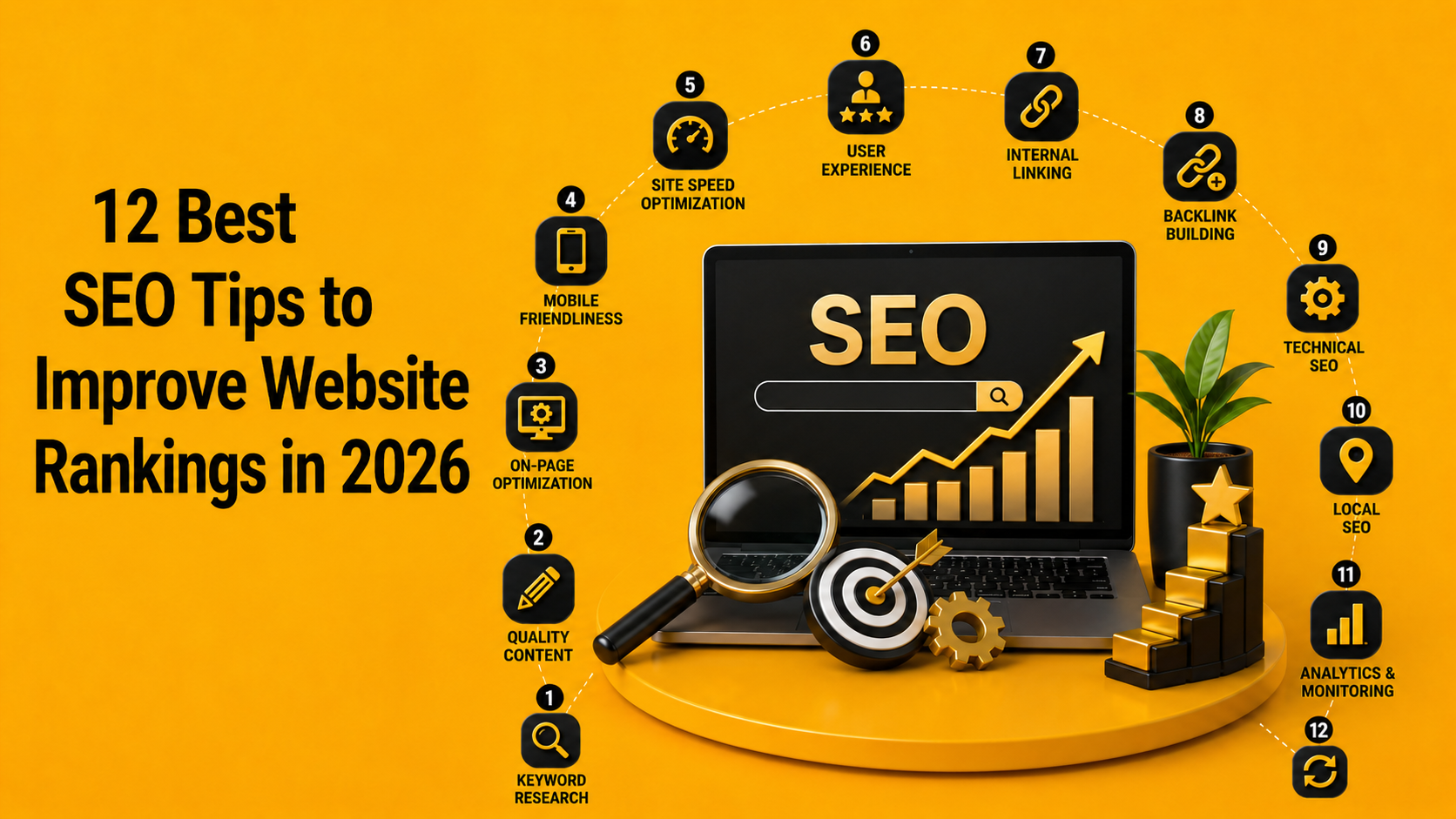
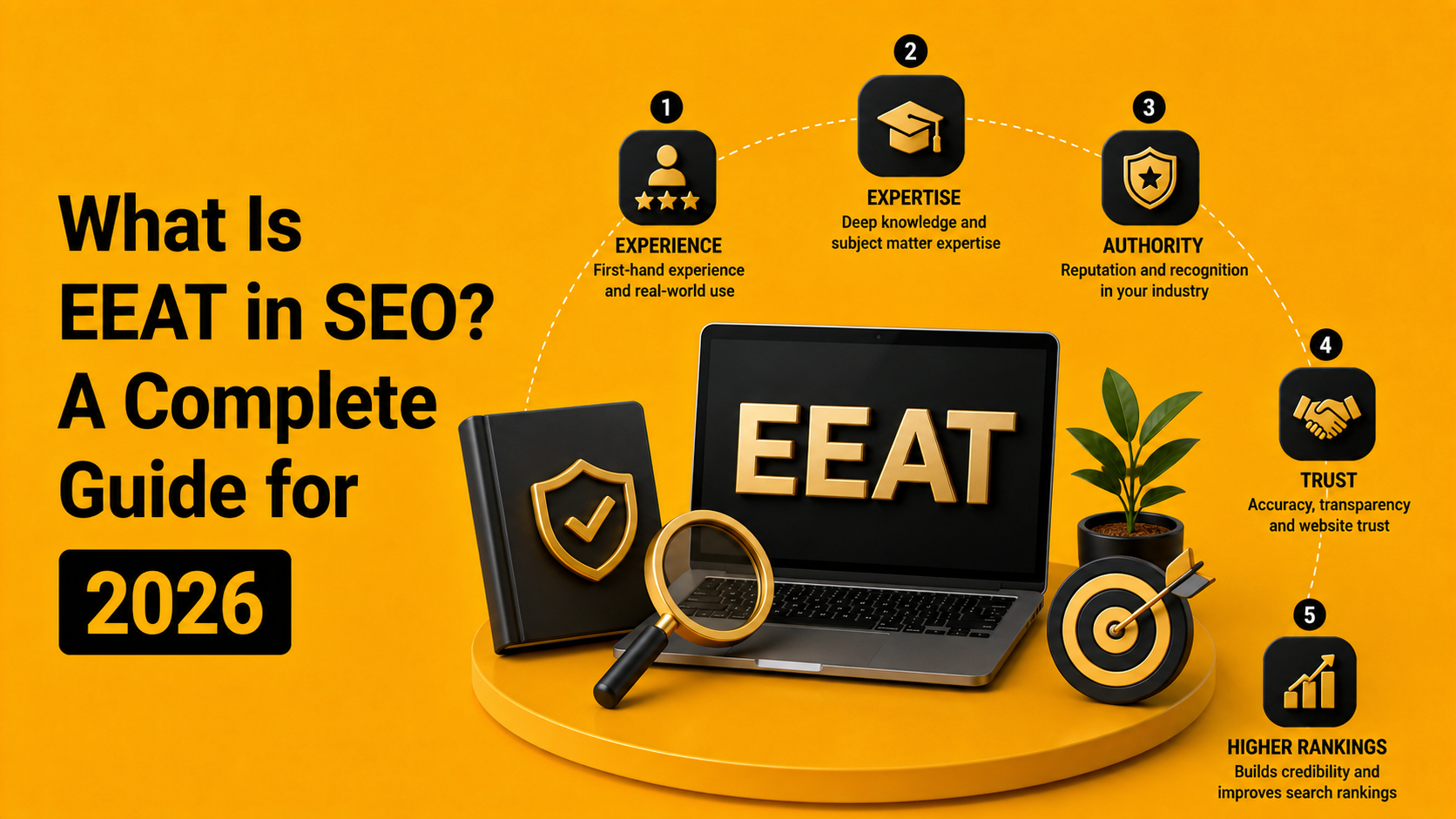
    • SEO Keyword Cannibalization: Causes & Fixes

      SEO Keyword Cannibalization: Causes & Fixes

      Your website might be competing against… itself. You invested months of effort writing SEO content. You chose important keywords and even created backlinks. You did everything right, but still, your ranking is not improving.

      One post ranks this week. Another one takes its place the next week. None makes it into the top three. Does that sound familiar? There could be many reasons behind it, and it might not be Google’s algorithm.

      It might be SEO keyword cannibalization.

      There are thousands of websites out there creating several pages for the same keyword intent. That doesn’t boost their SEO authority; rather, it dilutes it. Google finds it hard to determine which page deserves a higher ranking, backlinks lose their effectiveness, click-through rate falls, and organic traffic stops flowing.

      The worst thing is that most businesses have no idea it’s happening. If you’ve written a lot of content in the past months or even years, chances are you’ve already encountered this problem.

      Let’s solve it then.

      What Is Keyword Cannibalization in SEO?

      If you’ve ever wondered what keyword cannibalization is in SEO, here’s the simplest explanation.

      When you are creating more than one web page on the same website targeting the same keyword or search intent, you will face the problem of keyword cannibalization.

      Instead of providing Google with one option, you are giving them several.

      Google will have to choose:

      • Which page is more relevant?
      • Which page deserves backlinks?
      • Which page should appear in search results?

      As a result, it starts alternating between these pages or ranks them poorly.

      Think about sending three athletes from the same team in the qualifying round in the sport where only one can qualify.

      It is not going to increase your chances, but, on the contrary, will make your runners lose points to each other. That’s exactly what keyword cannibalization does.

      Consider an example of a digital marketing agency that has been publishing these blogs for over two years.

      • Complete SEO Guide
      • SEO for Beginners
      • SEO Basics
      • Learn SEO
      • Beginner’s Guide to SEO

      All articles target:

      • SEO guide
      • learn SEO
      • SEO basics
      • beginner SEO

      Content similarity reaches 80%. Thus, Google does not understand which of them is worth ranking on Page One.

      Because of that, one powerful page ranked #2. You now have five average pages ranking between #28 and #60. Nobody wins.

      Why Keyword Cannibalization Happens

      Most websites do not create duplicate content on purpose. This is a consequence when content grows.

      Reasons may vary:

      Publishing Without a Keyword Strategy

      Some businesses assign topics to individual writers without creating a keyword map.

      A few months later, another writer uses the same keyword without realizing that someone else is doing the same thing.

      Creating Content for Every Tiny Variation

      Individuals tend to consider these variations as unique topics:

      • Best CRM software
      • CRM software comparison
      • Top CRM platforms

      For Google, these keywords mean the same intent.

      Updating Old Content With New Articles

      Marketers publish another blog instead of optimizing an old one.

      Now there are two pages that compete.

      Location-Based Duplication

      There are many businesses that publish dozens of identical pages:

      • SEO Services Texas
      • SEO Services Houston
      • SEO Services Dallas

      Google will be challenged if the content is barely different.

      Poor Internal Communication

      SEO agencies, marketing departments, freelancers, and content writers all create content independently. 

      Without documentation, duplication becomes inevitable.

      How Does Keyword Cannibalization Affect SEO?

      A lot of people wonder, what is the effect of keyword cannibalization on SEO? It is much deeper than rankings.

      1. Google Gets Confused

      Search engines always seek one single answer.

      When several webpages meet the intent equally well, Google is confused. Instead of giving credit for authority, it begins by checking other websites.

      As a result, there is fluctuation.

      1. Link Equity Gets Split

      Consider the following example:

      Page A gets 25 links. Page B gets 18 links. Page C gets 12 links.

      None of these webpages will become authoritative individually; however, if all 55 links were pointed at one single webpage. There is a good chance that the page would rule.

      Link equity dilution is one of the most serious indirect costs associated with keyword cannibalization.

      1. Lower Click-Through Rates

      Google keeps alternating the pages from time to time.

      So, users will see various titles, various meta descriptions, and various URLs. As a result, CTR is reduced.

      1. Crawl Budget Gets Wasted

      There is a limited amount of crawl budget from Google.

      If there are several pages that are similar, then crawlers waste time crawling the same information rather than finding new, valuable pages.

      Large e-commerce sites tend to experience reduced efficiency when using duplicate keyword targeting.

      1. Rankings Become Unstable

      Ever seen rankings like this?

      Monday → Position 9

      Wednesday → Position 23

      Friday → Position 15

      Sunday → Position 31

      That may indicate cannibalization. Google continues to experiment with various pages.

      1. Conversions Drop

      Not all of the competing pages convert the same way.

      Sometimes Google shows:

      • an outdated blog
      • a thin article
      • an informational guide

      instead of your highly optimized service page. Traffic comes, but conversions don’t.

      Signs Your Website Has SEO Keyword Cannibalization

      There are several warning signs that appear before rankings collapse.

      Multiple URLs Ranking for One Keyword

      Type in Google:

      site:yourdomain.com “keyword”

      When you see several relevant pages, it’s time to dig deeper.

      Google Keeps Swapping URLs

      In Google Search Console, the same keyword begins to show various landing pages. It’s usually not a coincidence.

      Rankings Plateau

      Even after creating backlinks, enhancing content, and gaining authority, your ranking still doesn’t change.

      Organic Traffic Is Spread Across Similar Pages

      Traffic Generated Organically is Distributed Among Similar Web Pages

      Not one page = 20,000 visits, but five pages = 4,000 visits per page. 

      Overall, traffic is satisfactory. Authority of individual pages declines.

      How to Identify Keyword Cannibalization

      A professional SEO team uses multiple ways.

      Google Search Console

      Consider these elements:

      • Queries
      • Landing Pages
      • Average Position

      When one keyword redirects impressions to several pages, investigate further.

      Ahrefs

      Use Organic Keywords reports. Filter the keyword. Check how many pages are ranked for the keyword.

      Semrush

      The Position Tracking Cannibalization Report automatically recognizes URLs competing for the same positions.

      This method is among the fastest.

      Screaming Frog

      Export the following:

      • Titles
      • H1 Tag
      • URLs
      • Number of Words

      The keyword cannibalism will be detected immediately.

      Manual Keyword Mapping

      Make a table with the following columns:

      URLPrimary KeywordSearch IntentStatus
      /seo-guideSEO GuideInformationalOk
      /seo-basicsSEO GuideDuplicateMerge
      /learn-seoSEO GuideDuplicateRedirect

      Big agencies always have keyword maps before creating content.

      How to Fix Keyword Cannibalization in SEO

      So let’s solve the problem that everyone wants solved: How to solve keyword cannibalization in SEO?

      Merge Similar Content

      Imagine you have:

      • SEO Guide
      • Beginner SEO
      • SEO Tutorial

      And merge them into one single page. Then, do a redirection of the weaker pages. And it would lead to instant improvement in rankings.

      Use 301 Redirects

      If a duplicate page holds no unique content, make it redirect permanently. The 301 redirects pass all the link equity to the main page.

      Canonical Tags

      In case there is a need for having several pages…

      Like, for instance:

      • Options for printing in colors
      • Various product types

      Utilize canonical tags to show your preference.

      Differentiate Search Intent

      Two similar keywords are not necessarily looking for the same thing.

      Example:

      SEO pricing vs SEO services

      One is geared towards research. The other is geared towards purchase. Use the content differently.

      Enhance Internal Links

      Make sure that your internal links always go back to the same page. Do not use similar anchor text on competing pages.

      Internal linking can help Google find the topic relevance.

      Rewrite Overlapping Sections

      In some cases, the common content only makes up 40%.

      Revise:

      • Headers
      • Examples
      • FAQs
      • Target Audience
      • Use Cases

      Ensure the topical uniqueness of your content.

      Consolidate Thin Content

      Instead of 15 blogs of 700 words, consider three resources over 3,000 words.

      How to Avoid Keyword Cannibalization SEO Problems

      Figuring out how to avoid keyword cannibalization SEO problems will be much easier than solving them.

      Build a Keyword Map

      Use:

      One keyword, one URL, one intent, always check the map before publishing.

      Research Existing Content First

      Do not start writing anything until you search your website.

      You may find an article about it. Make changes to it.

      Focus on Search Intent

      Keywords can be similar, but intent is different.

      Ask:

      What does the user want to do?

      • Learn something?
      • Compare?
      • Buy?
      • Hire?
      • Download?

      The intent defines whether the page should be created or not.

      Create Topic Clusters

      Create not a bunch of isolated blogs, but rather create pillar pages with cluster articles.

      For example:

      • Pillar
      • SEO guide

      Supporting Content

      • Technical SEO
      • Local SEO
      • On-page SEO
      • Schema markup
      • Link building

      Each page serves a unique purpose.

      Perform Quarterly SEO Audits

      Check:

      • Rankings
      • Duplicate topics
      • Outdated blogs
      • Thin content
      • Internal links

      Keyword cannibalization problems usually develop over time.

      Keyword Cannibalization vs Duplicate Content

      These concepts are frequently misunderstood.

      Yet they’re separate.

      Keyword CannibalizationDuplicate Content
      Multiple pages rank for the same keywordContent is the same on multiple pages
      Can have unique contentOften has the exact content
      Affects rankingsCauses indexing issues
      Resolved by strategyResolved by canonicals/redirects

      One can exist without the other.

      It’s possible to have keyword cannibalization without duplicate content and duplicate content without keyword cannibalization.

      Does Google Penalize Keyword Cannibalization?

      No. Google doesn’t manually penalize keyword cannibalization. What it does is, it has trouble figuring out which page is the best.

      which results in:

      • Ranking fluctuations
      • Lowered authority
      • Weakened backlinks
      • Decreased exposure

      Effectively a penalty without actually being one.

      A Simple Framework Used by SEO Agencies

      Professional SEO agencies normally do this:

      Step 1

      Find competing URLs.

      ↓

      Step 2

      Determine search intent.

      ↓

      Step 3

      Choose one primary page.

      ↓

      Step 4

      Combine or redirect weaker pages.

      ↓

      Step 5

      Update internal links.

      ↓

      Step 6

      Refresh content.

      ↓

      Step 7

      Monitor 6-8 weeks ranking.

      This process does not cause any trouble to your website’s authority.

      Common Mistakes Businesses Make

      Even the most experienced marketers make these mistakes:

      • Publishing a new blog post rather than revising an old one.
      • Trying to target all keyword variations on a new page.
      • Ignoring search intent due to differences in keywords.
      • Allowing different teams to develop similar content.
      • Failing to change internal links in case of page redirections.
      • Developing city pages with the same content.
      • Focusing on content volume and not on its results.

      Not making such mistakes may save you from months of SEO problems.

      Final Thoughts

      SEO keyword cannibalization is one of the biggest overlooked reasons why sites fail to achieve their potential rankings.

      It is not usually a result of bad quality content; rather, it is a consequence of an excessive amount of similar content fighting for the same chance.

      The cure does not include writing more articles but organizing, consolidating, and optimizing content.

      Knowing what keyword cannibalization is in SEO, being aware of how keyword cannibalization affects SEO, and applying methods on how to fix keyword cannibalization in SEO and how to avoid keyword cannibalization SEO problems, will provide a signal to search engines about which of the webpages should be ranked.

      For companies trying to rank in competitive U.S. search engine results, this will make the difference between page three and page one.

      At Xparro, we focus on creating SEO through content architecture and not only keyword optimization. Each page is created with a certain goal, identified search intent, and has a place in the bigger topical context. This is how successful rankings and organic growth are made.