Category: SEO

  • What Is EEAT in SEO? A Complete Guide for 2026

    What Is EEAT in SEO? A Complete Guide for 2026

    You’ve got the keywords, content, and even the technical SEO part… So why isn’t your website getting the visibility you expected?

    Sometimes, the missing piece is credibility.

    Google wants to surface content that people can actually rely on—not pages that simply happen to mention the right keywords 15 times. That’s where EEAT comes into the picture.

    E-E-A-T stands for Experience, Expertise, Authoritativeness, and Trustworthiness. It’s not a rating system used by Google to assign scores to your website. E-E-A-T simply refers to the criteria that Google uses when assessing how useful and reliable content is. According to Google, Trust is the most critical component of all these criteria.

    So, what does E-E-A-T actually mean for your SEO strategy? More importantly, what can you do about it? Let’s get into it.

    What Is E-E-A-T?

    E-E-A-T stands for:

    Experience – Have you actually done or experienced what you’re talking about?

    Expertise – Do you know the subject?

    Authoritativeness – Do other credible people or organizations recognize that knowledge?

    Trustworthiness – Can people rely on the information you’re providing?

    The framework used to be called E-A-T. Google added the extra E for Experience in December 2022 because firsthand experience can make a huge difference depending on what someone is searching for.

    And honestly, it makes sense. Say you’re looking for “best CRM for a small business.” Would you rather read an article that lists 10 CRMs after summarizing their websites?

    Or one written by someone who actually tested them, struggled with integrations, compared onboarding times, and can tell you which platform became frustrating after the first month?

    The second article has something the first one doesn’t… Experience.

    The Four Parts of E-E-A-T

    1.Experience: “Have you actually done this?”

    Experience is about firsthand knowledge.

    This is increasingly important because the internet has no shortage of articles written by people who have never actually used the product, visited the location, run the experiment, or performed the process they’re explaining.

    If you’re reviewing software, show what happened when you used it. If you’re writing about SEO, talk about campaigns you’ve actually worked on. If you’re publishing a product comparison, explain how the products were tested.

    Screenshots, original photographs, case studies, testing notes, customer experiences, and real results can all help demonstrate experience.

    There’s a big difference between “Personalized emails can increase conversions.” and “We tested three subject-line variations across 20,000 subscribers and saw X% more opens with the personalized version.”

    The second gives the reader something to work with.

    Just make sure the data is real. Making up “firsthand experience” because it sounds good is a spectacularly bad content strategy.

    2.Expertise: “Do you actually know your stuff?”

    Experience and expertise aren’t quite the same thing.

    You can have firsthand experience without being an expert. You can also have deep expertise without personally experiencing every situation you write about.

    The level of expertise you need depends on the topic.

    A casual restaurant review doesn’t require the same credentials as an article explaining U.S. tax law. A blog about cybersecurity should ideally be written or reviewed by someone who understands cybersecurity beyond what they found in three Google searches.

    That’s why author information matters.

    Instead of an author bio that says “John is a passionate digital marketing expert who loves helping businesses grow.” Tell readers something useful “John has 10 years of experience in technical SEO and has led organic growth programs for B2B SaaS companies across the U.S.”

    Now there’s context.

    Readers know where the writer’s knowledge comes from, and the website isn’t asking them to take a stranger’s word for everything.

    3.Authoritativeness: “Do other people recognize your expertise?”

    This is when the role of reputation comes into play.

    It doesn’t matter how much you know about your niche. The key point is whether people outside of your site acknowledge your expertise.

    Backlinks can do the trick here, as well as mentioning your site in relevant publications and in expert interviews, writing for respected websites, conducting your own research, and so on.

    Don’t confuse “the more backlinks = the more authority.”

    If you’re a U.S. cybersecurity company, one relevant mention from a respected technology publication is more meaningful than a pile of random links from websites nobody in your industry cares about.

    Authority is built through relevance and reputation, not link-counting gymnastics.

    4.Trustworthiness: “Can I actually believe you?”

    This is the big one.

    Google’s guidance identifies trust as the most important part of E-E-A-T. Experience, expertise, and authority all help establish that trust. And trust isn’t limited to your blog articles.

    Look at your website as a customer would. Can they tell who runs the business? Is there a real contact page? Are your claims supported by credible sources? Are your authors identifiable? Is important information current? Do you clearly disclose affiliate relationships or sponsored content? Does the website use HTTPS?

    These might sound like small details, but together they answer a very important question:

    “Why should I trust this website?”

    If your website sells financial services, healthcare products, legal services, or anything else that can significantly affect someone’s life or money, that question becomes even more important.

    Why Does E-E-A-T Matter for SEO?

    Because Google search doesn’t work the way it used to.

    Not everyone is still relying on ten blue links. Google is more and more often providing answers right out of the box using artificial intelligence-based search experience.

    According to Pew Research Center’s analysis of 68,879 Google searches conducted in March 2025, 18% of searches contained AI-generated summaries. When such a summary was provided, the user only clicked on the regular search results link 8% of the time, compared to 15% when no AI summary was provided.

    A considerable change indeed.

    Not only do you want your content to be ranked well, but you also want to be recognized as a credible source of information worthy of citation.

    According to Google’s guidelines on succeeding in AI search, the key to success is creating unique and valuable content, not just another page designed for search traffic. In other words, “another article explaining the same thing” probably isn’t going to set your website apart.

    How Can You Improve E-E-A-T?

    You don’t need to redesign your entire website tomorrow. Start with the pages that matter most to your business.

    Put real people behind your content

    Take a look at the authors writing your important pages.

    Do they actually understand the subject? Can you show their experience? For specialized topics, consider having qualified subject-matter experts review the content before publication.

    And give those people proper author profiles. A name alone doesn’t tell readers much.

    Give readers something original

    This is probably the biggest opportunity for most websites.

    Search your target keyword. Read the top results. Then ask “What can we add that these pages don’t already have?”

    Maybe it’s original research or customer data or a real experiment or an expert interview. Maybe it’s simply a much more honest explanation of what works and what doesn’t.

    If your article could be produced by copying the top five search results into an AI tool, that’s a warning sign.

    Use better sources

    If you’re making a factual claim, especially one involving statistics, don’t cite another blog that cites another blog that cites another blog. Go to the original source.

    For U.S. audiences, that might mean government agencies, research institutions, universities, industry organizations, or the company that originally produced the data.

    Readers notice when research is sloppy. Search engines are getting better at it too.

    Build authority around a subject

    Publishing one great article doesn’t make your website an authority. Consistency matters.

    If you’re a cybersecurity company, build meaningful coverage around cybersecurity. If you’re a SaaS company specializing in project management, develop content that genuinely demonstrates knowledge of that space.

    Think in topics, not isolated keywords.

    For example:

    Ransomware → prevention → employee security → incident response → backups → recovery → compliance

    Those topics naturally connect. Together, they demonstrate much more subject knowledge than 20 unrelated articles written simply because the keywords had search volume.

    Keep your content fresh

    Nothing kills trust quite like an article published as “The Best SEO Tools for 2026” that recommends a product discontinued two years ago.

    Review important pages regularly.

    Check:

    • Statistics
    • Links
    • Product information
    • Screenshots
    • Recommendations
    • Industry regulations
    • Examples
    • Dates and terminology

    And don’t just update the date at the top, ‘actually’ update the content.

    Does AI-Generated Content Hurt E-E-A-T?

    Here’s the short answer: not automatically.

    Google has said that using AI to create content isn’t inherently against its guidelines. What matters is the quality and purpose of that content.

    The problem starts when AI becomes a shortcut for producing hundreds of pages that say absolutely nothing new.

    AI can help you brainstorm, organize research, create an outline, or clean up a rough draft. But someone still needs to bring the experience and judgment.

    What did you actually learn? What happened when you tried the strategy? What surprised you? What failed? What would you do differently? Those details turn generic content into something people might actually bookmark, share, cite, or remember.

    Is E-E-A-T a Google Ranking Factor?

    Not exactly. This is an important distinction.

    Google says E-E-A-T itself is not a specific ranking factor. Its Search Quality Rater Guidelines use E-E-A-T as a framework for assessing the quality of search results, while Google’s ranking systems use many different signals.

    So don’t treat E-E-A-T like an SEO checklist:

    • Add author bio
    • Add three backlinks
    • Add some citations
    • Congratulations, you’re trustworthy

    It doesn’t work that way. Instead, think of E-E-A-T as a way to pressure-test your content.

    • Is it written by someone who knows the subject?
    • Does it contain firsthand knowledge?
    • Does anyone credible recognize that expertise?
    • Can readers trust the information?

    If the answer is yes, you’re moving in the right direction.

    Final Takeaway

    E-E-A-T isn’t about making your website look credible. It’s about giving people a genuine reason to trust it.

    Show what you’ve actually experienced. Put knowledgeable people behind important content. Back up claims with solid sources. Build a reputation in your industry. Keep your information accurate.

    And don’t be afraid to sound human. The internet already has enough articles that say, “In today’s rapidly evolving digital landscape…”

    What it needs is someone who can say “We tried this. Here’s what happened. Here’s what worked. And here’s what we’d do differently next time.”

    That’s the kind of content that earns trust and increasingly, that’s the kind of content worth building your SEO strategy around.

    FAQs

    1. What is E-E-A-T in SEO?

    E-E-A-T stands for experience, expertise, authoritativeness, and trustworthiness. These are features that Google associates with helpful content.

    1. What is the difference between E-A-T and E-E-A-T?

    Initially, E-A-T meant expertise, authoritativeness, and trustworthiness. Google introduced the concept of experience in 2022 to acknowledge the significance of experience.

    1. Is E-E-A-T a ranking factor?

    Google does not use E-E-A-T as an individual ranking factor but considers various factors when creating rankings for websites. E-E-A-T is a structure that defines qualities of good content.

    1. How can I improve E-E-A-T on my website?

    Focus on qualified authors, firsthand information, original research, references to reputable sources, relevant backlinks and mentions, clear company data, and frequent updates of the content.

    1. Does AI-generated content hurt E-E-A-T?

    No, it does not. The usage of AI does not influence Google rankings. The bigger concern is low-quality content produced primarily to manipulate search rankings rather than genuinely help users. 
  • Proven Link Building Strategies for SEO in 2026

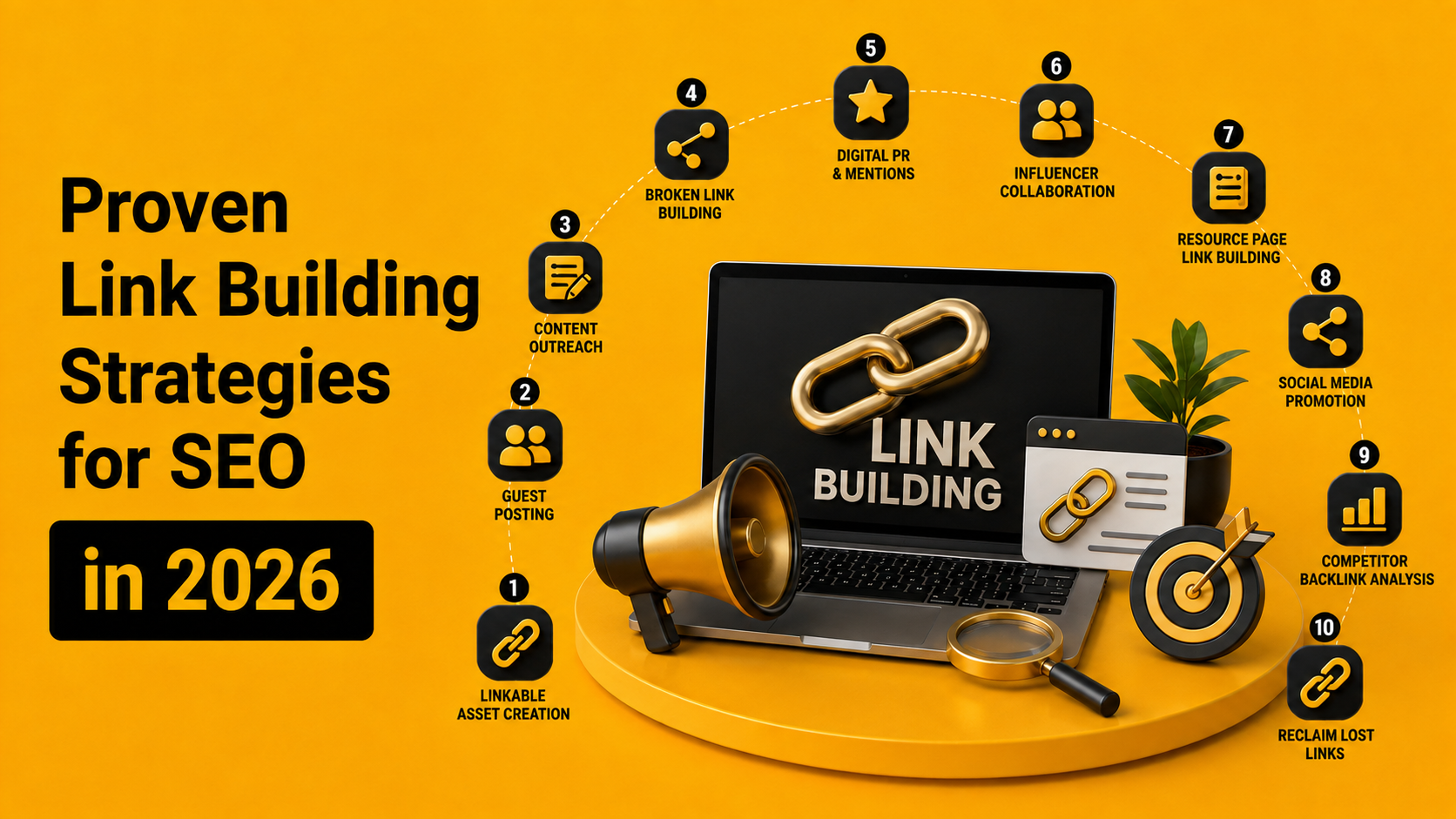
    Proven Link Building Strategies for SEO in 2026

    Publishing great content is only half the SEO battle. If nobody credible is linking to that content, getting it in front of competitive searchers can be much harder.

    That is the problem many businesses run into. Even when they publish on a regular basis, optimize their pages, and target the right keywords, they still see other companies outranking them.

    The missing piece is often authority.

    That is where the right link building strategies can make a difference. However, good link building cannot mean building hundreds of irrelevant backlinks. Good link building means creating relevant and credible links to your site from sites that already have authority in your field.

    In this guide, we will discuss the different strategies and techniques of link building for U.S. based businesses in 2026.

    What Makes a Backlink Valuable?

    Before building links, it helps to understand what you’re actually trying to acquire.

    A backlink is simply a link from another website to yours. But two backlinks can have completely different value depending on where they come from and why they exist.

    Consider these two examples.

    A respected U.S. marketing publication references your original SEO research and links to the study.

    Another website you’ve never heard of publishes a page containing thousands of unrelated links, including yours.

    Both technically give you a backlink. They are not remotely the same opportunity. When evaluating a link, look at relevance, authority, editorial context, and potential referral traffic. Relevance is particularly important. 

    Links from websites covering your industry would make more sense than links from unrelated sites that might have high third-party authority. 

    Google also recommends using descriptive and relevant anchor text and stresses that links are meant to be helpful rather than being used for manipulative purposes. 

    This is why a proper link building strategy always prioritizes quality over quantity.

    1. Create Original Research That People Want to Reference

    One of the strongest link building techniques is also one of the most useful forms of content marketing: original research.

    Think about the articles you read online. When writers mention a statistic, they often link to the original study, report, or dataset.

    That is exactly the behavior you want to create.

    For example, a U.S. digital marketing agency could survey 1,000 small businesses about their 2026 marketing budgets and publish the results as:

    “2026 U.S. Small Business Marketing Budget Report.”

    Now you have something other websites can cite.

    A business publication might use one of the statistics in an article. A marketing consultant could reference the report in a presentation. Another agency might link to it from an industry guide.

    The asset earns links because it provides information that other publishers don’t already have.

    Useful formats include:

    • Original surveys
    • Industry benchmarks
    • First-party datasets
    • Annual reports
    • Consumer research
    • Market studies
    • Trend reports

    Semrush’s research on link building identifies original research and data-driven content as effective linkable assets because other publishers have a reason to reference them.

    The important part is originality. Rewriting statistics from five other websites isn’t original research.

    If you want links from research, give publishers something new to cite.

    1. Use Digital PR to Earn Editorial Links

    Traditional outreach often sounds like this:

    “Hi, we have an amazing website. Would you like to link to us?”

    Unsurprisingly, it doesn’t always work.

    Digital PR takes a different approach. Instead of asking publications to link to your website, you give them a reason to talk about your company, research, experts, or findings.

    For example, a cybersecurity company could release research about the most common security mistakes among U.S. small businesses.

    That creates a story.

    A journalist can report the findings. An industry publication can discuss the implications. A business website can reference the research.

    The backlink becomes part of the editorial coverage rather than the entire purpose of the conversation.

    Other PR-friendly assets include:

    • Original surveys
    • Industry predictions
    • Trend reports
    • Consumer studies
    • Proprietary data
    • Expert commentary
    • Annual rankings
    • Market comparisons

    This approach works particularly well when the research is timely and connected to something people are already discussing.

    Instead of asking, “Who will give us a backlink?”, ask:

    “What information could we publish that a journalist would actually want?”

    That question usually produces better campaigns.

    1. Find Competitor Backlink Gaps

    Your competitors have already done some of the research for you.

    If another company consistently ranks above you, examine its backlink profile and look for websites linking to them but not to you.

    Suppose three competitors all have links from the same industry publication.

    That’s worth investigating.

    It implies that the website you are investigating already covers your business niche and is ready to mention your business.

    Pay attention to:

    • Industry publications
    • Resource pages
    • Business associations
    • Expert interviews
    • Industry roundups
    • Research citations
    • Guest contributions
    • Partner pages

    It does not mean that you need to try to get all the backlinks from your competitors’ list. Some of them might be irrelevant, expired, or simply low-quality backlinks. Try to look at the patterns.

    When several competitors have a backlink from one reliable website, it might be a true link opportunity.

    Such an approach will help you become more targeted when sending out link requests since you start from the websites that are interested in your niche.

    1. Reclaim Unlinked Brand Mentions

    Sometimes another website has already talked about your company but forgot to link to you.

    That’s one of the easiest link opportunities to overlook.

    Imagine a publication writes “Xparro recently published a report on SEO trends.” The brand is mentioned, but there is no hyperlink.

    You can reach out to the publisher and politely ask whether they would consider linking the mention to the original report or relevant company page.

    The conversation is much easier because the publisher has already decided that your brand is worth mentioning.

    The same principle applies to links pointing to outdated URLs.

    A website may still link to an old article that has been moved, deleted, or replaced. If the old URL now returns a 404, you can either redirect it to a highly relevant replacement page or contact the publisher and suggest the correct URL.

    This is known as link reclamation. It isn’t glamorous. But SEO doesn’t always need to be glamorous. Sometimes the best backlink opportunity is simply one you already earned and forgot to maintain.

    1. Use Broken Link Building

    Broken link building works because you’re solving a problem for another website.

    First, you need to find websites that have relevant pages with broken external links.

    For instance, let’s take an industry website that has a resource page with a dead link to SEO research conducted long ago.

    If you happen to know about your company’s recent SEO research on the same topic, then you should contact the owner of the website and suggest replacing the broken link.

    The crucial point here is relevancy. It’s not enough to simply write an article on a certain topic just because you’ve found a broken link.

    The new resource must be as useful as the previous one.

    An effective outreach email could look like this:

    “I noticed that the research link on your website in the SEO resources section is leading to a 404 page. I’ve recently conducted updated research on the same topic. Maybe you will find it useful to replace the broken resource with ours.”

    This is much better than saying, “Please, link us on your site.” You’re identifying a problem and offering a solution.

    1. Build Linkable Assets, Not Just Blog Posts

    Not every article you publish needs to attract backlinks.

    But if link acquisition is one of your goals, some content should be deliberately designed to earn citations.

    A linkable asset gives another website a reason to reference your page.

    That could be:

    • An original statistics page
    • A calculator
    • A research report
    • A downloadable template
    • An industry database
    • A detailed benchmark
    • An interactive tool
    • A comprehensive resource

    For example, an SEO agency could create a free SEO ROI calculator for U.S. businesses.

    A business owner might use it, a marketing consultant might recommend it, or a publication writing about SEO budgets might link to it.

    The asset works because it provides something useful beyond another 1,500-word article.

    Before creating an asset, ask one simple question: “Why would another website link to this?” If you don’t have a good answer, the asset probably needs more originality or utility.

    1. Contribute Expert Content to Relevant Publications

    Guest posting can still be useful when it is approached as an expert contribution, rather than a backlink manufacturing system.

    Google has warned against large-scale article campaigns created primarily to manipulate rankings through links.

    That doesn’t mean contributing an article to an industry publication is automatically a problem.

    The difference is whether you’re providing genuine value. A cybersecurity executive could explain how small businesses should respond to ransomware risks. A SaaS founder could discuss lessons from reducing customer acquisition costs.

    An SEO strategist could explain what businesses should actually do after a major search update.

    These are useful contributions because they come from experience and expertise.

    Choose publications based on:

    • Audience relevance
    • Editorial quality
    • Industry reputation
    • Organic visibility
    • Topic relevance

    Don’t select websites simply because a third-party tool gives them a high Domain Rating. Third-party metrics are useful for prospecting, but they aren’t Google ranking factors.

    And don’t force exact-match anchor text into every contribution.

    Natural, descriptive anchor text is much more appropriate. Google specifically recommends concise and relevant anchor text rather than keyword stuffing.

    1. Turn Expertise Into Journalist Links

    Journalists regularly need credible sources.

    They need someone who can explain a new development, interpret data, provide an expert opinion, or comment on an industry trend.

    That creates another link-building opportunity.

    If your company has genuine subject-matter experts, make them accessible.

    For example, if Google introduces a significant search change, an experienced SEO professional can provide commentary about what businesses should watch.

    If a new AI technology changes advertising, a marketing strategist can explain its practical implications.

    When journalists use that expertise, the resulting article may include the expert’s name, company, website, or supporting research.

    The value goes beyond the backlink. You’re building brand authority, expert visibility, and relationships with publishers at the same time. This is one reason link building and digital PR increasingly overlap.

    1. Strengthen Internal Links After Earning External Links

    External backlinks bring authority into your website. And internal links are needed to establish a connection between the authority and other pages.

    Assume that some marketing magazine links to your guide on SEO strategy.

    In this case, your guide is supposed to link users to other pages of your website, like service pages, research, etc.

    Google suggests linking the most important pages through other relevant pages with descriptive anchor text. But this does not imply linking every page. It implies having a structured website.

    If your pages that are valuable from a commercial point of view are disconnected from the other pages of your website, it creates problems both for visitors and for the search engines.

    So whenever you earn an important backlink, review the page receiving it.

    Ask which related pages this page should naturally link to. That small step can make your broader link building strategy more effective.

    How to Build a Link Building Plan

    A successful link-building plan should be based on your website’s actual competitive position.

    Start with a backlink audit.

    Identify your:

    • Referring domains
    • Best backlinks
    • Unlinked backlinks
    • Broken backlinks
    • Most linked pages
    • Anchor texts

    Conduct a competitor gap analysis by looking at your competitors’ websites. Find out what websites are linking to your competitors but not to you.

    From here, create categories of prospects including:

    • Editorial opportunities – Media and industry publications.
    • PR opportunities – Journalists and media sites.
    • Resource opportunities – Resource pages, guide pages, and industry lists.
    • Reclamation opportunities – Unlinked mentions and lost links.
    • Content opportunities – Websites that could cite your research, tools, and reports.

    This will provide your team with a process rather than a spreadsheet full of websites. Now it is possible to develop campaigns using different tactics on a monthly basis.

    One month could involve research and PR; the next month could involve link reclamation and broken link building, etc.

    How to Measure Link Building Success

    Don’t judge a campaign solely by the number of backlinks acquired.

    A campaign that produces 200 irrelevant links isn’t necessarily better than one that earns 15 highly relevant editorial links.

    Track metrics such as:

    • New referring domains
    • Relevant referring domains
    • Editorial placements
    • Links to priority pages
    • Referral traffic
    • Ranking changes
    • Organic traffic
    • Assisted conversions
    • Organic leads

    You should also look at the quality of the websites linking to you.

    If your campaign is consistently earning links from websites that have genuine audiences, strong editorial standards, and relevance to your industry, you’re building something valuable.

    If the report is full of strange websites you’ve never heard of, it’s time to ask some uncomfortable questions.

    Link Building Strategies to Avoid

    Some tactics can create more problems than opportunities. Avoid buying links specifically to manipulate search rankings. Google classifies this as link spam.

    Be cautious with:

    • Automated backlink software
    • Mass directory submissions
    • Link farms
    • Private blog networks
    • Excessive reciprocal links
    • Comment spam
    • Irrelevant guest posts
    • Keyword-stuffed anchor text
    • Large-scale low-quality link campaigns

    Google also identifies automated link creation and excessive link exchanges among practices that can violate its spam policies.

    And if someone promises thousands of backlinks overnight, remember that a large backlink number isn’t the same thing as authority.

    Final Takeaway

    The best link building strategies don’t begin with the question, “How many backlinks can we get?” They begin with “What can we create that another credible website would genuinely want to reference?”

    That could be original research, a useful tool, expert insight, proprietary data, or a genuinely valuable resource.

    From there, competitor research, digital PR, broken-link building, link reclamation, expert outreach, and targeted content contributions can help turn those assets into real authority.

    The strongest link building strategy is ultimately a combination of good content, smart prospecting, relevant outreach, and genuine relationships.

    Don’t chase links just because they’re available. Chase the links that make sense. Because one relevant editorial backlink from a trusted website can be far more valuable than a spreadsheet full of links nobody would ever click.

  • How Much Do SEO Prices Really Cost in 2026?

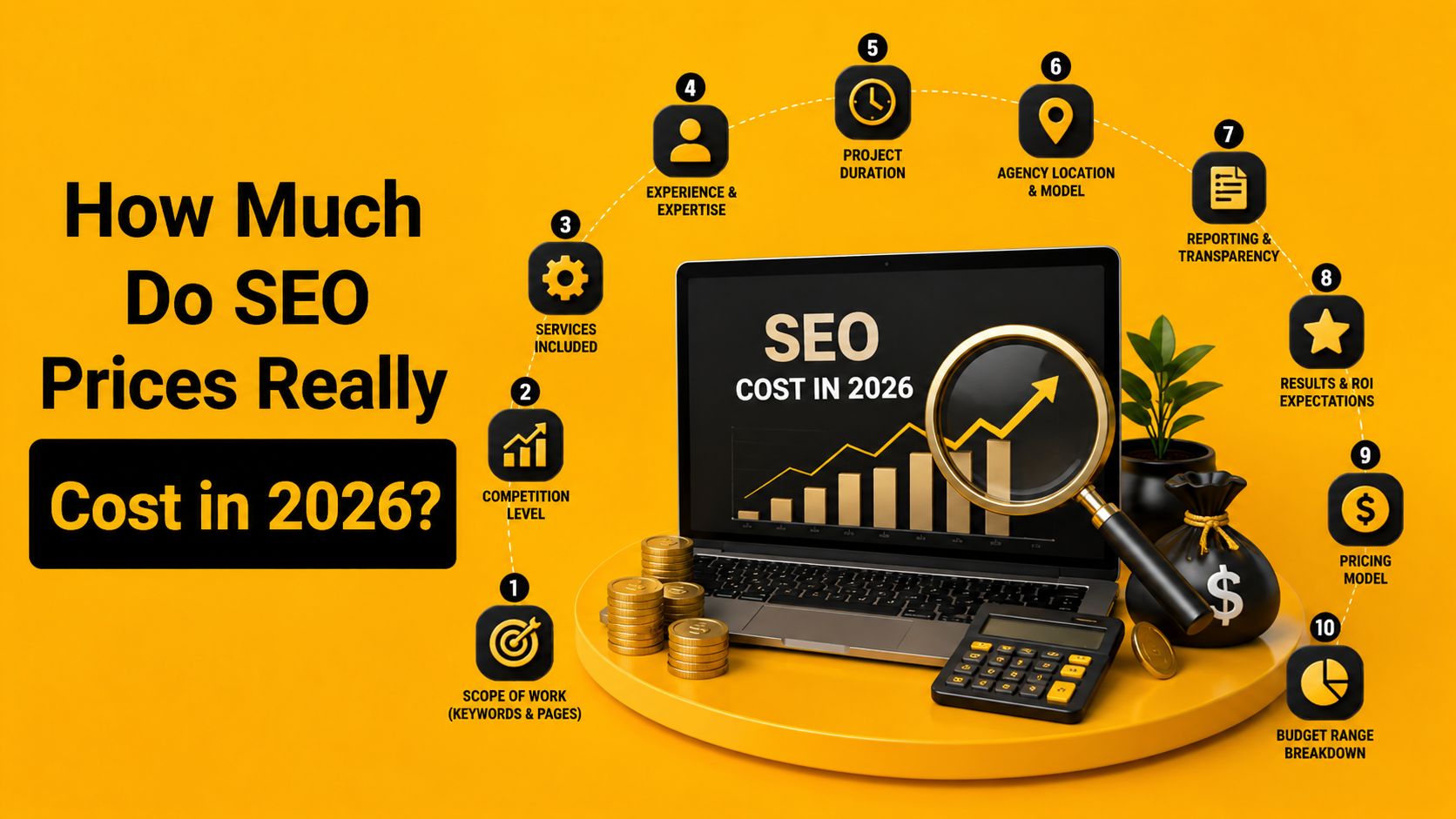
    How Much Do SEO Prices Really Cost in 2026?

    SEO pricing can feel like someone threw numbers at a wall and called it a strategy.

    One SEO agency quotes $800 a month. Another asks for $3,000. Someone else promises “guaranteed Google rankings” for $299.

    So, how much should you actually spend on SEO in 2026?

    For most U.S. businesses, that largely depends on the level of competition, size of the website, technical difficulty, content needs, authority and, most importantly, the value of your customers who can be brought in via SEO.

    SEO Prices in 2026: Quick Overview

    There is no official SEO price list, but there are industry averages which give good guidelines.

    According to a study conducted by Ahrefs on 439 SEO companies, the average monthly cost for SEO retainer services was $2,917 while the average hourly cost was about $111. In addition, the most used pricing strategy among SEO providers was monthly retainers.

    For U.S. businesses, practical monthly budget ranges look roughly like this:

    Monthly SEO BudgetBest Suited For
    $500 – $1,000Small local businesses and basic SEO
    $1,000 – $2,500Small businesses and niche markets
    $2,500 – $5,000Competitive local, B2B, e-commerce and regional SEO
    $5,000 – $10,000Competitive national markets
    $10,000+Enterprise SEO and highly competitive industries

    These are planning ranges, not fixed rates. A good SEO quote should be based on the amount and complexity of work required… not an arbitrary package labeled “Gold.”

    What Determines SEO Prices?

    Why can two companies get completely different quotes for SEO?

    Because SEO is not one task.

    It includes technical optimization, writing of content, researching keywords, digital PR, link building, analyzing, conversion optimization and experimenting.

    1. Website Size

    A 20-page local business website doesn’t require the same SEO resources as a 20,000-page e-commerce store.

    Large websites may require:

    • Crawl-budget analysis
    • Indexation management
    • Canonicalization
    • Internal-link optimization
    • Faceted navigation control
    • XML sitemap management
    • JavaScript rendering analysis
    • Content pruning
    • Template optimization

    Google says crawl-budget optimization becomes particularly relevant for very large sites, including sites with more than 1 million unique pages or large websites with frequently changing content.

    In other words, if your website has 50 pages, you probably don’t need an enterprise crawl-budget war room.

    1. Keyword Competition

    Ranking for “dentist in Austin” isn’t the same game as ranking for “best CRM software.”

    Competitive keywords demand better:

    • Relevance
    • Content Quality
    • Backlink Profiles
    • Technical Basis
    • Internal Linking
    • Brand Signals

    SEO prices therefore need to consider the level of competition, rather than the number of keywords in a package.

    1. Website Health

    Before making 50 new pages for your website, you first need to find out whether Google is able to crawl and index all existing pages.

    Technical SEO considerations may include:

    • Robots.txt files
    • XML Sitemap
    • Canonical Tags
    • HTTP Status Codes
    • Duplicate Content
    • JS Rendering
    • Core Web Vitals
    • Structured Data
    • Mobile Usability

    According to Google’s guidelines for technical SEO, Googlebot must be able to access pages, pages need to give the right HTTP response code, and pages need to have indexable content to be indexed.

    Sometimes the highest-ROI SEO work isn’t publishing another blog. It’s fixing the thing preventing Google from understanding the pages you already built.

    How Much Does SEO Cost Per Month in 2026?

    Let’s break the pricing down into realistic budget levels.

    $500 – $1,000 Per Month

    This is an entry-level SEO budget.

    It can work for a small local business with a limited geographic market and relatively low competition.

    A campaign at this level may include:

    • Basic keyword research
    • On-page optimization
    • Google Business Profile support
    • Basic technical recommendations
    • Metadata optimization
    • Limited content optimization
    • Monthly reporting

    What it probably won’t support is an aggressive national campaign involving content production, digital PR, technical development, and substantial link acquisition.

    If somebody promises to take a brand-new website from zero to dominating competitive national keywords for $500 a month, raise an eyebrow.

    Maybe both.

    $1,000 – $2,500 Per Month

    For many small U.S. businesses, this is a more realistic starting point.

    A campaign may include:

    • Technical SEO
    • Keyword mapping
    • Service-page optimization
    • Content strategy
    • Local SEO
    • Internal linking
    • Competitor analysis
    • Content creation
    • Link-building
    • Performance reporting

    This range can work well for:

    • Local service businesses
    • Professional services
    • Small B2B companies
    • Niche e-commerce brands
    • Regional businesses

    The key is prioritization. You don’t need 100 SEO tasks. You need the right 10 tasks executed consistently.

    $2,500 – $5,000 Per Month

    This is the point where the SEO firm may be able to handle several work streams at once:

    Technical SEO + Content + Link Building + Digital PR + CRO + Analytics

    The budget would work well for:

    • Competitive local markets
    • SaaS businesses
    • B2B businesses
    • E-commerce companies
    • Regional businesses
    • High-end professional services firms

    This will not only optimize your current pages but grow your search footprint as well.

    $5,000 – $10,000+ Per Month

    This is generally appropriate for businesses targeting highly competitive markets.

    The SEO program may include:

    • Large-scale content production
    • Technical SEO
    • Digital PR
    • Editorial link acquisition
    • International SEO
    • Programmatic SEO
    • Conversion rate optimization
    • Content refreshes
    • Competitor intelligence
    • Advanced analytics

    At this point, SEO is no longer “something marketing does once a month.” It’s a serious acquisition channel.

    How Much Should You Spend on SEO?

    Here’s the better way to calculate your SEO budget.

    Don’t start with “What does everyone else spend?” Start with “What is one customer worth to my business?”

    Suppose your average customer generates $2,000 in lifetime gross profit.

    If SEO brings you five additional customers per month:

    5 × $2,000 = $10,000

    A $2,000 monthly SEO investment could therefore make economic sense.

    Now imagine your average customer is worth only $100.

    A $5,000 monthly SEO retainer becomes much harder to justify.

    This is why SEO budgets should be tied to customer economics, not arbitrary industry averages.

    How Much Does SEO Optimization Cost?

    “SEO optimization” is an incredibly broad term. Optimizing one landing page is very different from optimizing an entire website.

    On-Page SEO

    This can include:

    • Title tags
    • Meta descriptions
    • Heading structure
    • Search intent alignment
    • Keyword targeting
    • Content structure
    • Internal links
    • Image optimization
    • URLs
    • Entity coverage

    Technical SEO

    This can involve:

    • Crawlability
    • Indexability
    • Canonicalization
    • Redirects
    • XML sitemaps
    • Robots.txt
    • Structured data
    • JavaScript rendering
    • Core Web Vitals

    Content SEO

    A professional campaign may include:

    • Keyword mapping
    • Topic clusters
    • Content-gap analysis
    • Search-intent analysis
    • Content refreshes
    • Expert-reviewed content
    • Original research
    • Internal linking

    Google emphasizes creating helpful, reliable, people-first content rather than content created primarily to manipulate rankings.

    So, yes, you can technically publish 100 AI-generated articles. That doesn’t automatically make them useful.

    SEO Agency vs. Freelancer: Which Costs More?

    The vendor you choose will influence SEO costs.

    According to the study by Ahrefs, the average monthly cost was $3,209 for agencies and $1,349 for freelancers, calculated using the methodology of Ahrefs’ survey.

    If you need:

    • Keywords research
    • On-page optimization
    • Content optimization
    • Local SEO
    • Technical expertise

    Then you should consider hiring a freelancer.

    However, if you need:

    • Technical experts
    • Content writers
    • Developers
    • Links building
    • Digital PR
    • Analytics
    • Conversion rate optimization
    • Strategy management

    Then you should consider working with an SEO agency.

    The key question here is not “Agency or freelancer?” But rather “How many resources do I really need for my SEO campaign?”

    What Should an SEO Agency Include?

    Before signing a contract, get the scope in writing.

    Technical SEO

    Ask:

    • What technical issues will you fix?
    • How will you prioritize them?
    • Will developers implement changes?
    • How will indexation be monitored?

    Content

    Ask:

    • How many pages will be created?
    • How many existing pages will be optimized?
    • Who writes the content?
    • Is it reviewed by subject-matter experts?
    • How is search intent determined?

    Link Building

    Ask:

    • How are backlinks acquired?
    • Are they editorial?
    • What websites are targeted?
    • Are paid or private-network links involved?

    Reporting

    Don’t settle for “You gained 47 keywords!”  Rankings matter, but business outcomes matter more.

    Your SEO dashboard should ideally track:

    • Organic clicks
    • Organic impressions
    • Rankings
    • Qualified traffic
    • Leads
    • Conversion rate
    • Revenue
    • Cost per acquisition

    Google Search Console provides search-performance data that can help businesses evaluate how their pages perform in Google Search.

    Beware of Cheap SEO Packages

    Think of an SEO company that claims “Guaranteed top Google ranking for only $299 per month.” It is quite attractive, but highly suspicious.

    Cheap SEO could consist of:

    • Content generation
    • Inferior backlinks
    • Generic reports
    • Spam directories
    • Reused articles
    • Little technical effort

    Google advises against using techniques created just for manipulation of search results.

    The problem with bad SEO isn’t just wasted money. You may eventually have to pay someone else to clean it up. So the cheapest SEO package can become the most expensive one.

    How Long Does SEO Take to Produce Results?

    SEO is a long-term acquisition channel.

    Google states that changes can take anywhere from hours to several months to be reflected in Search and recommends waiting several weeks before evaluating the impact of changes.

    That means judging an SEO campaign after 30 days solely by rankings isn’t particularly useful.

    Track progress in stages.

    • Early Signals
    • Impressions
    • Indexed pages
    • Organic clicks
    • Keyword visibility
    • Crawl improvements
    • CTR
    • Business Signals
    • Leads
    • Qualified traffic
    • Sales
    • Revenue
    • Conversion rate
    • Customer acquisition cost

    The goal isn’t visibility → celebration → screenshot

    It’s visibility → Traffic → Leads → Customers → Revenue

    Much better dashboard.

    Is SEO Worth It for a Small Business?

    Yes, when search demand exists and the economics work.

    SEO can prove to be especially effective when:

    • Customers search before a purchase
    • You have a product with high profit margin
    • Lifetime customer value is high
    • The search need remains steady
    • Your niche has commercially viable keywords
    • Your site has the ability to convert organic visitors

    For example, an HVAC company that ranks for high-intent keywords such as “AC repair near me” can benefit from lead generation through SEO.

    But SEO isn’t automatically profitable because it’s SEO.

    It needs:

    Search demand + relevant traffic + conversion + acceptable acquisition cost.

    Miss one of those, and your beautiful ranking report may not pay the bills.

    A Simple SEO Budget Formula

    Here’s a practical formula businesses can use:

    Maximum SEO Budget = Target Incremental Customers × Target CAC

    Suppose you want:

    10 additional customers per month

    Your acceptable customer acquisition cost is:

    $400

    Then:

    10 × $400 = $4,000

    That gives you a theoretical $4,000 monthly acquisition budget.

    Now compare that against:

    • Search demand
    • Keyword competition
    • Current rankings
    • Conversion rate
    • Customer lifetime value
    • Required SEO resources

    This is a far better approach than selecting a package because it has the word “Premium” in the title.

    SEO Pricing Red Flags 

    Before hiring an SEO agency, watch for these warning signs.

    Guaranteed Rankings – No agency controls Google’s algorithm.

    No Clear Deliverables – “SEO optimization” isn’t a deliverable. Ask exactly what will be changed.

    Huge Backlink Numbers – 500 backlinks aren’t impressive if 490 come from websites nobody trusts.

    Rankings as the Only KPI – Rankings matter. Revenue matters more.

    No Analytics Access – Without proper measurement, proving ROI becomes unnecessarily difficult.

    Long Contracts With No Review

    SEO can require time, but you should still understand how performance will be evaluated.

    How to Choose the Right SEO Agency

    Before choosing an SEO agency, ask:

    • What technical issues did you find?
    • Which keywords have commercial value?
    • Who are my organic competitors?
    • What happens during the first 90 days?
    • How will content be created and reviewed?
    • How will backlinks be acquired?
    • Which KPIs will you report?
    • How will SEO connect to leads and revenue?
    • What assumptions support your forecast?
    • How will strategy change if results don’t meet expectations?

    A strong SEO agency won’t promise that Google will obey them.

    They’ll explain what they can influence, how they will measure it, and where your money is going.

    Final Takeaway: Don’t Buy SEO. Buy Business Growth.

    So, how much does SEO cost in 2026?

    For U.S. businesses, SEO can range from $500 to $10,000+ per month, depending on the scope, competition, website size, and growth objectives.

    For many small businesses, $1,000–$2,500 per month is a practical starting range. Competitive regional and national campaigns may require $2,500–$5,000+, while enterprise SEO can move well beyond $10,000 per month.

    But don’t choose your SEO budget because somebody on the internet declared an “industry average.”

    Choose it based on economics.

    Ask. Asking doesn’t cost you. Ask how much is one customer worth? How many customers can organic search realistically generate? What will it cost to acquire them?

    And most importantly ask if the SEO investment create more business value than it costs?

    That’s the question that turns SEO from another marketing expense into an actual growth investment.

    Frequently Asked Questions

    How much does SEO cost per month in 2026?

    The typical price for SEO ranges from $500 to $10,000+, depending on the level of complexity and competition of the campaign. Small businesses may begin their journey with $1,000-$2,500 monthly budgets, while competitive national campaigns require at least $2,500-$5,000 or even more.

    Ahrefs’ survey of 439 SEO providers reported an average monthly retainer of $2,917.

    Is SEO worth it for a small business?

    SEO can be considered beneficial if your customers actively use search in order to find your products or services, and the value they generate covers the investment you have made.

    Estimate the demand for search, competition, conversion rate, the value of the customer and the cost of his acquisition prior to making the decision.

    What should a small company budget for SEO?

    The small U.S business can begin its SEO journey with the $1,000-$2,500 monthly budget, depending on the nature of its market.

    Those who operate in less competitive local market may require less, but the company that competes nation-wide in highly competitive industry may require much more money.

    The best SEO budget isn’t necessarily the cheapest, or the biggest.

    It’s the one that gives your business enough resources to compete while maintaining a realistic path to positive ROI.

  • 10 Engine Optimization Strategies to Boost AI Visibility

    10 Engine Optimization Strategies to Boost AI Visibility

    You can rank #1 on Google and still be invisible to an AI-generated answer, and that is the new search problem.

    Google now uses AI Overviews and AI Mode, while websites like ChatGPT and Perplexity analyze information from various sources. According to Pew Research, users click on a regular search result if an AI-powered overview was shown only in 8% of cases, while without an AI-generated overview they do it 15%.

    Now it is not enough just to ask, “How do I rank?” Instead, you need to ask, “How do I become one of those sources which AI systems trust enough to mention or cite?”

    This is where engine optimization strategies, especially Generative Engine Optimization (GEO), play their role.

    What Is Generative Engine Optimization?

    Generative Engine Optimization is the optimization of your content, website, and brand online in such a way that artificial intelligence-based search engines find, comprehend, rate, and cite or recommend your business.

    In traditional SEO, you rank your website for specific keywords. But in GEO, your objective is to make your brand valuable for an AI-based search engine as an information source.

    For instance, your traditional SEO campaign would target “best SEO agency USA.” But the user in a generative search could ask, “What are the best SEO agencies in the USA for a SaaS company?”

    The additional meaning in the second question has context, intent, and restrictions.

    Your AI-driven response would provide a shortlist, reasons why companies are suitable, and credible sources of information for the recommendation.

    Your goal is to become that source. And no, not by adding “AI” in the headings of your website.

    SEO vs. GEO: What’s the Difference?

    SEO and GEO are very similar but differ in the type of optimization they offer.

    Traditional SEOGenerative SEO
    Optimize for rankingsOptimize for AI visibility
    Target keywordsTarget questions, entities, and intent
    Earn backlinksEarn authoritative mentions and citations
    Improve SERP CTRImprove mentions, citations, and referrals
    Optimize individual pagesBuild broader digital authority
    Measure rankings and trafficMeasure AI visibility and source inclusion

    You don’t need to choose between them. 

    Google’s official guidance says the SEO principles required for pages to succeed in traditional searches are still applicable for AI Overviews and AI Mode. These pages have to be crawlable, indexable, and eligible for regular Google searches.

    Consider GEO an extra layer of SEO.

    10 Engine Optimization Strategies for AI Visibility

    1. Build Content Around Search Questions

    Keyword optimization is not dead. However, keyword-oriented approaches are becoming less effective. Users ask more complex and long-tailed questions.

    According to the Pew Research Center, only 8% of one-word or two-word Google searches conducted in the center’s experiment led to an AI summary. However, 53% of the search queries consisting of 10 words or more generated an AI summary.

    This is an important insight for content marketers.

    Stop thinking about a single page on:

    • “CRM software” and create a content set of questions around:
    • What is CRM software?
    • How does CRM software work?
    • What features should be in CRM software for a small business?
    • What is the cost of CRM software?
    • What is the best CRM software for a company of 20 people?
    • CRM vs spreadsheets, which is better?
    • How to implement CRM software?
    • CRM implementation pitfalls.

    This will help you create a topic cluster rather than a graveyard of keywords.

    Practical strategy

    Map content by four intents:

    • Informational: What is CRM software?
    • Commercial: Best CRM software for small businesses
    • Comparative: HubSpot vs Salesforce
    • Transactional: CRM implementation services

    This gives AI systems more opportunities to encounter your expertise.

    1. Use Answer-First Content Structure

    AI systems need information they can retrieve and synthesize quickly.

    The reader will appreciate not having to sift through 2,000 words of an introductory discussion on “the rapidly evolving digital landscape” in order to find the answer.

    Start with the answer.

    Example:

    What is GEO?

    Generative Engine Optimization is the optimization of a brand’s digital footprint in such a way that AI search engines are able to find, understand, and cite the information of said brand.

    Expand from there.

    Utilize:

    • Short paragraphs
    • Concise H2s and H3s
    • Bullet points
    • Charts
    • Definitions
    • Processes
    • Examples
    • Statistics
    • FAQs

    Doing so will increase the readability of your content for both humans and computers.  The point is not to produce robotic content. The point is to provide clear information.

    1. Create Citation-Worthy Content

    Here’s one of the biggest differences between ordinary content and strong GEO content:

    Stop merely repeating data and start creating evidence.

    Let’s assume that your article states, “Mobile optimization increases conversions.” It is an ordinary piece of information.

    But how about this statement: “According to our analysis of 1,500 e-commerce sessions, mobile users showed 23% higher rates of abandonment on checkout pages with more than five form fields.” It is another case.

    Because it contains:

    • Original information 
    • Sample size
    • Measurable outcome
    • Context

    It is the type of information that can be used by other websites for citation.

    Build assets, such as:

    • Research reports
    • Industry surveys
    • Benchmark reports
    • Case studies
    • Datasets
    • Interviews with experts
    • Statistics
    • Technical tests
    • Price comparison

    Try to make the information that other websites would like to cite. Since every third-party citation strengthens your authority ecosystem.

    1. Strengthen Your Brand Entity

    AI systems need to understand what your company actually is.

    Your brand shouldn’t consist of five companies that exist all over the web.

    Google advises Organization Structured Data, which helps search engines recognize and disambiguate organizations. This may be information such as your name, URL, logo, contact details, and references to external entities by the property “sameAs”.

    Make sure your identity is consistent on:

    • Website
    • About Us page
    • Author pages
    • LinkedIn
    • Business directories
    • Reviews
    • Press release
    • Partner websites

    Clearly establish: Who you are → What you do → Who you serve → Where you operate → What you specialize in

    Example: Xparro is a digital marketing agency that provides SEO services, AI marketing, performance marketing, and digital growth for businesses that want to enter Western markets.

    That’s far clearer than: “We develop innovative digital solutions for modern businesses.”

    The second one sounds cool. But what is it really? Because it says almost nothing.

    1. Build Expert-Led Content

    Visibility is not just about websites; visibility is also about people and expertise. Create recognizable authors and experts in subject matters.

    Instead of “Written by Marketing Team”, use “Written by [Name], SEO Strategist with 8+ years of experience in technical SEO and enterprise search strategy.”

    Authors’ profiles may contain:

    • Professional experience
    • Credentials
    • Expertise
    • Publications
    • Relevant projects
    • Social profiles
    • Areas of specialization

    Identifying authors and creating connections to their relevant pages or profiles is also recommended by Google’s Article structured-data guidelines.

    And for technical, financial, healthcare, and other subjects, this is particularly important. People want to know who talks, so do search engines.

    1. Earn Third-Party Authority

    Your website isn’t your entire reputation.

    An AI system can collect data from many different corners of the web, from publishers, industry sites, reviews, forums, and many more authoritative sources.

    Research on generative search revealed that an AI system can have a preference for earned media and third-party authoritative sources over branded content.

    This means that the GEO strategy cannot just be limited to creating blog posts.

    Develop a digital PR strategy that will focus on:

    • Industry publications
    • Expert interviews
    • Podcasts
    • News coverage
    • Research collaborations
    • Expert roundups
    • Industry associations
    • Original reports
    • Thought leadership

    And no need to obsess over link building. Obsess over mentions instead. There is a huge difference between “Click here.” and “According to Xparro’s analysis of U.S. search trends…”

    Because the second one gives context to your authority.

    1. Build Semantically Complete Content

    A webpage targeting a single keyword does not imply completeness. If your target is the following keyword phrase: “how to increase website conversion rate.”

    A basic article might discuss:

    • CTAs
    • Headlines
    • Landing pages

    A stronger resource could cover:

    • Conversion rate formula
    • Traffic segmentation
    • User intent
    • Landing page UX
    • CTA placement
    • Form optimization
    • Mobile experience
    • Page speed
    • Trust signals
    • Social proof
    • A/B testing
    • Heatmaps
    • Session recordings
    • Funnel analysis
    • Statistical significance

    Now you’ve covered the information ecosystem around the topic.

    A good framework for content creation is:

    Definition → Why → How → Examples → Tools → Cost → Problems → Alternatives → Best practices → FAQs

    This helps demonstrate topical depth instead of superficial keyword coverage.

    1. Make Information Easy to Extract

    Important information shouldn’t be hidden inside walls of text.

    Format clear information blocks.

    Example:

    What is Generative SEO?

    Generative SEO refers to optimizing your content and digital assets so that your brand can have better visibility in AI-driven search and answer engines.

    Then add relevant details.

    Use:

    Key takeaway – GEO complements SEO. This means that search optimization goes beyond just rankings into AI-driven discovery.

    Quick comparison

    FactorSEOGEO
    Main goalRankingsAI visibility
    Primary outputSERP positionMention/citation
    Core signalsRelevance, links, technical SEORelevance, authority, evidence
    MeasurementRankings, CTR, trafficMentions, citations, referrals

    In this way, important information is presented clearly from the start. Plus, your readers will appreciate that.

    1. Don’t Ignore Technical SEO

    Before thinking of AI citations, ensure search engines are even able to crawl your website.

    As per Google, pages should be indexable and suitable for Google Search in order to qualify for being a candidate for citation in AI Overviews and AI Mode.

    Audit:

    • robots.txt
    • noindex directives
    • Canonical tags
    • XML sitemap
    • Internal links
    • HTTP status codes
    • JavaScript rendering
    • Mobile accessibility
    • Page speed
    • Duplicate pages
    • Orphan pages

    Remember:

    Crawled ≠ Indexed

    Indexed ≠ Ranked

    Ranked ≠ Cited

    Optimization is necessary at each step. If Googlebot isn’t even crawling your page, your GEO efforts are basically shouting in a vacuum.

    1. Measure AI Visibility

    This is where GEO becomes a marketing strategy, not another acronym.

    It’s not enough to ask, “Is ChatGPT talking about us?” Be systematic. Build an index of high-potential prompts.

    For example:

    • 100 informational prompts
    • 100 commercial prompts
    • 50 comparison prompts
    • 50 transactional prompts
    • Test them across relevant AI search platforms.

    Track:

    Brand Mention Rate – Prompts mentioning your brand / total prompts × 100

    Citation Rate – Responses citing your domain / total responses × 100

    Share of AI Visibility – Compare your appearance against competitors.

    BrandAI Mention RateCitation Rate
    Brand A34%22%
    Brand B27%18%
    Brand C19%13%
    Your Brand11%7%

    Now you have yourself a benchmark.

    And keep track of:

    • Mentions of your competitors
    • Sources of citations
    • Brand Sentiment
    • # of recommendations
    • Referral Traffic
    • Conversion rate

    AI-generated search results are not entirely static. Studies on AI Search visibility have shown variance in citation results when the same query is repeated.

    Therefore, don’t assess the success of GEO from one prompt test. Look for patterns, not anecdotes.

    How to Build a Generative SEO Strategy

    If you’re starting from scratch, use this five-step process.

    Step 1: Build a Prompt Map

    List the questions that consumers ask at each stage of the buyer’s journey.

    Map:

    Informational → Commercial → Comparison → Transactional

    Step 2: Audit Existing Content

    Rank your key pages for:

    • Search intent
    • Depth of coverage
    • Original evidence
    • Authoritative credentials
    • Clear entity descriptions
    • Content quality
    • Technical SEO
    • Content freshness

    Prioritize fixing the low-performing pages.

    Step 3: Build Topic Clusters

    Create pillar pages along with thorough subtopics.

    Example:

    Generative Engine Optimization

    → GEO vs SEO

    → AI search optimization

    → AI citations

    → ChatGPT search optimization

    → Google AI Overviews

    → GEO tools

    → AI visibility tracking

    → Generative SEO strategy

    This connects the cluster and forms more powerful topical relationships as well as ensures that key pages become more discoverable.

    Step 4: Build External Authority

    • Publish unique research.
    • Have experts quote your content.
    • Be featured in industry magazines.
    • Make guest appearances in interviews and podcasts.
    • Build digital PR opportunities related to your niche.

    The objective is to build your brand beyond the walls of your site.

    Step 5: Test, Measure and Improve

    Run your target prompts every month.

    Look for:

    • Where you’re appearing
    • Where competitors are appearing
    • Which sources AI systems cite
    • Which topics you’re missing
    • How your brand is described

    Then optimize based on the gaps.

    Common GEO Mistakes

    Publishing hundreds of generic AI articles. 

    Having more content does not necessarily mean more authority. Being unique is key.

    Optimizing only your website. 

    Your website is your base. It’s not all about your reputation.

    Stuffing prompts into articles

    There’s no need to write “What is the best SEO agency?” fifty times. This is not GEO. This is simply keyword stuffing but in disguise.

    Ignoring traditional SEO

    Google guidelines explicitly show that traditional SEO elements should be used for AI search features.

    Measuring one AI response

    AI outputs can vary. Measure repeated prompts and larger datasets.

    Final Takeaway

    The best engine optimization strategies don’t treat SEO and GEO as competing disciplines. Instead, they use technical SEO, search intent, topical authority, entity optimization, original research, digital PR, and AI visibility to enhance the search visibility of their website.

    SEO allows pages to be discovered and ranked, whereas generative SEO allows for their knowledge and expertise to be used in generating AI-powered answers. As the way people search is evolving, companies will need to go beyond search visibility and become credible, clear, quotable, and consistent throughout the web.

    It is not about producing more content and targeting all of the emerging AI platforms. The key is building an online presence that is reliable and understood by the search engines and the AI system itself. Be not just discovered, but be the resource that AI looks for.

  • SEO Keyword Cannibalization: Causes & Fixes

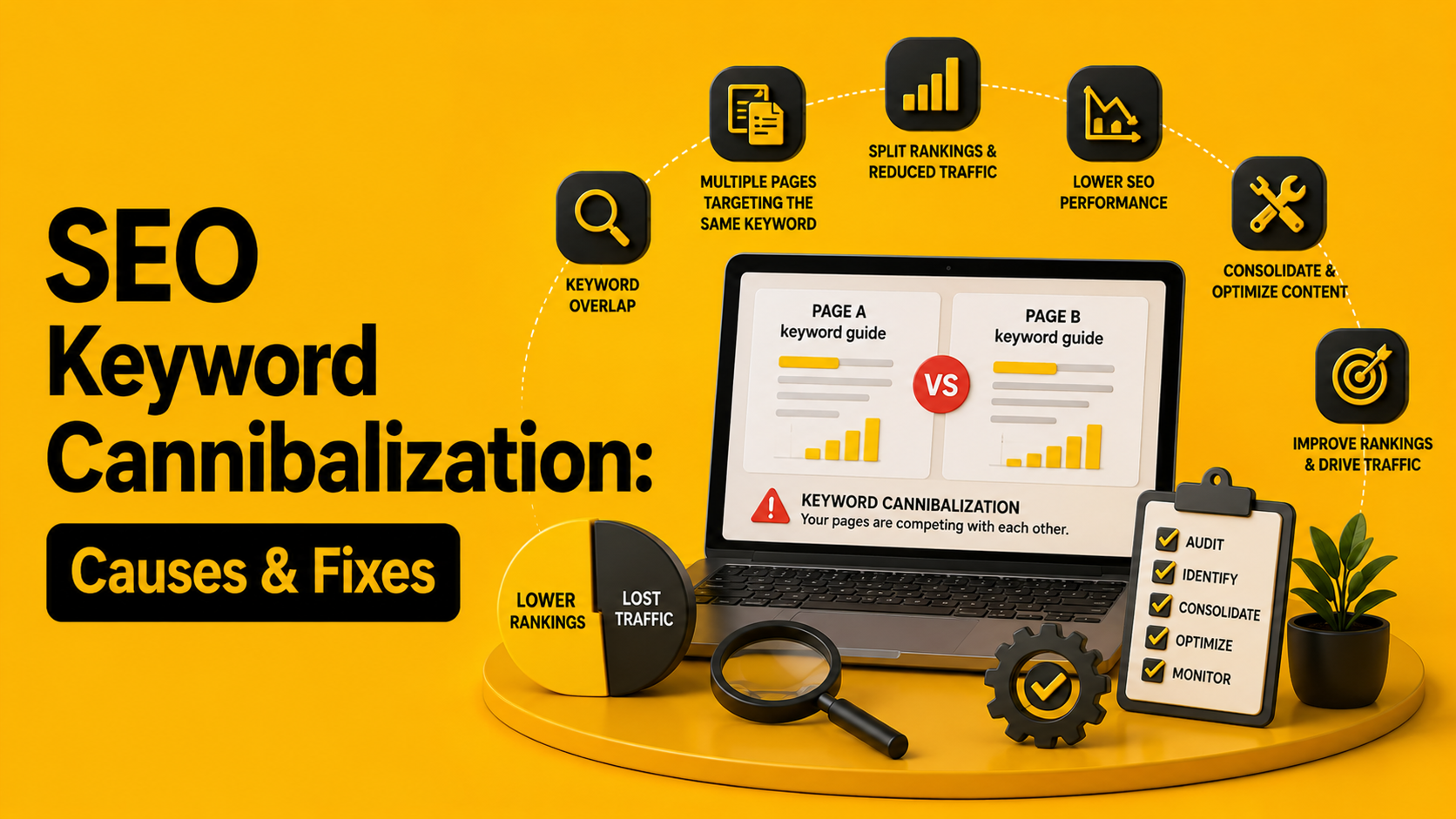
    SEO Keyword Cannibalization: Causes & Fixes

    Your website might be competing against… itself. You invested months of effort writing SEO content. You chose important keywords and even created backlinks. You did everything right, but still, your ranking is not improving.

    One post ranks this week. Another one takes its place the next week. None makes it into the top three. Does that sound familiar? There could be many reasons behind it, and it might not be Google’s algorithm.

    It might be SEO keyword cannibalization.

    There are thousands of websites out there creating several pages for the same keyword intent. That doesn’t boost their SEO authority; rather, it dilutes it. Google finds it hard to determine which page deserves a higher ranking, backlinks lose their effectiveness, click-through rate falls, and organic traffic stops flowing.

    The worst thing is that most businesses have no idea it’s happening. If you’ve written a lot of content in the past months or even years, chances are you’ve already encountered this problem.

    Let’s solve it then.

    What Is Keyword Cannibalization in SEO?

    If you’ve ever wondered what keyword cannibalization is in SEO, here’s the simplest explanation.

    When you are creating more than one web page on the same website targeting the same keyword or search intent, you will face the problem of keyword cannibalization.

    Instead of providing Google with one option, you are giving them several.

    Google will have to choose:

    • Which page is more relevant?
    • Which page deserves backlinks?
    • Which page should appear in search results?

    As a result, it starts alternating between these pages or ranks them poorly.

    Think about sending three athletes from the same team in the qualifying round in the sport where only one can qualify.

    It is not going to increase your chances, but, on the contrary, will make your runners lose points to each other. That’s exactly what keyword cannibalization does.

    Consider an example of a digital marketing agency that has been publishing these blogs for over two years.

    • Complete SEO Guide
    • SEO for Beginners
    • SEO Basics
    • Learn SEO
    • Beginner’s Guide to SEO

    All articles target:

    • SEO guide
    • learn SEO
    • SEO basics
    • beginner SEO

    Content similarity reaches 80%. Thus, Google does not understand which of them is worth ranking on Page One.

    Because of that, one powerful page ranked #2. You now have five average pages ranking between #28 and #60. Nobody wins.

    Why Keyword Cannibalization Happens

    Most websites do not create duplicate content on purpose. This is a consequence when content grows.

    Reasons may vary:

    Publishing Without a Keyword Strategy

    Some businesses assign topics to individual writers without creating a keyword map.

    A few months later, another writer uses the same keyword without realizing that someone else is doing the same thing.

    Creating Content for Every Tiny Variation

    Individuals tend to consider these variations as unique topics:

    • Best CRM software
    • CRM software comparison
    • Top CRM platforms

    For Google, these keywords mean the same intent.

    Updating Old Content With New Articles

    Marketers publish another blog instead of optimizing an old one.

    Now there are two pages that compete.

    Location-Based Duplication

    There are many businesses that publish dozens of identical pages:

    • SEO Services Texas
    • SEO Services Houston
    • SEO Services Dallas

    Google will be challenged if the content is barely different.

    Poor Internal Communication

    SEO agencies, marketing departments, freelancers, and content writers all create content independently. 

    Without documentation, duplication becomes inevitable.

    How Does Keyword Cannibalization Affect SEO?

    A lot of people wonder, what is the effect of keyword cannibalization on SEO? It is much deeper than rankings.

    1. Google Gets Confused

    Search engines always seek one single answer.

    When several webpages meet the intent equally well, Google is confused. Instead of giving credit for authority, it begins by checking other websites.

    As a result, there is fluctuation.

    1. Link Equity Gets Split

    Consider the following example:

    Page A gets 25 links. Page B gets 18 links. Page C gets 12 links.

    None of these webpages will become authoritative individually; however, if all 55 links were pointed at one single webpage. There is a good chance that the page would rule.

    Link equity dilution is one of the most serious indirect costs associated with keyword cannibalization.

    1. Lower Click-Through Rates

    Google keeps alternating the pages from time to time.

    So, users will see various titles, various meta descriptions, and various URLs. As a result, CTR is reduced.

    1. Crawl Budget Gets Wasted

    There is a limited amount of crawl budget from Google.

    If there are several pages that are similar, then crawlers waste time crawling the same information rather than finding new, valuable pages.

    Large e-commerce sites tend to experience reduced efficiency when using duplicate keyword targeting.

    1. Rankings Become Unstable

    Ever seen rankings like this?

    Monday → Position 9

    Wednesday → Position 23

    Friday → Position 15

    Sunday → Position 31

    That may indicate cannibalization. Google continues to experiment with various pages.

    1. Conversions Drop

    Not all of the competing pages convert the same way.

    Sometimes Google shows:

    • an outdated blog
    • a thin article
    • an informational guide

    instead of your highly optimized service page. Traffic comes, but conversions don’t.

    Signs Your Website Has SEO Keyword Cannibalization

    There are several warning signs that appear before rankings collapse.

    Multiple URLs Ranking for One Keyword

    Type in Google:

    site:yourdomain.com “keyword”

    When you see several relevant pages, it’s time to dig deeper.

    Google Keeps Swapping URLs

    In Google Search Console, the same keyword begins to show various landing pages. It’s usually not a coincidence.

    Rankings Plateau

    Even after creating backlinks, enhancing content, and gaining authority, your ranking still doesn’t change.

    Organic Traffic Is Spread Across Similar Pages

    Traffic Generated Organically is Distributed Among Similar Web Pages

    Not one page = 20,000 visits, but five pages = 4,000 visits per page. 

    Overall, traffic is satisfactory. Authority of individual pages declines.

    How to Identify Keyword Cannibalization

    A professional SEO team uses multiple ways.

    Google Search Console

    Consider these elements:

    • Queries
    • Landing Pages
    • Average Position

    When one keyword redirects impressions to several pages, investigate further.

    Ahrefs

    Use Organic Keywords reports. Filter the keyword. Check how many pages are ranked for the keyword.

    Semrush

    The Position Tracking Cannibalization Report automatically recognizes URLs competing for the same positions.

    This method is among the fastest.

    Screaming Frog

    Export the following:

    • Titles
    • H1 Tag
    • URLs
    • Number of Words

    The keyword cannibalism will be detected immediately.

    Manual Keyword Mapping

    Make a table with the following columns:

    URLPrimary KeywordSearch IntentStatus
    /seo-guideSEO GuideInformationalOk
    /seo-basicsSEO GuideDuplicateMerge
    /learn-seoSEO GuideDuplicateRedirect

    Big agencies always have keyword maps before creating content.

    How to Fix Keyword Cannibalization in SEO

    So let’s solve the problem that everyone wants solved: How to solve keyword cannibalization in SEO?

    Merge Similar Content

    Imagine you have:

    • SEO Guide
    • Beginner SEO
    • SEO Tutorial

    And merge them into one single page. Then, do a redirection of the weaker pages. And it would lead to instant improvement in rankings.

    Use 301 Redirects

    If a duplicate page holds no unique content, make it redirect permanently. The 301 redirects pass all the link equity to the main page.

    Canonical Tags

    In case there is a need for having several pages…

    Like, for instance:

    • Options for printing in colors
    • Various product types

    Utilize canonical tags to show your preference.

    Differentiate Search Intent

    Two similar keywords are not necessarily looking for the same thing.

    Example:

    SEO pricing vs SEO services

    One is geared towards research. The other is geared towards purchase. Use the content differently.

    Enhance Internal Links

    Make sure that your internal links always go back to the same page. Do not use similar anchor text on competing pages.

    Internal linking can help Google find the topic relevance.

    Rewrite Overlapping Sections

    In some cases, the common content only makes up 40%.

    Revise:

    • Headers
    • Examples
    • FAQs
    • Target Audience
    • Use Cases

    Ensure the topical uniqueness of your content.

    Consolidate Thin Content

    Instead of 15 blogs of 700 words, consider three resources over 3,000 words.

    How to Avoid Keyword Cannibalization SEO Problems

    Figuring out how to avoid keyword cannibalization SEO problems will be much easier than solving them.

    Build a Keyword Map

    Use:

    One keyword, one URL, one intent, always check the map before publishing.

    Research Existing Content First

    Do not start writing anything until you search your website.

    You may find an article about it. Make changes to it.

    Focus on Search Intent

    Keywords can be similar, but intent is different.

    Ask:

    What does the user want to do?

    • Learn something?
    • Compare?
    • Buy?
    • Hire?
    • Download?

    The intent defines whether the page should be created or not.

    Create Topic Clusters

    Create not a bunch of isolated blogs, but rather create pillar pages with cluster articles.

    For example:

    • Pillar
    • SEO guide

    Supporting Content

    • Technical SEO
    • Local SEO
    • On-page SEO
    • Schema markup
    • Link building

    Each page serves a unique purpose.

    Perform Quarterly SEO Audits

    Check:

    • Rankings
    • Duplicate topics
    • Outdated blogs
    • Thin content
    • Internal links

    Keyword cannibalization problems usually develop over time.

    Keyword Cannibalization vs Duplicate Content

    These concepts are frequently misunderstood.

    Yet they’re separate.

    Keyword CannibalizationDuplicate Content
    Multiple pages rank for the same keywordContent is the same on multiple pages
    Can have unique contentOften has the exact content
    Affects rankingsCauses indexing issues
    Resolved by strategyResolved by canonicals/redirects

    One can exist without the other.

    It’s possible to have keyword cannibalization without duplicate content and duplicate content without keyword cannibalization.

    Does Google Penalize Keyword Cannibalization?

    No. Google doesn’t manually penalize keyword cannibalization. What it does is, it has trouble figuring out which page is the best.

    which results in:

    • Ranking fluctuations
    • Lowered authority
    • Weakened backlinks
    • Decreased exposure

    Effectively a penalty without actually being one.

    A Simple Framework Used by SEO Agencies

    Professional SEO agencies normally do this:

    Step 1

    Find competing URLs.

    ↓

    Step 2

    Determine search intent.

    ↓

    Step 3

    Choose one primary page.

    ↓

    Step 4

    Combine or redirect weaker pages.

    ↓

    Step 5

    Update internal links.

    ↓

    Step 6

    Refresh content.

    ↓

    Step 7

    Monitor 6-8 weeks ranking.

    This process does not cause any trouble to your website’s authority.

    Common Mistakes Businesses Make

    Even the most experienced marketers make these mistakes:

    • Publishing a new blog post rather than revising an old one.
    • Trying to target all keyword variations on a new page.
    • Ignoring search intent due to differences in keywords.
    • Allowing different teams to develop similar content.
    • Failing to change internal links in case of page redirections.
    • Developing city pages with the same content.
    • Focusing on content volume and not on its results.

    Not making such mistakes may save you from months of SEO problems.

    Final Thoughts

    SEO keyword cannibalization is one of the biggest overlooked reasons why sites fail to achieve their potential rankings.

    It is not usually a result of bad quality content; rather, it is a consequence of an excessive amount of similar content fighting for the same chance.

    The cure does not include writing more articles but organizing, consolidating, and optimizing content.

    Knowing what keyword cannibalization is in SEO, being aware of how keyword cannibalization affects SEO, and applying methods on how to fix keyword cannibalization in SEO and how to avoid keyword cannibalization SEO problems, will provide a signal to search engines about which of the webpages should be ranked.

    For companies trying to rank in competitive U.S. search engine results, this will make the difference between page three and page one.

    At Xparro, we focus on creating SEO through content architecture and not only keyword optimization. Each page is created with a certain goal, identified search intent, and has a place in the bigger topical context. This is how successful rankings and organic growth are made.

  • How to Get Backlinks: 15 Link-Building Tips

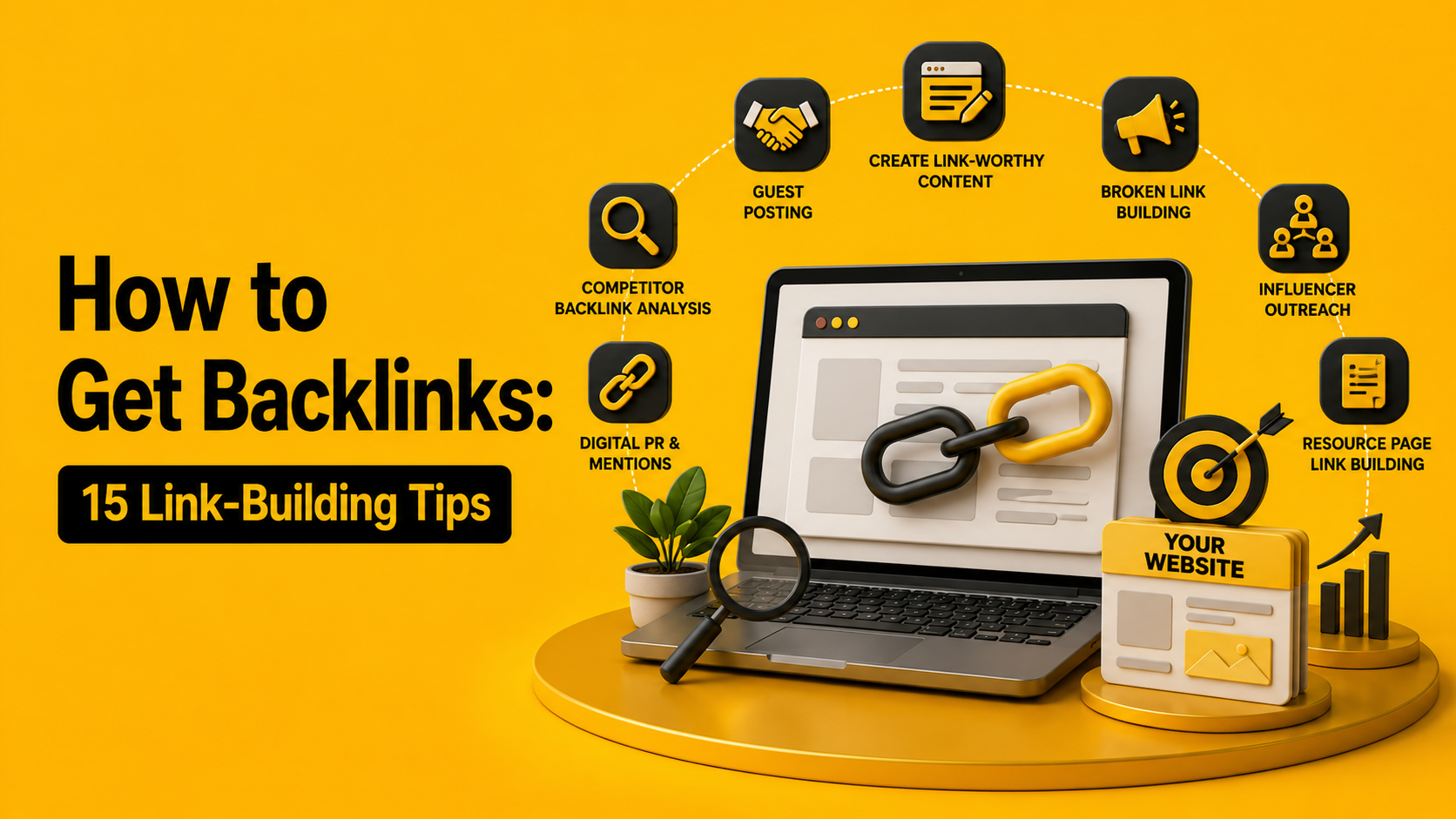
    How to Get Backlinks: 15 Link-Building Tips

    Have you ever published a fantastic blog only to watch it disappear into Google’s version of a black hole? You are not alone, because even though millions of pages are indexed every single day, but not many make it to page one.

    That is not because the pages do not contain good information, but more so because they do not have the authority that comes with it.

    Google does not only assess your written content; rather, it assesses whose trust is put in the written content. That is where the backlinking comes in.

    This guide will cover everything about backlinks and will take a look at the actual strategies that marketers, SEO agencies, and SaaS companies use to get high-quality backlinks.

    Let’s start with the basics before diving into the tactics that actually work.

    What Are Backlinks?

    A backlink is a hyperlink from another website pointing to yours. In other words, each backlink is a recommendation. Whenever a reputable website adds a link to your content, search engines perceive it as an indicator of your page being valuable.

    But all votes are equal in no way.

    Backlinks from Forbes or HubSpot have much more effect on ranking positions compared to tens of low-quality, spammy links from poor directories.

    So, SEO in the modern world is less about getting tons of links and more about getting the right ones.

    Why Are Backlinks Still Important for SEO?

    Even after hundreds of updates, backlinks remain one of the key ranking signals used by Google.

    The Google ranking algorithms consider a variety of signals while evaluating content quality, and authoritative links remain an essential part of building authority.

    The importance of backlinks lies in their ability to:

    • Improve keyword rankings
    • Increase Domain Authority (or Domain Rating)
    • Get pages indexed faster
    • Establish topical authority
    • ive referral traffic
    • Build EEAT (Experience, Expertise, Authoritativeness, Trustworthiness)

    Consider two blogs covering the same topic. They are both written in a good manner, both load fast and both cover search intent.

    But the deciding factor becomes authority, and backlinks are one of the clearest indicators of authority.

    What Makes a Quality Backlink?

    One good backlink can outperform fifty mediocre ones. This is what differentiates quality links from those that aren’t worthwhile.

    Authority

    Backlinks from authoritative sites have a lot more power to rank your site higher on search engines.

    For instance, a backlink from a leading publication in the industry has much more power than one from a new website with no organic traffic.

    Relevance

    The surrounding text matters.

    If you have a digital marketing company, it makes sense for you to have a backlink from an SEO site rather than a cooking blog.

    Google is now assessing the topic-based relationship between websites more often.

    Natural Placement

    Links placed naturally within quality content are always stronger compared to links that are inserted into footers, sidebars, or author bios.

    Natural links show authenticity compared to unnatural links.

    Traffic Potential

    Not all links help with SEO ranking. There are some links that actually bring visitors in addition to improving SEO ranking.

    Such backlinks tend to be very powerful.

    Anchor Text

    Anchor text helps Google understand what the backlinked page is all about.

    For example, instead of ‘Click here’ use ‘Learn how to get backlinks for your site’.

    How Google Evaluates Backlinks

    Google has become very advanced in detecting artificial patterns of backlinks.

    Modern algorithms analyze:

    • Topical relevance
    • Velocity of links
    • Variation of anchor text
    • Editorial context
    • Spam characteristics
    • Site quality
    • User engagement

    What this means is that purchasing thousands of backlinks not only fails to help, it can actually hurt your position.

    The current best practice is getting links you would have received regardless of Google.

    How to Get Backlinks: Proven Strategies That Work

    Let’s move beyond theory.

    Here are some practical methods used by successful SEO agencies and large corporations.

    1. Publish Original Research

    Unique data is the ultimate backlink magnet on the web.

    Every day journalists, bloggers, scientists, and marketers need to find trustworthy statistics to prove their points.

    But don’t recycle what others already published. Make your own original research.

    Possible ideas for the unique data you can gather:

    • Industry surveys
    • Behavioral studies
    • Your SEO experiments
    • Marketing trends
    • AI usage
    • Insights into consumers’ minds

    Imagine that your agency has researched 500 websites and found out that pages with less than two seconds loading speed get 27% more conversions.

    It is a piece of data nobody else possesses. References to your research will naturally generate

    1. Create Linkable Assets

    All pages don’t deserve backlinks. There are some formats that automatically generate links because they are helpful. These are known as linkable assets.

    Some examples are:

    • Ultimate Guides
    • Statistics pages for the industry
    • Calculators
    • Estimator tools
    • Templates
    • Checklists
    • Comparison charts
    • Infographics
    • Frameworks

    Consider Hubspot. A number of the most successful pages on Hubspot are not sales pages but resources. Writers link because of the solutions they provide.

    Always ask yourself, “Would someone else refer to this page instead of creating it?” If the answer is yes, then you have created a linkable asset.

    1. Build Statistics Pages

    The statistics pages keep earning backlinks year after year. The reason behind this is the need for data from writers.

    Instead of going through a number of sites, they link to one comprehensive page for all their requirements.

    For example:

    SEO Statistics 2026

    Some of the sections are:

    • Organic search statistics
    • AI Search Adoption
    • Local SEO growth statistics
    • Voice search statistics
    • Mobile stats
    • Conversion rates

    Keep updating this page each year. Over time, it becomes a backlink-generating machine.

    1. Use Digital PR Instead of Traditional Link Building

    Cold e-mailing random bloggers asking for backlinks doesn’t work anymore. Digital PR works much better.

    This method consists of creating stories that media outlets would actually like to cover.

    Such stories include:

    • Original research
    • Industry trends forecasts
    • Unusual achievements of a company
    • Market trends reports
    • Surveys
    • Expert opinions

    Media outlets need sources to support their stories.

    And if your content helps them tell a story, then linking to it becomes a natural thing to do. Instead of asking someone to link to you, create something worth covering.

    1. Turn Case Studies Into Link Magnets

    Results always speak louder than words.

    So don’t say,

    “Our SEO approach improved traffic.”

    Show it.

    The case study must include:

    • Problem
    • SEO approach
    • Technical details of the SEO process
    • Timeframe
    • Result
    • Lessons learned

    Example:

    “How We Gained 214% Organic Traffic Growth in 8 Months Without Paying for Backlinks.”

    This kind of content will appeal to bloggers and other industry publications that search for credible examples.

    1. Reclaim Unlinked Brand Mentions

    Sometimes people already mention your brand but forget to link. This is one of the simplest backlink strategies there is.

    With tools such as Google Alerts, Ahrefs, or Semrush, search for brand mentions within:

    • Your company
    • Your CEO
    • Your products
    • In-house frameworks
    • Studies or research reports

    Wherever an article mentions your organization but fails to provide any kind of link, reach out via email asking:

    “Just wanted to say thank you for the mention of our study. Is it possible to include a link to the full report?”

    Since they have mentioned your brand already, chances of success with this strategy will always be much higher than with cold outreach.

    1. Guest Posting Done Right

    Guest posting hasn’t died, it just wasn’t being done properly.

    Guest posting that involves publishing poor quality articles across a host of websites purely for backlinks was exactly the type of strategy that Google discouraged.

    Instead, try to seek out sites that are reputable within your industry.

    An ideal guest post should:

    • Help solve a reader’s issue
    • Provide insights, data, and experience that the site lacks
    • Mention your website when necessary, not constantly
    • Not be recycled content

    One well-placed guest article on a respected industry website can outperform dozens of links from low-quality blogs.

    Even better, it builds both backlinks and brand credibility.

    1. Leverage Broken Link Building

    Broken link building has been around for years, but it still works when done strategically.

    The concept is simple:

    Find broken links on authoritative websites, create (or identify) content that matches the original intent, and suggest your page as a replacement.

    Website owners appreciate it because you’re helping improve their user experience.

    Here’s the process:

    • Find broken links using tools like Ahrefs, Semrush, or Screaming Frog.
    • Analyze what the dead page originally covered.
    • Create a better, updated version of that content.
    • Reach out to the website owner with a polite email explaining the issue and offering your resource.

    Your email shouldn’t sound like a sales pitch. It should sound like you’re helping them maintain a high-quality website.

    1. Analyze Your Competitors’ Backlinks

    One of the fastest ways to discover backlinks quickly is as simple as analyzing where your competitors get their backlinks.

    SEO tools like Ahrefs, Semrush, and Moz give you an opportunity to analyze backlink profiles of your competitors in no time.

    Check for:

    • Industry blogs with links to multiple competitors
    • Resource pages
    • Guest posting opportunities
    • Directories of businesses
    • Industry associations
    • Newspaper mentions
    • Case studies referencing the brand

    When multiple competitors managed to earn backlinks from one particular website, it most likely means that website will also accept quality content on your topic.

    It’s not a question of imitating your competition, rather, it’s a matter of finding opportunities they’ve already proven to be successful.

    1. Create Free Tools That Solve Real Problems

    It’s natural to link to tools that ease people’s job.

    Consider how many times marketers promote:

    • ROI calculator
    • SEO audit tool
    • Keyword generator
    • Website speed checker
    • UTM builder

    Those resources keep getting more and more backlinks years after publication.

    Even a simple calculator may turn into something valuable when it solves a specific issue.

    Here are just a few examples of free tools a digital marketing agency can offer:

    • PPC budget calculator
    • SEO ROI calculator
    • Website Cost Estimator
    • Content Calendar Generator

    Interactive tools often outperform standard blog posts because they provide immediate value.

    1. Build Resource-Worthy Content

    Resource pages are found on many websites which suggest articles and other sources that can prove valuable.

    They include:

    • Universities’ websites
    • Governmental sites
    • Trade organizations
    • Professional organizations
    • Marketing communities

    What you need to do is create resource worthy of being suggested.

    Examples of backlink-worthy resources are:

    • Beginner tutorials
    • Industry-specific glossaries
    • Templates for downloading
    • Checklists
    • Researches
    • Educational material

    After publishing your material, contact relevant websites with a suggestion of how you can help their readers with your content.

    If your content is really worth it, links will come as a result.

    1. Become a Trusted Source for Journalists

    Journalists are always looking for experts willing to share their opinion on different topics.

    If you become such an expert, chances are high that you will start receiving backlinks from credible media sources.

    Answer quickly to requests to comment on:

    • SEO trends
    • Digital marketing
    • AI integration
    • Customer psychology
    • Development of small businesses
    • Statistics of industries

    Quotes based on experience and facts have much bigger chances of getting published. And that’s not about promotion, it’s about authority.

    1. Appear on Podcasts and Industry Webinars

    Not every backlink comes from written content.

    Podcast guest appearances will usually have links to your website, social media pages, or resource pages within the episode description.

    Aside from being great for SEO, appearing on podcasts helps build your personal and brand authority.

    Share:

    • Original experiences
    • Insights into the industry
    • Success stories
    • Frameworks
    • Lessons learned

    The more valuable the information, the more likely the listener is to link to—and visit—your website.

    1. Build Relationships Before You Need Backlinks

    The most valuable backlinks tend to come from existing relationships.

    Rather than reaching out to strangers whenever you need a backlink:

    • Connect with industry influencers on LinkedIn.
    • Comment on blogs.
    • Share others’ research.
    • Participate in webinars and other events.
    • Work together on content.

    If your authority is well-known already, backlinks will come naturally.

    Networking might seem counterintuitive as an SEO tactic, but it is definitely one of the most sustainable ways to build online authority.

    1. Keep Publishing Content Worth Linking To

    Businesses work on creating backlinks without paying attention to the quality of their content. It is impossible to get backlinks through an outreach campaign for poor-quality content.

    Before making any post public, ask yourself:

    • Does this answer the search intent completely?
    • Is there original data or experience?
    • Would I bookmark this page?
    • Does it offer something competitors don’t?

    Quality content makes all other strategies for backlinking easier. Good content reduces the difficulty level of earning links because people really want to link to it.

    Common Backlink Mistakes That Hurt SEO

    Not every backlink helps your rankings. There are practices that could have the opposite effect.

    Here are some of the most popular ones:

    Buying Cheap Backlinks

    Never trust anyone who tries to sell you “1,000 backlinks for $99.” Links from low-quality sites won’t bring any value and could harm your brand’s reputation.

    Ignoring Relevance

    A link from an irrelevant site outside your field doesn’t help SEO as much. Relevancy is as important as domain authority.

    Over-Optimizing Anchor Text

    An anchor text containing the same keyword all the time looks like manipulation.

    Always keep a balance between:

    • Branded anchor texts
    • Generic anchors
    • Keywords
    • URL anchors
    • Relying on Quantity Only

    Ten quality backlinks will do better than a hundred poor-quality links. Quantity never beats quality.

    Forgetting Internal Links

    While backlinks transfer authority to the destination page, internal linking allows you to redistribute it across your whole website.

    Having proper internal linking structure increases the worth of every single backlink.

    A 90-Day SEO Backlinks Strategy

    Are you searching for ways to acquire backlinks without going down the path of quick fixes? Consistency is the way to go.

    Here is what you need to do:

    Month 1: Build Assets

    • Publish two pillar guides.
    • Create one statistics page.
    • Build a downloadable checklist/template.
    • Improve your internal links.

    Month 2: Start Outreach

    • Look for competitor backlink chances.
    • Contact relevant resource pages.
    • Submit pitches for guest posts.
    • Claim lost brand mentions.

    Month 3: Grow Authority

    • Publish a unique case study.
    • Begin a digital PR campaign.
    • Add your insights to the journalists.
    • Get your content featured on LinkedIn and newsletters.

    In three months, you’ll lay out the groundwork for future success rather than focusing on backlinking hacks.

    Why Your SEO Backlinks Strategy Should Focus on Value

    Backlinks aren’t rewards for asking, they’re rewards for helping. The websites with the most powerful backlinks aren’t contacting thousands of people every day. They’re producing high-quality content that everyone wants to cite.

    An efficient SEO backlinks strategy requires a combination of outstanding content, effective promotion, relationship building, and technical SEO.

    When all of these things work together, backlinks are simply the result of these actions, not the goal itself.

    This is the key difference between a temporary ranking boost and sustained search visibility.

    Build High-Authority Backlinks with Xparro

    Knowing how to earn backlinks is one thing. Doing it effectively in order to scale your business is quite another.

    Xparro doesn’t use any outdated techniques or shady practices when it comes to creating backlink strategies. We always develop and implement only such backlink strategies that meet the standards of Google and provide sustainable growth.

    These strategies include:

    • Backlink audits and analysis
    • Competitor link-gap analysis
    • Digital PR campaigns
    • Creating high-value content
    • Guest blogging
    • Technical SEO
    • Internal linking
    • Creating content that will help you increase your authority

    Each and every backlink we acquire serves a specific purpose, to enhance your visibility and build up topical authority.

    Conclusion

    If you’ve been searching for how to gain backlinks to your website, keep one thing in mind: There are no easy fixes that will give you lasting results.

    The most valuable backlinks can only be gained by creating amazing content, addressing real issues, and establishing yourself as an expert in your niche.

    Always strive for quality rather than quantity. Build partnerships instead of just gathering backlinks. Create content that is worth citing.

    Your search engine rankings may vary, but your authority level will grow gradually.

    And when your website becomes the ultimate source for your industry, then you don’t need to go hunting for backlinks anymore, you’ll start earning them.

  • SEO Site Migration Explained :Steps & Tips

    SEO Site Migration Explained :Steps & Tips

    Launching a new website feels exciting.

    Having your organic traffic evaporate the following week? Not so much.

    Every year, companies redesign websites, move to a different domain, change CMS systems, change hosting services, or update their URLs. However, very few companies pay attention to an important part of the process, SEO site migration .

    Google doesn’t know that your brand new website is an improvement of your previous website; from Google’s point of view, you’ve just moved your house, but without any forwarding information.

    The outcome?

    Organic traffic drops by 20 – 70%, ranking instantly disappears, indexed pages become unavailable, loss of income, and months of SEO efforts are lost.

    Good thing it’s not too late.There is a solution for all of the above.

    Let’s break down exactly how.

    What Is SEO Migration?

    SEO migration is an effort to secure your site’s natural search visibility amid major technical or structural changes.

    As opposed to conventional website migration, SEO migration guarantees search engines will still make sense of your website after the migration.

    SEO migration can be necessitated by the following changes:

    • Domain migration
    • HTTPS migration
    • CMS migration
    • Website redesign
    • URL restructuring
    • Platform migration
    • Server migration
    • International website expansion
    • Website consolidation
    • Mobile-first design

    Simply put:

    Website migration is the alteration of your website. SEO site migration guarantees that Google doesn’t lose its memory about your website.

    Why Do You Need to Consider SEO in a Website Migration?

    Imagine moving your business to a new office.

    Change the furniture, paint the walls, add better lighting, but fail to communicate your new location to customers.

    This is what happens if you don’t include SEO during website migration.

    The search engines use hundreds of signals, including:

    • URLs
    • Internal links
    • Canonical
    • XML sitemap
    • Crawling paths
    • Redirects
    • Metadata
    • Schema
    • Content hierarchy

    Modifying these without adequate planning messes up Google’s understanding of your website.

    As shown by numerous industry research reports, inadequate migrations may take 3-12 months to recover from, whereas successful migrations typically restore performance in 4-8 weeks.

    SEO is not something that needs to be done “after you’ve launched your site.” It needs to be done before you even write a single line of code.

    What Happens If You Don’t Include SEO in Your Website Migration Strategy?

    Here’s what usually happens.

    Rankings Crash

    Google finds dozens, or even hundreds of broken links.

    The absence of redirects results in the loss of the authority accumulated over the years by those pages.

    Organic Traffic Drops

    No more traffic from search engines, because there are no more pages to be shown:

    • 404 errors
    • Soft 404
    • Redirect Loops
    • Inconsistent Canonicalization

    It will fall very quickly.

    Backlink Authority Gets Lost

    Think of having earned backlinks from such resources as Forbes, HubSpot, TechCrunch.

    If those pages become dead links without any redirect, then you will lose their authority.

    Crawl Budget Gets Wasted

    Googlebot starts crawling:

    • Redirect Loops
    • Broken Links
    • Duplicate Pages
    • Parameter Pages

    Rather than finding new and valuable pages.

    Revenue Suffers

    In the case of eCommerce sites, each rank drop results in:

    • Less traffic
    • Lower conversion rate
    • Sales drop

    SEO errors are not only technical issues.

    They are business issues.

    Types of SEO Site Migration

    Each migration process is different.

    Knowing the type of migration will help choose the correct SEO strategy.

    Domain Migration

    Changing:

    exampleold.com

    to

    examplenew.com

    Requires:

    • Domain-level redirects
    • Search Console updates
    • Brand citation updates
    • Backlink monitoring

    HTTPS Migration

    Moving from HTTP to HTTPS.

    While very popular, wrong migration will lead to duplicate content indexing problems.

    CMS Migration

    Examples:

    • WordPress → Shopify
    • Drupal → WordPress
    • Magento → Shopify
    • Wix → WordPress

    These often affect:

    • URLs
    • Metadata
    • Templates
    • Schema
    • Internal linking

    Website Redesign

    Design changes often introduce:

    • Content removal
    • Navigation changes
    • Page hierarchy shifts

    Google notices these changes too.

    URL Structure Migration

    Changing:

    /services/seo

    to

    /seo-services

    Seems harmless?

    Unless thousands of URLs are changed at once.

    The Complete SEO Migration Strategy

    Successful migrations follow three phases:

    • Before migration
    • During migration
    • After migration

    Skipping any stage increases your risks.

    Phase 1: Pre-Migration

    The first step where successful migrations win.

    1. Crawl Your Existing Website

    Make an inventory.

    Common tools include:

    • Screaming Frog
    • Sitebulb
    • Ahrefs
    • Semrush

    Extract:

    • URLs
    • Titles
    • Meta descriptions
    • Canonicals
    • Status codes
    • H1 tags
    • Internal links
    • Images
    • Structured data

    This will become your benchmark.

    1. Export Current Rankings

    Export existing keyword positions.

    List:

    • Top landing pages
    • Ranking keywords
    • Featured snippets
    • Local rankings

    You can’t do anything without this baseline.

    1. Create a Backup

    Always migrate with backups.

    Backup:

    • Database
    • Website files
    • Redirect rules
    • XML sitemaps
    • Robots.txt
    • Analytics data
    1. Benchmark SEO Performance

    List down:

    • Organic sessions
    • Conversions
    • Indexed pages
    • Crawl errors
    • Core Web Vitals
    • Page speed
    • Domain authority
    • Backlinks

    These metrics will be compared later.

    1. Map Every URL

    This will be the crucial stage.

    All old URLs need mapping to new locations.

    Old URL

    ↓

    New URL

    With no exceptions.

    1. Highlight High-Value Pages

    Identify pages that generate:

    • Revenue
    • Leads
    • Organic traffic
    • Backlinks

    Protect these first.

    Phase 2: Website Migration SEO Checklist

    Here’s the website migration SEO checklist professionals use.

    1. Implement 301 Redirects

    Do not use:

    • Homepage redirects
    • 302 redirects
    • JavaScript redirects

    Use 301 redirects.

    Redirect pages to their nearest equivalents.

    1. Preserve Metadata

    Maintain:

    • Page titles
    • Meta descriptions
    • H1 tags
    • Alt attributes

    Doing it all at once confuses search engines.

    1. Keep Content Consistent

    Making big changes during migration increases volatility.

    Redesign first. Then rewrite.

    1. Maintain Internal Linking

    Internal links pass authority.

    Check:

    • Broken links
    • Redirected links
    • Orphan pages
    • Navigation
    1. Update Canonical Tags

    The canonical tag must link to the new URL.

    Not the old website.

    1. Generate a Fresh XML Sitemap

    Pages to Include:

    • Indexable pages
    • Canonical URLs
    • 200 status pages

    Pages To Exclude:

    • Redirects
    • Noindex pages
    • Errors
    1. Update Robots.txt

    Be careful of accidental blocks:

    Disallow: /

    It’s more common that you might imagine. Especially following staging deployments.

    1. Validate Structured Data

    Verify:

    • Organization schema
    • Product schema
    • FAQ schema
    • Breadcrumb schema
    • Article schema

    Run through the Rich Results Test on Google.

    1. Improve Core Web Vitals

    This is a great opportunity to improve your:

    • Largest Contentful Paint (LCP)
    • Interaction to Next Paint (INP)
    • Cumulative Layout Shift (CLS)

    Google will reward improved user experience.

    1. Optimize Images

    Compress:

    • PNG
    • JPEG
    • WebP

    Enable:

    • Lazy loading
    • Responsive images
    • Alt text

    Phase 3: After Migration

    Launch day is just the starting point. The real work begins now.

    1. Submit the New Sitemap

    Submits the new XML sitemap in Google Search Console.

    1. Monitor Indexing

    Monitor:

    • Indexed pages
    • Excluded pages
    • Crawled but not indexed
    • Duplicate pages

    Once a day for the first month.

    1. Monitor Redirects

    Check for:

    • Chains
    • Loops
    • Invalid redirects

    Even one extra redirect may delay crawling.

    1. Watch Google Search Console

    Monitor:

    • Coverage
    • Page indexing
    • Manual actions
    • Core Web Vitals
    • Enhancements
    • Monitor Rankings

    Some temporary fluctuations are to be expected. Any sharp drop-offs need to be looked at.

    1. Check Analytics

    Watch:

    • Organic traffic
    • Bounce rate
    • Conversion rate
    • Revenue
    • Goal completions

    The success of the migration is not only defined by the rankings but rather by business performance.

    SEO Migration Checklist

    Below is a simplified SEO migration checklist that you may follow prior to the launch.

    Planning

    • Crawl current website
    • Export URLs
    • Note rankings
    • Benchmark traffic
    • Backup website
    • Perform backlink audit
    • Determine prioritized pages

    Technical

    • 301 redirects
    • Canonicalization
    • XML sitemap
    • Robots.txt file
    • SSL verification
    • Structured data
    • Page speed optimization
    • Mobile optimization
    • Internal linking
    • Meta tags

    Post-launch

    • Submit sitemap
    • Indexing status monitoring
    • Redirects check
    • Analytics verification
    • Google Search Console verification
    • Rankings tracking
    • Crawl issues fixing
    • Traffic monitoring

    Common SEO Migration Mistakes

    Even experienced teams make these mistakes.

    Redirecting Everything to the Homepage

    Google dislikes irrelevant redirects.

    Every page deserves a matching destination.

    Changing URLs and Content Simultaneously

    Too many variables make troubleshooting impossible.

    Ignoring Internal Links

    Thousands of internal links still pointing to redirected pages waste crawl budget.

    Update them.

    Forgetting Noindex Tags

    Staging websites often contain:

    <meta name=”robots” content=”noindex”>

    Launching with this tag can remove an entire website from search.

    Yes, it still happens.

    Blocking Google

    A forgotten robots.txt rule can silently destroy visibility.

    Removing High-Performing Pages

    Just because marketing no longer likes a page doesn’t mean Google agrees.

    Check performance before deleting anything.

    Ignoring Mobile Experience

    Google indexes the mobile version first.

    Desktop perfection means little if mobile performance suffers.

    How Long Does SEO Recovery Take After Migration?

    Recovery depends on:

    • Website size
    • Crawl frequency
    • Redirect quality
    • Authority
    • Migration complexity

    Typical timeline:

    TimeExpected Outcome
    Week 1Crawling begins
    Weeks 2-4Rankings fluctuate
    Month 2Most pages stabilize
    Months 3-6Full recovery for larger sites

    Large enterprise websites may take longer. Patience and continuous monitoring matter.

    Essential Tools for SEO Site Migration

    A successful migration depends on visibility into technical performance. These tools help you identify issues before and after launch.

    ToolPrimary Purpose
    Google Search ConsoleIndexing, coverage, sitemap submission, performance monitoring
    Google Analytics 4Organic traffic, conversions, engagement tracking
    Screaming Frog SEO SpiderFull website crawl, redirect validation, metadata audit
    SitebulbTechnical SEO visualization and crawl analysis
    AhrefsBacklink analysis, keyword tracking, link equity monitoring
    SemrushPosition tracking, site audits, competitive insights
    Google PageSpeed InsightsCore Web Vitals and page performance analysis
    Rich Results TestStructured data validation

    Using these tools together gives you a complete picture of how search engines experience your new website.

    Why Professional SEO Site Migration Matters

    Website migration isn’t just a developer’s task.

    Developers focus on functionality. Designers focus on aesthetics. Marketing focuses on branding. SEO focuses on ensuring customers can still find you.

    A successful migration requires collaboration between all teams, guided by a structured SEO framework.

    Without it, even a technically flawless website can lose years of accumulated search authority.

    Move Your Website Without Sacrificing Organic Growth

    A website migration should be an opportunity, not a setback.

    Whether you’re moving to a new CMS, redesigning your site, changing domains, or restructuring URLs, a well-planned SEO site migration ensures your rankings, traffic, and revenue remain protected throughout the transition.

    At Xparro, we combine technical SEO expertise with data-driven migration planning to minimize risk and maximize long-term organic performance. From comprehensive URL mapping and redirect implementation to crawl audits, indexation monitoring, and post-launch optimization, our team manages every stage with precision.

    If your business is planning a website migration, don’t leave your organic visibility to chance. Partner with Xparro to execute a migration strategy that preserves your search equity, protects your revenue, and positions your new website for sustainable growth.

  • How to Drive Traffic to Your Website: Proven Tips

    How to Drive Traffic to Your Website: Proven Tips

    You’ve built a website. The design looks great. The pages load fast. The content is polished. And yet your traffic dashboard looks like a ghost town.

    You are not alone. Countless businesses create their websites, hoping traffic will just start coming from nowhere. But this is not how the internet works. In 2026, traffic generation for websites will mean a clear plan that includes SEO, content marketing, AI visibility, distribution through social media, paid acquisition, and conversion optimization.

    The good thing about this is that it does not require millions of dollars for marketing. It only requires the right sources for traffic, correct implementation, and enough time.

    This guide explains how to get traffic on your website in simple terms based on data.

    Why Website Traffic Matters More Than Ever

    Traffic isn’t just a vanity metric.

    More qualified traffic means:

    • More leads
    • More selling opportunities
    • More visibility for your brand
    • More data on your customers
    • More money

    As per research conducted in the industry, the companies that frequently publish optimized content receive a lot more organic traffic and leads than those that do not.

    But there’s a twist. All traffic is not equal.

    What would you like:

    100,000 visitors? Or 5,000 highly qualified visitors who are ready to purchase from you?

    You would definitely pick the second one. Increasing traffic is not the purpose. Increasing qualified traffic is the goal.

    Start With Search Intent Before Anything Else

    All businesses make this mistake. They write content based on keywords. Intelligent marketers write content based on intent.

    There are four types of intent for all searches:

    Informational Intent

    People are looking for answers.

    Examples:

    • What is technical SEO?
    • How does Google indexing work?
    • How to increase the speed of your website?

    Navigational Intent

    They already know the brand name.

    Examples:

    • Xparro SEO services
    • Hubspot CRM
    • Shopify pricing

    Commercial Intent

    They are comparing the options.

    Examples:

    • Best SEO firms in the USA
    • Ahrefs vs Semrush
    • Marketing automation tools comparison

    Transactional Intent

    They are prepared to purchase.

    Examples:

    • Hire an SEO agency
    • Purchase CRM software
    • Website audit service

    The best converting traffic generally comes through commercial and transactional keywords.

    But 90% of companies write informative content.

    It is just like running a restaurant and providing only appetizers.

    Build a Search-First Content Engine

    Content is still one of the most scalable sources of traffic. But the approach “write blogs and hope for the best” is outdated.

    The modern content marketing strategy needs:

    Topic Clusters

    Not only write any posts, but also organize them into clusters.

    Example:

    Pillar Page:

    SEO Services

    Additional Articles:

    • Technical SEO Audit
    • Local SEO Optimization
    • Link Building Tactics
    • Keyword Research Strategy
    • Core Web Vitals Optimization

    It builds semantic relevance.

    Google knows what you are an expert in. Rankings improve faster. Traffic compounds over time.

    Cover the Entire Buyer Journey

    Top Funnel

    • Guides
    • Industry news
    • Beginner material

    Middle Funnel

    • Comparisons
    • Examples
    • Frameworks

    Bottom Funnel

    • Services pages
    • Pricing pages
    • Demo pages

    Most sites have an abundance of top funnel material and lack material to convert customers.

    Dominate Google AI Overviews

    Traditional SEO is not enough anymore. Google AI Overviews provide the answers to many queries right in the search results page. If your content is not referenced by AI algorithms, you will be missing out on exposure.

    Tips to increase AI Overviews:

    Answer Questions Immediately

    Don’t do:

    Too long introductions with stories.

    Do:

    Answers within the first 50 words.

    Use Structured Formatting

    AI algorithms love:

    • Lists
    • Tables
    • Numbers
    • Definitions
    • Processes

    Demonstrate Experience

    Google favors:

    • Original insights
    • Examples from the real world
    • Case studies
    • Commentaries by experts

    Content made only for the search engines will be overlooked.

    Add Entity Signals

    Refer to:

    • Tools
    • Technologies
    • Frameworks
    • People
    • Brands

    It helps to establish topic authority.

    The future is reserved for those who optimize for people and AI algorithms.

    Win Technical SEO Before Competitors Do

    While many organizations allocate substantial budgets for their content while overlooking important technical factors that can negatively impact their rankings.

    This is like pouring water into the bucket through which there is already a hole.

    Work on:

    Core Web Vitals

    Track:

    • Largest Contentful Paint (LCP)
    • Interaction to Next Paint (INP)
    • Cumulative Layout Shift (CLS)

    Bad results decrease the user experience and affect organic performance.

    Crawl Efficiency

    Make sure you have:

    • A working XML sitemap
    • An optimized robots.txt file
    • Broken links are removed
    • Redirect chains are solved

    Indexing Management

    Look for:

    • Indexed pages
    • Duplicate pages
    • Canonical tags
    • Noindex tags

    Many sites unintentionally disallow their pages to be indexed by search engines.

    Structured Data

    Add schema to:

    • Articles
    • Frequently Asked Questions (FAQs)
    • Products
    • Reviews
    • Organizations

    Schema improves search visibility and increases click-through rates.

    Capture Featured Snippets and SERP Features

    Being ranked #1 is no longer enough.

    Search results now include:

    • AI Summary
    • Featured snippets
    • People Also Ask blocks
    • Video sliders
    • Local pack
    • Image pack

    Most of the time, these SERP features drive more traffic than standard rankings.

    For featured snippets, create:

    Create Definition Sections

    “For example,

    What is technical SEO?”

    And write a short answer containing 40-60 words.

    Use Question-Based Headings

    • “How does website indexing work?”
    • “Why is page speed crucial?”
    • “Why do rankings fall?”

    Include Lists and Tables

    They are used by Google as featured snippets.

    The easier your content is to extract, the better your chances of getting featured.

    Turn LinkedIn Into a Traffic Machine

    LinkedIn may be the most underutilized traffic source for B2B brands. Most organizations write posts that nobody cares about.

    Instead,

    Publish Contrarian Opinions

    Like,

    “Traffic isn’t the issue you have; the conversion rate is.”

    This drives engagement.

    Repurpose Blog Content

    Take one blog post and turn it into:

    • Carousel posts
    • Videos
    • Polls
    • Text posts
    • Thought leadership series

    A single blog post can be turned into 10-20 pieces of content.

    Use Curiosity Gaps

    Instead of saying,

    “Read our blog on SEO.”

    Say,

    “Companies struggle to maintain rankings because of this technical reason. This is how you solve it.”

    Curiosity drives clicks. Not boring company posts.

    Use Programmatic SEO for Scalable Growth

    Programmatic SEO allows you to create hundreds or thousands of landing pages catering to long tail keywords.

    Example Keywords:

    • SEO services in Chicago
    • SEO services in Dallas
    • SEO services in Austin

    Or:

    • CRM software for healthcare
    • CRM software for law firms
    • CRM software for real estate

    Pros:

    • Coverage of numerous keywords
    • Growth of organic traffic
    • Reduced costs of creating content

    But there’s a catch. Nothin’ but thin pages will not help you. The page needs to add value.

    Build Authority Through Digital PR

    Backlinks are one of the top signals used by Google for ranking websites. But paying for links might be harmful. Digital PR is the answer.

    Some ways are:

    Publish Original Research

    Journalists love stats.

    Write an industry report using:

    • Survey results
    • Insights from customers
    • Analysis of the market

    Create Data Studies

    Examples:

    • AI adoption trends
    • Benchmark marketing performance
    • Specific industry reports

    Provide Expert Commentary

    Respond to media inquiries.

    Provide insights. Get links through natural mention. A single quality backlink can outperform dozens of low-quality links.

    Leverage Video SEO Before Everyone Else Does

    Video consumption is growing rapidly. And Google is becoming more and more video-centric.

    Use videos to:

    • Educate
    • Demos
    • Analyze industry
    • Do case studies

    Optimize:

    • Video titles
    • Video descriptions
    • Video transcripts
    • Video chapters
    • Video thumbnails

    Embed videos in your blog articles.

    It will increase:

    • Engagement rate
    • Time on page
    • Visibility in search engines

    Moreover, the same video may be used on several platforms.

    Invest in Paid Traffic Strategically

    Growth through organic channels will take time.

    Paying for traffic will accelerate it. The trick is to pay for traffic wisely.

    Google Search Ads

    Good fit for:

    • High intent keywords
    • Service-oriented businesses
    • Lead gen campaigns

    LinkedIn Ads

    Perfect for:

    • B2B
    • Decision makers
    • Enterprise-level campaigns

    Meta Ads

    Suitable for:

    • Retargeting campaigns
    • Brand awareness
    • Nurturing leads

    Retargeting Campaigns

    Most of the time, people do not convert on the first visit. That is where retargeting comes in. With a much lower cost per lead.

    The smartest companies leverage SEO and paid media together rather than competing with them.

    Optimize for Click-Through Rate (CTR)

    Ranking does not automatically mean clicks. Your search listing needs to be unique.

    Increase your CTR with:

    Strong Title Tags

    Bad – SEO Guide

    Good – Technical SEO Checklist: 25 Fixes That Will Improve Your Rankings

    Compelling Meta Descriptions

    Highlight the benefits. Not keyword stuffing.

    Emotional Triggers

    Samples:

    • Proven
    • Step-by-Step
    • Complete
    • Data-Backed
    • Beginner-Friendly

    Higher CTR usually translates to more organic traffic, even when your ranking stays the same. This is free traffic. Everybody loves free traffic.

    Build an Email Traffic Flywheel

    Most companies spend countless resources trying to attract visitors.

    Very few concentrate on retaining them.

    Email still represents one of the most profitable marketing methods.

    Make:

    Lead Magnets

    Samples:

    • Templates
    • Checklists
    • Reports in your industry
    • Calculators

    Email Sequences

    Engage your subscribers with:

    • Educational materials
    • Case studies
    • Product updates
    • Offer

    Newsletter Delivery

    Each piece of content needs to be delivered to your subscribers.

    This way, you get instant traffic signals.

    And unlike social media, where your audience could vanish overnight because of some algorithm change, your subscribers are still yours.

    Use Analytics Like a Growth Marketer

    You can’t fix what you can’t measure.

    Measure:

    Traffic Metrics

    • Sessions
    • Visits
    • Referral traffic sources
    • Engagement rate

    SEO Metrics

    • Ranking
    • Impressions
    • Click-through rates
    • Indexed pages

    Conversion Metrics

    • Leads
    • Revenue
    • Cost per acquisition
    • Customer lifetime value

    Behavioral Metrics

    • Heatmap
    • Scroll Depth
    • Session Recordings

    Software such as GA4, Search Console, Microsoft Clarity, and Looker Studio offer data points to discover growth.

    Data must drive your decisions. Not gut feeling.

    The Traffic Strategy Most Businesses Should Follow in 2026

    Here is how to get started:

    Phase 1: Foundation

    • SEO audit
    • Analytics
    • Conversion tracking
    • Optimization for speed

    Phase 2: Organic Growth

    • Keyword research
    • Topic clusters
    • Creating content
    • Internal linking

    Phase 3: Authority Building

    • Digital PR
    • Link building
    • Collaboration within the industry

    Phase 4: Distribution

    • Promotion on LinkedIn
    • Email marketing
    • Video content

    Phase 5: Acceleration

    • Paid search
    • Retargeting
    • Conversion optimization

    Most businesses skip straight to Phase 5.

    It explains why their advertising budget gets depleted quicker than the office donuts at work on a Monday morning.

    Conclusion

    Learning how to drive traffic to your website isn’t about finding a secret hack. It is about developing multiple traffic sources that play together.

    The fastest-growing websites are leveraging technical SEO, high-intent content, AI Overview optimization, digital PR, social distribution, e-mail marketing, and paid acquisition

    Every tactic supports the other tactics. Traffic becomes consistent. Lead generation becomes scalable. Growth no longer relies on chance. Those who win in 2026 will not be looking for hacks. They will be building systems.

    If you want to have consistent website traffic, begin with search intent, develop high-value content, optimize for AI searches, and distribute aggressively. Because on the internet, it pays to get visibility. But consistency is more valuable.

  • SERP Volatility: Causes & How to Track It

    SERP Volatility: Causes & How to Track It

    Your Rankings Dropped Overnight? Welcome to SERP Volatility.

    You wake up, log in to Google Search Console, and see that your No. 3 ranking page is now at No. 11.

    Panic mode activated.

    Before you go ahead and assign blame to your SEO company, your copywriter, or Google’s mysterious algorithms, hold your horses. There is a chance that what you are witnessing is just SERP volatility.

    Rankings on search engines change all the time due to new updates from Google, better competition, automated page summaries, and changes in users’ behavior. One day, you celebrate being ranked on the first page. Another day, you ask yourself if your website got deleted from the face of the Internet.

    The positive news? Every single ranking drop is not necessarily a tragedy.

    Knowing about SERP volatility will help you recognize ranking changes that require no action from you.

    Let’s break it down.

    What Is SERP Volatility?

    SERP volatility is a term used to describe the rate of change of occurrences within the Search Engine Results Pages.

    In other words:

    How “jittery” Google search rankings are at any moment in time.

    If SERP volatility is low, ranking stays more or less consistent.

    When SERP volatility is high, websites go up and down rapidly through the ranks.

    Google rankings are similar to the stock market. Some days are tranquil. On other days, everything is as if all traders drank six cups of coffee at once.

    This is what SERP volatility means.

    Why Does SERP Volatility Matter?

    Many firms believe that their ranking will be consistent when they hit page one. However, they have a different view about this at Google.

    SERP volatility may influence:

    • Organic traffic
    • Lead generation
    • E-commerce sales
    • Visibility
    • Conversion rates
    • Marketing projections

    You could:

    • React excessively to natural ranking changes
    • Ignore huge algorithm updates
    • Ignore new competition
    • Miss important SERP features

    And all due to the lack of SERP volatility tracking.

    What Causes SERP Fluctuations?

    A number of things cause SERP fluctuations. Here are some of the main ones.

    1. Google Algorithm Updates

    This is an easy guess. Google introduces hundreds of changes every year,r including:

    • Core Update
    • Spam Update
    • Helpful Content Update
    • Product Review Update
    • AI Search improvements

    Some of these updates only affect certain industries. Others completely change the internet for all of us.

    An algorithm update could be the cause of sudden changes in your rankings for several different keywords.

    2. Competitors Are Improving Their SEO

    Occasionally, Google isn’t the problem. Your competitors just got better at SEO than you.

    Perhaps they:

    • Published higher-quality content
    • Generated better backlinks
    • Increased their website speed
    • Improved their user experience
    • Implemented structured data

    SEO is not a competition with Google.

    It’s a competition with everybody else who wants to rank for the same keyword.

    3. Search Intent Changes

    Google is always analyzing what people really mean to find.

    For instance:

    The search for “best CRM software” could have returned comparison pieces last year.

    Nowadays, Google may prefer:

    • Review pages
    • Video content
    • AI Overviews
    • Landing pages for products

    With any changes in search intent, the rankings usually get updated dramatically.

    4. New SERP Features

    Google is always introducing new features that transform the way search results look.

    Such features include:

    • AI Overviews
    • Featured Snippets
    • People Also Ask
    • Knowledge Panel
    • Local Pack
    • Image Pack
    • Video Carousel

    Your rankings might remain the same even though traffic falls with the appearance of new SERP features.

    5. Seasonal Search Trends

    Some industries have an inherent tendency toward ranking instability.

    Industries in question are:

    • Tax software around tax time
    • E-commerce around holidays
    • Tourism websites around vacation time
    • Fitness programs in January

    Seasonality can influence both rankings and user behavior.

    What Is SERP Tracking?

    The following question is often asked by many marketers: What is SERP tracking?

    SERP tracking can be defined as the practice of tracking rankings for your website on search engine result pages for target keywords.

    Instead of manually checking your site rankings each morning as a nervous day trader, SERP tracking tools will help you track:

    • Keywords’ positions
    • Ranking changes
    • Movements from your competitors
    • SERP features
    • Trends in your site’s search visibility

    Imagine it to be your fitness tracker, but for your SEO performance. You wouldn’t measure yourself once and expect not to get fat anymore, would you? The same goes for rankings.

    Signs You’re Experiencing SERP Volatility

    Not all drops in rankings indicate volatility. The following are the common indications:

    Rankings Move Daily

    Ranking positions of your website keep changing every few days, regardless of any changes on your website.

    Competitors Constantly Rotate

    Different sites occupy the top 10 spots every week.

    Traffic Swings Dramatically

    Traffic levels change drastically without any changes in content performance.

    Multiple Keywords Shift Simultaneously

    Rankings either fall or go up at the same time.

    Industry-Wide Changes Occur

    SEO professionals observe changes in

    SERP Volatility vs SEO Problems

    One of the biggest mistakes businesses make is confusing volatility with actual SEO issues.

    Let’s compare.

    SERP VolatilitySEO Problems
    Temporary ranking changesLong-term ranking decline
    Industry-wide movementWebsite-specific issues
    Multiple sites affectedOnly your site was affected
    Rankings recover naturallyRankings continue dropping
    Often tied to updatesCaused by technical or content issues

    If rankings recover within days or weeks, volatility is often the reason. If declines persist for months, a deeper SEO investigation is necessary.

    The Best SERP Volatility Tracker Tools

    Tracking volatility is great at eliminating any guesswork. Here is a list of some of the best SERP volatility tracker tools.

    Semrush Sensor

    One of the most widely used tools for tracking volatility.

    Features include:

    • Daily volatility scores
    • Industry-based tracking
    • Device-based tracking
    • Geography-based tracking

    It shows volatility levels in a weather-like manner.

    Since apparently SEO needed its very own weather report.

    MozCast

    MozCast presents the turbulence in rankings on Google through weather reports.

    The higher the temperature, the more volatile search rankings are.

    Advantages include:

    • Clear presentation of data
    • Trends in history
    • Up-to-date information

    Excellent tool for detecting any abnormal movement in the SERP.

    Algoroo

    Algoroo is a tool used to track changes in rankings through a large number of keywords.

    Useful for:

    • Detecting changes from algorithms
    • Ranking turbulence
    • Historic comparison

    AccuRanker

    AccuRanker provides detailed keyword tracking coupled with volatility monitoring.

    It enables companies to:

    • Track ranking fluctuations
    • Compare their competitors
    • SERP analysis

    Ideal for organizations managing large keyword portfolios.

    Advanced Web Ranking

    An efficient approach for businesses that want to conduct SERP analysis more deeply.

    The features offered by the service include:

    • Volatility reports
    • Competitor research
    • Historical rankings information
    • Search feature analysis

    SERP Volatility Tools Every SEO Team Should Use

    In addition to volatility reports, there are other tools that can be used to diagnose changes in ranking.

    Google Search Console

    Useful for:

    • Click-throughs
    • Impressions
    • Positions
    • Indexing

    As well as being absolutely free. Which is quite unusual for an SEO tool.

    Ahrefs

    Perfect for:

    • Keyword tracking
    • Competitor tracking
    • Backlink tracking
    • Content gaps analysis

    Semrush

    Can track your:

    • Position
    • SERP features
    • Competitor’s activity
    • Visibility

    Screaming Frog

    It will help to discover technical mistakes that could affect your ranking.

    Including:

    • Link breakage
    • Redirect chains
    • Duplicate content
    • Crawling problems

    How to Track SERP Features

    A lot of businesses care about nothing but rankings. That’s wrong. Google search results contain many SERP features that affect visibility.

    So, let’s figure out how to track SERP features.

    Step 1: Identify Target Keywords

    Look for keywords that bring:

    • Traffic
    • Leads
    • Conversions
    • Brand visibility

    You should analyze not only main but long-tail keywords too.

    Step 2: Monitor Existing SERP Features

    Find out which features are displayed with your keywords.

    There are such:

    • Featured Snippets
    • AI Summary
    • Local Packs
    • Videos
    • FAQs
    • Images

    Every keyword generates its own SERP layout.

    Step 3: Use SERP Tracking Software

    Almost any platform now tracks automatically:

    • Featured snippets
    • Local packs
    • Video ranking
    • Shopping features
    • Knowledge panels

    That gives you insights beyond standard ranking.

    Step 4: Track Competitor Ownership

    Find out which competitors own SERP features.

    Ask yourself questions like:

    • Who owns the featured snippet?
    • Who appears in People Also Ask?
    • Which videos rank?

    These insights reveal optimization opportunities.

    How to Capture SERP Features

    Monitoring is only part of the problem. The key thing is knowing how to get SERP features.

    Let us see some ways that work.

    Optimize for Featured Snippets

    Google may take answers from webpages to populate featured snippets.

    Tips:

    • Answer the question
    • Add H2 and H3 tags
    • List items
    • Define concepts concisely

    Clear answers are something that Google likes. And we like it too. Everyone wins.

    Structure Content Strategically

    Use:

    • Bulleted points
    • Table formats
    • FAQ sections
    • Step-by-step guide

    Structured content increases the chances of featuring.

    Implement Schema Markup

    It will help Google to understand your content better.

    Effective schemas include:

    • FAQ schema
    • Product schema
    • Review schema
    • Organization schema
    • Article schema

    Structured data increases the possibility of SERP features.

    Create Video Content

    Google takes videos that appear in carousels quite seriously.

    Use:

    • How-to videos
    • Product demonstration
    • Explainer videos
    • Insightful industry videos

    A properly implemented video strategy may significantly boost search visibility.

    Create Local SEO Signals

    If you run a local business, then consider:

    • Google My Business optimization
    • Reviews collection
    • NAP consistency
    • Local content creation

    It will help with local packs.

    How Google AI Is Increasing SERP Volatility

    The rise of AI search experiences has introduced a new layer of unpredictability.

    Google AI-based results influence:

    • Click-through rates
    • Organic ranking positions
    • Structure of SERPs
    • User flows

    AI Overviews can alter:

    • Visibility of websites on the web
    • Interaction with searches
    • Effective content formats

    With the development of AI search technology, it is highly probable that volatility will increase, not decrease.

    Future SEO is not about reaching high rankings. It is about getting visibility where Google displays information.

    What Should You Do When Rankings Suddenly Drop?

    Do not freak out.

    Use this approach:

    Check Volatility Trackers

    Figure out whether your industry is moving.

    If all websites are dropping, it is definitely volatility.

    Check Google Search Console For:

    • Indexation problems
    • Manual action
    • Trends in traffic
    • Changes in page performance

    Analyze Competitors

    Figure Out:

    • Did competitors improve content?
    • Are new sites entering results?
    • Have SERP features changed?

    Audit Your Website

    Inspect:

    • Site Speed
    • Technical SEO
    • Internal Linking
    • Content Freshness

    Do Not Act Immediately

    There are a lot of websites that harm themselves because of their excessive reactions.

    Do not make these steps:

    • Website rewrites
    • Removing content
    • URLs changes
    • Emergency website redesigns

    Give rankings time to stabilize before making major decisions.

    How Smart Businesses Stay Ahead of SERP Volatility

    Successful brands aren’t fixated on their daily rankings. Instead, they concentrate on their SEO foundations.

    Such foundations include:

    Publishing Helpful Content

    Useful content solves a problem. Not just satisfy algorithms.

    Building Authority

    Online authority is gained through:

    • Goodbacklinkss
    • Expert content
    • Branding signals

    Diversification of Traffic Channels

    Don’t solely depend on Google.

    Work on:

    • Email marketing
    • Social media marketing
    • Pay-per-click advertising
    • Referrals

    Consistent Monitoring of Trends

    Data-driven actions always beat impulse ones hands down.

    Monitoring SERP Changes Consistently

    Data-driven decisions outperform emotional reactions every time. The businesses that track trends early usually recover faster from volatility.

    Conclusion

    SERP volatility is not a bug in Google’s system; it’s a feature of modern search.

    Rankings will always change because of algorithmic changes, better content by rivals, the evolution of search intent, and the appearance of new SERP features.

    Rather than stressing about every change, you should look at the bigger picture. Utilize trusted SERP volatility metrics, make an investment in SERP tracking, analyze SERP features, and keep working on improving your content and UX.

    The companies that do well at SEO are not those that can escape volatility. They are the companies that understand it, embrace it, and capitalize on it to beat their competitors.

    In today’s search environment, it is not enough to rank well. One has to survive volatility regardless.

  • How to Rank in Google AI Overviews (2026 Playbook)

    How to Rank in Google AI Overviews (2026 Playbook)

    You invested many months into optimizing your content. You were ranking on page one. Finally, you started seeing traffic.

    Until Google introduced AI Overviews, where all of a sudden, people would get their answers without visiting your website at all.

    Painful, right?

    Well, here’s the deal. You can forget about traditional SEO techniques because Google’s AI Overviews have completely altered the way people look for information, compare products, and make their decisions. Rather than displaying 10 blue links on SERPs, Google now displays AI-driven summaries based on the information gathered from various sources.

    The good news?

    Websites included in AI Overviews receive tremendous exposure, increased authority, and brand awareness despite not receiving clicks right away.

    The problem? Determining how to rank in Google AI Overviews when there is no such thing as a clear playbook.

    In this guide, I’ll explain exactly which techniques, technical optimizations, content structures, and authority signals are necessary in order to be cited by Google’s AI-driven answers.

    Why? Because in 2026, ranking #1 is no longer the goal. Being cited by Google’s AI is.

    What Are Google AI Overviews?

    Google AI Overviews are AI-powered summaries shown on top of search results for many informational and commercial queries.

    Rather than making users click through multiple pages, Google leverages its Gemini-based systems to:

    • Analyze high-ranking content
    • Extract relevant information
    • Synthesize answers
    • Present a summarized response

    Imagine Google has read 20 websites and created a “best of” answer.

    The AI Overview usually includes:

    • Summaries
    • Product recommendations
    • Comparison information
    • How-tos
    • Statistics
    • Insights by experts
    • Sources

    If your content is used as a source, then your brand will be included in the Google answer. This is why marketers are trying hard to figure out how to rank in AI Overview results.

    Why AI Overviews Matter More Than Traditional Rankings

    Many SEO specialists are obsessed with rankings. Google cares about answers. The difference between them.

    Sometimes, a page that ranks #7 will be referenced in the AI Overview and not a page that ranks #2.

    Why?

    Because AI algorithms value:

    • Informational quality
    • Relevance to the topic
    • Clarity of the answer
    • Authority of the sources
    • Contextual completeness of information

    And not just rankings.

    AI Overview: Visibility Benefits

    Brand Authority

    Once Google references your content, people will inherently trust your brand.

    More SERP Real Estate

    Your brand can appear in many different ways:

    • AI Overview
    • Organic result
    • Featured snippet
    • Knowledge panel

    Higher Assisted Conversions

    Users often research products multiple times before making a purchase.

    Even when they don’t click on the link initially, exposure to the brand still impacts their purchasing decision.

    Future-Proof SEO

    AI search is not a fleeting trend. It is where the search engines are headed.

    How Google Selects Content for AI Overviews

    Google does not select content at random. AI systems analyze multiple criteria all at once.

    Signals for Content Quality

    Google considers content to be:

    • Comprehensive coverage
    • Clear explanations
    • Updated information
    • Accurate facts
    • Expert insights

    Google will ignore thin content. AI likes content that actually helps solve people’s problems.

    Entity Recognition

    Google’s Knowledge Graph plays a major role.

    The search engine recognizes:

    • Brands
    • People
    • Products
    • Technologies
    • Concepts

    The stronger your entity relationships are, the better Google will understand your content.

    Example:

    Rather than constantly repeating:

    “SEO helps to get better rankings.”

    Try writing:

    “Technical SEO enhances crawling, indexing efficiency, and Core Web Vitals.”

    Entities help you build a stronger context.

    Topical Authority

    Google favors websites that show knowledge about complete topics more and more. Writing one article doesn’t turn you into an authority, but writing twenty interconnected articles can.

    Examples are:

    • AI SEO Guide
    • AI Search Optimization
    • Generative Engine Optimization
    • AI Crawling
    • AI Ranking Factors

    Google understands the topical depth. This is exactly what any AI wants to see.

    How to Rank in Google AI Overviews

    Let’s get into the actionable strategies.

    1. Write Content That Answers Questions Immediately

    AI loves straightforward answers. Most sites hide them behind 500 words of fluff. Google hates this.

    Bad Example

    “What is AI Overview?”

    6 paragraphs of storytelling later…

    Gives you an answer.

    Better Example:

    What is Google AI Overview?

    AI Overview for Google is an AI-generated search result that gives you an answer to your query using multiple information sources. And then go on expanding. This will improve AI extraction greatly.

    2. Build Query-Based Content Architecture

    A single page needs to answer multiple queries.

    AI systems often extract information from sites with content architecture based on topic clusters.

    Example:

    For your main keyword

    “How to rank in Google AI Overviews”

    Have sections on

    • What is AI Overview?
    • Ranking Factors
    • Content Structure
    • Schema Markup
    • EEAT
    • Technical SEO
    • Measurement

    This creates semantic completeness.

    3. Use Semantic SEO Instead of Keyword Stuffing

    Keyword stuffing can be viewed as an SEO version of screaming. AI likes Google to have context.

    Incorporate relevant entities:

    For AI Overview Content

    Some relevant semantic terms:

    • Generative search
    • Gemini
    • Language models
    • Search Generative Experience
    • Retrieval systems
    • Entity optimization
    • Knowledge Graph
    • Natural Language Processing
    • Information Gain

    Use of these keywords increases topical relevance.

    4. Optimize for Information Gain

    AI doesn’t care about reused content. It cares about unique value. This principle is referred to as Information Gain.

    Consider these questions:

    “What unique information does this article bring to the table compared to others?”

    Examples:

    • New frameworks
    • Case studies
    • Benchmarking data
    • Results from testing
    • Opinions of experts
    • Own research

    If your article is similar to everyone else’s, AI has no reason to cite you.

    Strategies for Optimizing Content for Google AI Overviews

    Let’s go deeper. Structure your answer using blocks of information. The following elements help the AI models grab content more easily.

    • Definitions
    • Process explanations
    • Tables
    • Comparisons
    • Bullet points
    • Statistics

    No need to create walls of text. Who does that?

    Create Content Using the Inverted Pyramid Method

    This approach was developed by journalists decades ago.

    Start with:

    • Answer
    • Context
    • Supporting details
    • Insights

    This layout fits perfectly with AI extraction patterns.

    Include Expert Commentary

    Google’s systems are increasingly becoming more advanced at evaluating expertise.

    Not:

    “SEO is important”

    But:

    “Sites with great entity relationship, schema implementation, and topical authority tend to be featured in the AI-generated search results”

    Specificity beats vague advice any day of the week.

    Optimize for Retrieval, Not Just Rankings

    One of the key changes that happened in AI-driven search is the way Google works; it retrieves specific snippets from different sources in order to produce an answer. In other words, your content should be easily retrievable, understandable, and cited by the AI systems.

    For that reason, create sections that provide a clear and concise answer to the particular question without a lengthy introduction. AI likes to have a point in place without unnecessary details.

    Use:

    • Descriptive headings
    • Lists
    • Numbered steps
    • Concise paragraphs

    All those formatting techniques will make it easier for the AI systems to identify important data and increase the probability of selection of your content as the main one for AI Overviews.

    Speaking about the content itself, remember to provide context along with just stating the fact. For example, if you want to inform your readers that Core Web Vitals affect rankings, show them the connection between fast loading time and the user experience.

    Moreover, make sure there are no ambiguities in your content. Be precise and define all the terms, concepts, and entities that are discussed in your piece.

    Optimize Website for AI Overviews Using E-E-A-T

    Showcase your expertise by adding:

    • Original screenshots
    • Case studies
    • Examples
    • Tests

    Only someone with first-hand experience can do that.

    Strengthen Your Author Profile

    Include:

    • Author bio
    • Author’s certification
    • Industry expertise
    • LinkedIn profile
    • Author’s publications

    Google wants to know the author behind the content.

    Build Strong Citation Signals

    References:

    • Studies by industry
    • Government data
    • Scholarly research
    • Official documents

    Citations make your content valuable to AI algorithms.

    Technical SEO Factors That Influence AI Overview Visibility

    Many marketers focus only on content. Big mistake. Technical SEO remains critical.

    Improve Crawlability

    Google can’t use content it can’t access.

    Audit:

    • Robots.txt
    • XML sitemaps
    • Internal linking
    • Redirect chains

    Make crawling effortless.

    Optimize Core Web Vitals

    Key metrics:

    Largest Contentful Paint (LCP)

    Target:

    Under 2.5 seconds

    Interaction to Next Paint (INP)

    Target:

    Below 200 milliseconds

    Cumulative Layout Shift (CLS)

    Target:

    Below 0.1

    Fast sites send stronger quality signals.

    Strengthen Internal Linking

    Internal links help Google understand:

    • Topic relationships
    • Content hierarchy
    • Entity connections

    Create topic clusters rather than isolated pages. Think web, not island.

    Schema Markup and AI Overview Rankings

    A schema helps machines comprehend the content. AI loves structured information.

    Implementation:

    • Article Schema
    • FAQ Schema
    • Organization Schema
    • Author Schema
    • Product Schema
    • HowTo Schema
    • Review Schema

    Schema provides machine-readable context. And AI thrives on context.

    How to Improve Visibility in Google AI Overviews With Entity SEO

    Entity SEO is becoming one of the most important ranking factors. Yet, most marketers overlook it. It’s their loss, not yours.

    What Is an Entity?

    An entity is:

    • Person
    • Company
    • Product
    • Location
    • Concept

    Entities are stored in the Knowledge Graph by Google. The clearer the connections between your entities for Google, the better.

    Improve Brand Entity Signals

    Consistently mention your brand through:

    • Website
    • LinkedIn
    • Industry directories
    • Media coverage
    • Podcasts
    • Contributions

    Entity signals increase entity recognition.

    Entity-Rich Language

    Not “marketing software,” but rather:

    “HubSpot CRM, Salesforce Marketing Cloud, and Marketo automation platforms.”

    Specific entities create stronger semantic relationships.

    Create AI-Friendly Content Formats

    Certain content formats tend to outperform others.

    Comparison Pages

    Examples:

    • HubSpot vs Salesforce
    • SEO vs PPC
    • GA4 vs Adobe Analytics

    AI Overviews regularly refer to comparison pages.

    Step-by-Step Guides

    Content in instructional formats tends to do extremely well.

    Example:

    “How to Optimize Content for AI Overviews in 8 Steps”

    Google loves how-to content.

    Definition Content

    • Simple.
    • Clear.
    • Accurate.

    Definitions are one of the easiest content formats for AI extraction.

    Data-Driven Research Pages

    Original data is the best kind of data.

    Create:

    • Industry surveys
    • Benchmarks
    • Trend reports
    • Performance studies

    The more unique your data, the more citations you’ll get from both human and AI sources.

    Measuring AI Overview Performance

    Regular SEO metrics are no longer sufficient.

    Measure:

    Branded Search Growth

    When AI picks up on your brand, your branded search volume increases.

    Impression Growth

    Watch Google Search Console. Impressions can increase before clicks.

    Citation Tracking

    Use:

    • Semrush
    • Ahrefs
    • Authoritas
    • ZipTie
    • Profound

    All of which are starting to incorporate AI visibility tracking.

    Assisted Conversions

    AI-affected users often convert later.

    Measure:

    • Multi-touch attribution
    • Assisted conversions
    • View-through attribution

    Every win is not going to be a last-click conversion.

    Common Mistakes That Prevent AI Overview Rankings

    Writing Generic Content

    If ChatGPT can create your blog post within 30 seconds, it’s not going to get any links from Google.

    Ignoring Technical SEO

    Great content on an unoptimized website hardly ever beats the competition.

    Publishing Without Topical Authority

    One article doesn’t build trust. Clusters do. No Structured Formatting. Messy content is harder for AI systems to process.

    Weak EEAT Signals

    • No author.
    • No sources.
    • No expertise.
    • No visibility.
    • No rankings.

    The Future of AI Overview

    Search is evolving from keyword matching to answer generation.

    Google increasingly evaluates:

    • Context
    • Expertise
    • Entity relationships
    • Information gain
    • User satisfaction

    The websites that win won’t necessarily be the ones publishing the most content. They’ll be the ones publishing the most useful content.

    The future belongs to brands that become trusted knowledge sources rather than keyword factories.

    Final Thoughts

    Learning how to rank in Google AI Overviews requires a shift in mindset. Stop optimizing solely for rankings. Start optimizing for extraction, citation, authority, and usefulness.

    What is common about sites that appear in AI Overviews:

    • Strong topical authority
    • Entity-based SEO
    • Technical excellence
    • Proper content structure
    • Expertise
    • Gained knowledge and information

    If your website is useful for Google to create better answers, Google will have reasons to include your content in its responses.

    When Google’s AI starts citing your brand, you won’t be fighting for traffic anymore.

    You will become a part of the answer.

    Ready to Optimize Your Website for AI Search?

    Xparro assists businesses in creating AI-based SEO strategies that take into account more than just ranking optimization. From entity optimization and technical SEO to topical authority strategy and AI Overview visibility, we assist companies in creating the presence needed to win the future of search.

    Because the next battle for search traffic isn’t page one.

    It’s becoming the source Google’s AI trusts.